

3 Required Minimum Distribution (RMD) Rule Changes Retirees Must Know in 2026
Key Points
Required minimum distributions (RMDs) on pre-tax retirement accounts start at age 73 for account holders born between 1951 and 1959.
The Secure 2.0 Act ended RMDs on Roth 401(k) plans and Roth 403(b) plans while the original account holder is alive, though beneficiaries must still take RMDs.
Generally, RMDs must be completed annually by Dec. 31; failure to take the RMD on time results in a penalty of up to 25%, though it can be reduced to 10%.
- The $23,760 Social Security bonus most retirees completely overlook ›
Retirement accounts such as traditional individual retirement accounts (IRAs) and 401(k) plans can reduce taxable income in the present by letting you invest pre-tax dollars. In exchange, the account holder must pay federal income tax on withdrawals (i.e., contributions and gains) in the future.
Withdrawals cannot be delayed indefinitely. Tax-deferred retirement accounts are subject to required minimum distribution (RMD) rules, meaning account holders must make sufficient withdrawals on an annual basis once they reach a certain age.
Where to invest $1,000 right now? Our analyst team just revealed what they believe are the 10 best stocks to buy right now, when you join Stock Advisor. See the stocks »
RMD rules can be confusing, especially due to relatively recent changes made by the Secure 2.0 Act in 2022. Read on to learn about three rules retired workers should know in 2026.
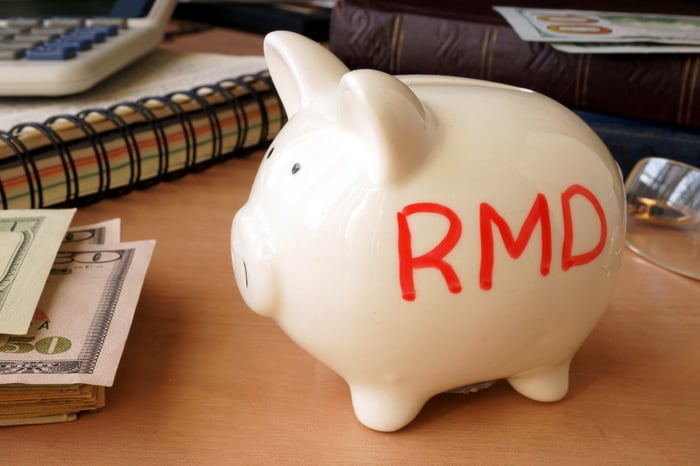
Image source: Getty Images.
1. Required minimum distributions (RMDs) begin at age 73 for account holders born between 1951 and 1959
The age at which RMDs begin depends on when you were born. The Secure 1.0 Act (2019) raised the starting age from 70 1/2 to 72 for individuals born on or after July 1, 1949. Then, the Secure 2.0 Act (2022) raised the starting age to 73 for individuals born on or after Jan. 1, 1951. The chart below provides a consolidated view of when RMDs begin.
|
Account Holder's Birth Date |
Age When RMDs Begin |
|---|---|
|
Before July 1, 1949 |
70 1/2 |
|
July 1, 1949, to Dec. 31, 1950 |
72 |
|
Jan. 1, 1951, to Dec. 31, 1959 |
73 |
|
After Dec. 31, 1959 |
75 |
Data source: Internal Revenue Service. RMD = required minimum distribution.
Importantly, RMDs on traditional 401(k) plans and traditional IRAs (including SEP IRAs and SIMPLE IRAs) are mandatory at the minimum age shown in the chart above, even if you are still working. In general, RMDs must be completed by Dec. 31, but the first one can be delayed until April 1 of the following year.
Here is an example: Ben turns 73 years old in 2026, so he must start taking RMDs. He is allowed to delay the first withdrawal until April 1, 2027, but the second withdrawal must be taken by Dec. 31, 2027. And all subsequent RMDs must be taken by Dec. 31 of the applicable year.
2. Account holders with Roth 401(k) plans and Roth 403(b) plans are no longer required to take RMDs
The Secure 2.0 Act eliminated required minimum distributions on Roth 401(k) plans and Roth 401(b) plans. Prior to that legislation, there was a discrepancy in that Roth IRAs were not subject to RMDs, while Roth 401(k) plans and Roth 403(b) plans were subject to RMDs.
To be clear, RMD rules no longer apply to dedicated Roth accounts while the original account holder is alive, but they do apply to Roth IRAs and Roth 401(k) plans once the account is inherited by a beneficiary.
3. Account holders will be penalized for failing to take RMDs before the deadline
RMDs are calculated by dividing the account balance from Dec. 31 (in the prior year) by a life expectancy factor found in one of three tables published by the IRS. Returning to my previous example, Ben (who turns 73 in 2026) will calculate his 2026 RMD by dividing his account balance as of Dec. 31, 2025, by the life expectancy factor listed on the applicable IRS table.
In most cases, the account holder will use Table III (Uniform Lifetime), and beneficiaries will use Table I (Single Life Expectancy) to determine the withdrawal amount. However, the account holder will use Table II (Joint and Last Survivor Life Expectancy) if their spouse is both their sole designated beneficiary and more than 10 years younger.
Historically, account holders who failed to complete their RMD on time were penalized with a 50% excise tax, meaning they owed the IRS 50% of the amount not withdrawn. The Secure 2.0 Act lowered the excise tax penalty to 25%, and a further reduction to 10% is possible if the account holder corrects the error within two years. Account holders who fail to take their RMD on time must file a Form 5329 with their tax return.
The $23,760 Social Security bonus most retirees completely overlook
If you're like most Americans, you're a few years (or more) behind on your retirement savings. But a handful of little-known "Social Security secrets" could help ensure a boost in your retirement income.
One easy trick could pay you as much as $23,760 more... each year! Once you learn how to maximize your Social Security benefits, we think you could retire confidently with the peace of mind we're all after. Join Stock Advisor to learn more about these strategies.
View the "Social Security secrets" »
The Motley Fool has a disclosure policy.
Recommended Articles


