

Warren Buffett Has 23% of Berkshire Hathaway's Portfolio Invested in 3 Artificial Intelligence (AI) Stocks Heading Into 2026
Key Points
All three of these stocks enjoy wide competitive moats in industries beyond AI.
Strong cash-flow generation provides each of them with the ability to invest in new opportunities and stave off competition.
Their valuations have climbed, but they may still be worth their premium prices right now.
- 10 stocks we like better than Berkshire Hathaway ›
Warren Buffett has never been one to push Berkshire Hathaway (NYSE: BRK.A) (NYSE: BRK.B) into hot trends. He gave an excellent reason for that in his 1996 letter to shareholders:
We are searching for operations that we believe are virtually certain to possess enormous competitive strength ten or twenty years from now. A fast-changing industry environment may offer the chance for huge wins, but it precludes the certainty we seek.
Where to invest $1,000 right now? Our analyst team just revealed what they believe are the 10 best stocks to buy right now, when you join Stock Advisor. See the stocks »
In other words, Buffett would rather be the tortoise than the hare. So, hot trends like internet stocks in 1996 or booming artificial intelligence (AI) companies today don't interest him too much as an investment manager.
Nonetheless, Buffett finds himself in charge of a stock portfolio where roughly 23% of the assets are invested in three companies that are heavily tied to AI -- among them, one of Berkshire's biggest equity purchases of the last few years. But all three have qualities that he generally seeks in investments -- and qualities that will surely set up his successor, Greg Abel, to deliver excellent returns for the next 10 or 20 years or more.
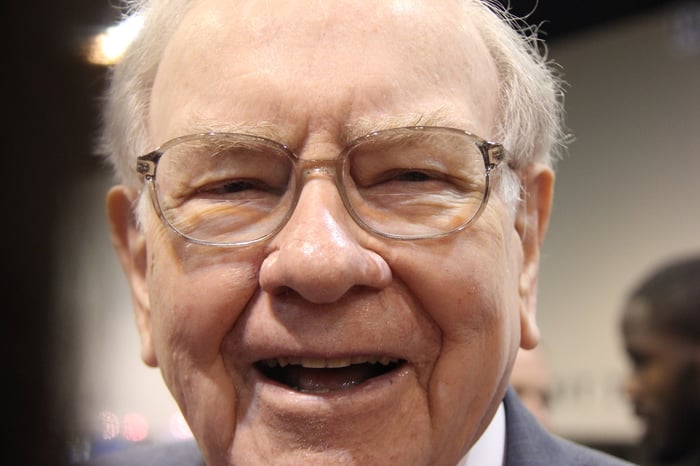
Image source: The Motley Fool.
1. Apple (20.5%)
Apple (NASDAQ: AAPL) has been the largest position in Berkshire Hathaway's equity portfolio since Buffett and his right-hand man, the late Charlie Munger, built up a massive stake in the company between 2016 and 2018. At this year's shareholder meeting, Buffett jokingly thanked Apple CEO Tim Cook for making Berkshire Hathaway shareholders more money than he ever has.
But Buffett has been selling shares of Apple since late 2023. There may be a few reasons for that. First, the stock's weight in the portfolio might have been too much, even for Buffett, who historically keeps a highly concentrated portfolio. At its peak, Apple accounted for about half of the portfolio's value. It remains Berkshire's largest marketable equity holding heading into 2026, based on the conglomerate's most recent SEC disclosures.
Second, Buffett saw what he viewed as an opportunity to take gains while corporate tax rates are low, as he expects that Congress will have to increase tax rates due to the federal government's massive deficits and debts. Lastly, Buffett assessed the valuation of Apple stock and deemed it to be well above its intrinsic value.
That last point is key. Apple hasn't benefited as much as other tech giants from the increase in AI spending on semiconductors, cloud computing infrastructure, and advanced software. It has continued to exhibit steady revenue and earnings growth, though, and its earnings per share have been further boosted by its massive share-repurchase program. But the stock now trades for a premium valuation of about 33 times forward earnings estimates, in line with other big AI stocks.
However, Apple will push its AI ambitions forward next year with the long-awaited release of a revamped Siri that will feature numerous new generative AI capabilities. The advanced AI assistant may spur a big upgrade cycle for the company's devices, pushing iPhone sales higher. Additionally, the introduction of more on-device AI capabilities could increase its high-margin services revenues significantly in the coming years. Based on those expectations, it may be worth paying a premium for Apple stock.
2. Alphabet (1.8%)
Alphabet (NASDAQ: GOOGL) (NASDAQ: GOOG) is the latest major addition to Berkshire Hathaway's portfolio. The conglomerate acquired 17.8 million shares during the third quarter, which are worth $5.6 billion as of this writing.
The stock has been on an incredible run since September, when a federal judge imposed remedies upon Alphabet that were much more lenient than expected following its conviction for maintaining an illegal monopoly in online search. Strong financial results and continued momentum for both its cloud computing business and its large language model (LLM) development have helped propel the stock materially higher.
Its cloud computing business has seen strong growth. Revenue climbed 33% last quarter, and its operating margin expanded to 24%, but there could be even more room for margins to expand as it scales. That's especially true given the momentum for its custom Tensor Processing Units (TPUs), which can offer its cloud computing clients a more cost-effective alternative to graphics processing units (GPUs) for AI training and inference. It has signed several big deals with major AI developers to use its TPUs, helping push its remaining performance obligations 46% higher year over year to $155 billion.
The core search business remains a cash cow despite the threat of AI chatbots taking market share away from Google. The company has effectively integrated AI into its search results through AI Overviews and AI Mode, resulting in an increase in search traffic without negatively impacting monetization. As a result, Google Search revenues continue to climb. And that may have been the key to Buffett's decision to invest in the company -- the "enormous competitive strength" of its core business.
As mentioned, Alphabet shares have climbed significantly in Q4, pushing their valuation to almost 30 times expected earnings. It's unclear if Buffett and his team will keep buying shares at that significantly higher valuation, but they could be worth it given the AI-driven momentum behind the company.
3. Amazon (0.7%)
Amazon (NASDAQ: AMZN) has been a small position in Berkshire Hathaway's marketable equity portfolio since 2019. Based on the size of the investment, many believe one of its other investment managers, Ted Weschler or Todd Combs, made the decision to buy it. The driving force behind Amazon's operations when Berkshire first acquired shares in 2019 was its cloud computing division, Amazon Web Services (AWS). That remains true today.
AWS is the world's largest public cloud computing platform. Its revenue is more than double Google Cloud's, and its operating margin of 35% dwarfs it. Management notes its AI services on AWS are growing at a triple-digit percentage pace, and demand continues to outstrip its ability to add capacity despite three years straight of building as fast as possible.
Like Alphabet, Amazon's massive investment in cloud capacity to capitalize on the AI opportunity is supported by a stalwart business with a wide competitive moat. Amazon's e-commerce business has become increasingly profitable over the past few years. That profitability has been driven by an increase in high-margin advertising sales as a percentage of total revenue, improvements to its logistics network to reduce shipping costs and operating expenses, and the continued growth and scale of its Prime subscription service. As a result, the operating margin for the North American retail business has expanded to 6.6% over the last 12 months, and the international segment's margin sits at a respectable 3.2%.
Amazon shares have recently been weighed down by investors' concerns about the high capital expenditures for its cloud computing business. As of Q3, its free cash flow over the last 12 months fell to $14.8 billion. But as sales continue to grow, margins expand, and capital spending levels off, Amazon should see its free cash flow soar to new highs. That could push the stock price significantly higher, making the stock worth paying a premium multiple of free cash flow for today.
Should you buy stock in Berkshire Hathaway right now?
Before you buy stock in Berkshire Hathaway, consider this:
The Motley Fool Stock Advisor analyst team just identified what they believe are the 10 best stocks for investors to buy now… and Berkshire Hathaway wasn’t one of them. The 10 stocks that made the cut could produce monster returns in the coming years.
Consider when Netflix made this list on December 17, 2004... if you invested $1,000 at the time of our recommendation, you’d have $509,470!* Or when Nvidia made this list on April 15, 2005... if you invested $1,000 at the time of our recommendation, you’d have $1,167,988!*
Now, it’s worth noting Stock Advisor’s total average return is 991% — a market-crushing outperformance compared to 196% for the S&P 500. Don't miss the latest top 10 list, available with Stock Advisor, and join an investing community built by individual investors for individual investors.
See the 10 stocks »
*Stock Advisor returns as of December 29, 2025.
Adam Levy has positions in Alphabet, Amazon, and Apple. The Motley Fool has positions in and recommends Alphabet, Amazon, Apple, and Berkshire Hathaway. The Motley Fool has a disclosure policy.
Recommended Articles


