


The Ultimate Growth Stock to Buy With $50 Right Now
Key Points
Figma's price quickly tripled after its IPO, then plummeted nearly 70%.
The company is positioned to compete in a new era of AI-infused software.
Figma's stock price is far more palatable and offers more upside at its current price.
- 10 stocks we like better than Figma ›
Whenever a company goes public, you'll often read and hear a lot of buzz about it. Unfortunately, investing in the hottest initial public offering (IPO) stocks frequently backfires.
Take Figma (NYSE: FIG) for example. The stock soared, more than tripling on its first day of trading. Since then, the stock has collapsed. Figma currently trades nearly 70% off its high, a catastrophic result for anyone who initially bought and held shares.
Where to invest $1,000 right now? Our analyst team just revealed what they believe are the 10 best stocks to buy right now, when you join Stock Advisor. See the stocks »
Figma isn't the first IPO stock to wash out, nor will it be the last. Investors shouldn't hold that against Figma.
Instead, now is a good time to revisit the company because it has such a high ceiling that it's arguably the best growth stock you can buy for $50 right now. Here is why.

Image source: Getty Images.
An emerging leader in next-generation creativity
Ultimately, there is no substitute for human creativity. Still, it has become clear that artificial intelligence (AI) and other technologies will play an increasingly larger role in shaping how people innovate and create content, whether that's art, entertainment, or any other digital experience.
Figma, a digital creativity software company, is coming of age at precisely the right moment.
The company's software, infused with AI capabilities, enables users to create digital experiences, ranging from websites to applications and social media content. What's unique about Figma is how easily it allows users to collaborate. With its multiplayer feature, multiple users can collaborate on a single project in real time. They can even see each other's cursors move across their screen.
Figma's success compelled Adobe, the incumbent leader in creativity software, to attempt to acquire it. The two companies agreed to a deal worth $20 billion, but it fell through due to regulatory scrutiny.
Already a cash cow and still growing
It has worked out well for Figma to remain independent. It received $1 billion from Adobe as a merger termination fee, and the company went on to IPO a couple of years later.
Revenue grew by 38% year over year in the third quarter, putting trailing-12-month revenue at just shy of $1 billion. Importantly, Figma is already highly profitable, with approximately $269 million in free cash flow over the past four quarters, accounting for roughly 28% of revenue.
Admittedly, Figma did issue a whopping $1.1 billion in stock-based compensation this year. Excessive stock-based compensation creates a risk of share dilution, but in this instance, it's primarily due to the IPO. Look for that to come way down over the coming quarters.
Looking ahead, Figma remains well-positioned for future growth. The business boasts an impressive 131% net revenue retention rate. That means Figma's customers are spending significantly more money as they use the platform.
There are currently 12,910 customers spending at least $10,000 in annual recurring revenue, and 1,262 customers spending at least $100,000. High-end customers are growing faster (44% year-over-year growth in the third quarter versus 32%), signaling that Figma is successfully integrating itself into its customers' core business activities.
This land-and-expand model bodes well for durable, long-term sales growth, helping Figma establish a competitive moat at a time when AI poses a threat to companies across the software space.
A strong buy following its IPO collapse
Does investing in Figma come with risks? Absolutely. Adobe will undoubtedly pressure Figma, and the company must continue to execute. Revenue growth has slowed somewhat from earlier this year, and investors will want to watch for that to stabilize. If the revenue retention rate collapses, that's a serious red flag.
But every stock has risks. The key is to invest when the stock price adequately reflects the risks. Figma's stock price collapsing the way it has actually makes it a better investment now. You can see how the price-to-sales ratio has come down drastically from its IPO time frame.
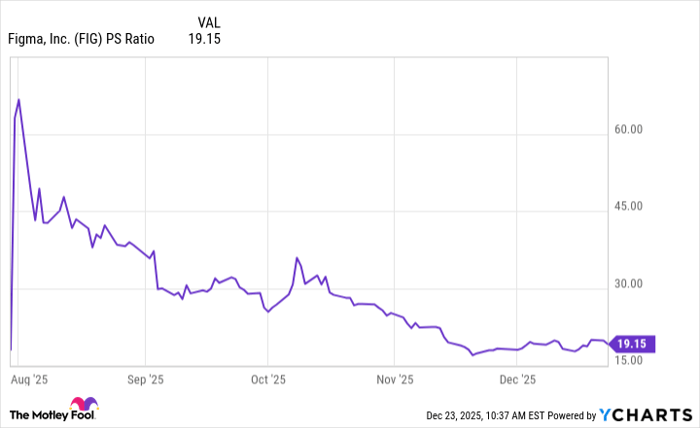
FIG PS Ratio data by YCharts
At 19 times trailing-12-month revenue, the stock is now less expensive than some of Wall Street's hottest software names, such as Palantir Technologies and CrowdStrike Holdings.
Figma could remain volatile as a new growth stock in an unpredictable AI and software landscape. Investors can dollar-cost average to avoid jumping in at an inopportune time. That said, a lot of the hot air has been let out of this IPO balloon, making its long-term upside as a leading next-generation software company worth buying into here.
Should you buy stock in Figma right now?
Before you buy stock in Figma, consider this:
The Motley Fool Stock Advisor analyst team just identified what they believe are the 10 best stocks for investors to buy now… and Figma wasn’t one of them. The 10 stocks that made the cut could produce monster returns in the coming years.
Consider when Netflix made this list on December 17, 2004... if you invested $1,000 at the time of our recommendation, you’d have $509,470!* Or when Nvidia made this list on April 15, 2005... if you invested $1,000 at the time of our recommendation, you’d have $1,167,988!*
Now, it’s worth noting Stock Advisor’s total average return is 991% — a market-crushing outperformance compared to 196% for the S&P 500. Don't miss the latest top 10 list, available with Stock Advisor, and join an investing community built by individual investors for individual investors.
See the 10 stocks »
*Stock Advisor returns as of December 29, 2025.
Justin Pope has no position in any of the stocks mentioned. The Motley Fool has positions in and recommends Adobe, CrowdStrike, and Palantir Technologies. The Motley Fool recommends Figma and recommends the following options: long January 2028 $330 calls on Adobe and short January 2028 $340 calls on Adobe. The Motley Fool has a disclosure policy.
Recommended Articles


