

6 Words From Fed Chair Jerome Powell That Are Likely to Haunt Wall Street After His Term Ends in May 2026
Key Points
The bull market has continued to steam ahead in 2025, with the Dow Jones Industrial Average, S&P 500, and Nasdaq Composite rising by 15%, 18%, and 22%, respectively.
Federal Reserve Chair Jerome Powell recently uttered the six words that all investors fear.
Regardless of what awaits the stock market in 2026, time has a way of supporting long-term-minded investors.
- 10 stocks we like better than S&P 500 Index ›
With just a handful of trading days left in 2025, it's safe to say that the stock market has, once again, delivered for investors. The widely followed Dow Jones Industrial Average (DJINDICES: ^DJI), benchmark S&P 500 (SNPINDEX: ^GSPC), and growth stock-propelled Nasdaq Composite (NASDAQINDEX: ^IXIC) have roared higher by 15%, 18%, and 22%, respectively, through the closing bell on Dec. 24.
While investors, including Wall Street analysts and pundits, are expecting this steady climb to continue into the new year, this optimism isn't universal.
Where to invest $1,000 right now? Our analyst team just revealed what they believe are the 10 best stocks to buy right now, when you join Stock Advisor. See the stocks »
One of Wall Street's subtle critics happens to be one of the most influential policymakers in the country, Federal Reserve Chair Jerome Powell.

Federal Reserve Chair Jerome Powell delivering remarks. Image source: Official Federal Reserve Photo.
Fed Chair Powell highlights a stock market risk that can't be swept under the rug
Usually, Powell and the other Fed governors refrain from making remarks that specifically pertain to the stock market. The Federal Reserve's primary job is to oversee the nation's monetary policy, with the goals of maximizing employment and stabilizing prices. The directional movement of equity markets is secondary to these goals.
With this being said, Fed Chair Powell, whose term is set to end in May 2026, recently fielded a question regarding the role that stock market valuations play in shaping Federal Open Market Committee (FOMC) policy. The FOMC is a 12-person body (that includes Powell) responsible for adjusting the federal funds rate and overseeing open market operations, including the purchase and sale of long-term Treasury bonds to influence yields.
Said Powell,
We do look at overall financial conditions, and we ask ourselves whether our policies are affecting financial conditions in a way that is what we're trying to achieve. But you're right, by many measures, for example, equity prices are fairly highly valued.
The point of emphasis is the final six words of Powell's statement: "equity prices are fairly highly valued."
Although valuations are subjective (i.e., what you find to be pricey might be viewed as a bargain by another investor), one time-tested valuation measure fully supports Fed Chair Powell's commentary that the broader market is historically expensive. This valuation tool is the S&P 500's Shiller Price-to-Earnings (P/E) Ratio, which is also referred to as the cyclically adjusted P/E Ratio, or CAPE Ratio.
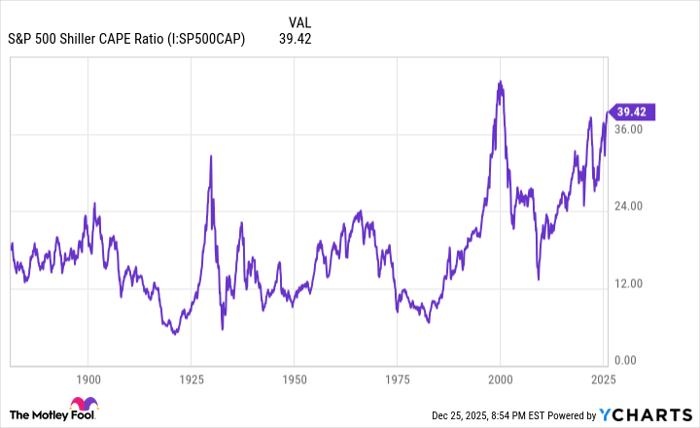
S&P 500 Shiller CAPE Ratio data by YCharts.
The S&P 500's Shiller P/E has been back-tested 155 years to January 1871. Over this period, it's averaged a multiple of 17.32. But as of the closing bell on Dec. 24, the Shiller P/E closed at 40.74, which is a stone's throw away from its high of 41.20 during the current bull market, and within striking distance of its all-time high of 44.19, set in December 1999, mere months before the dot-com bubble burst.
Historical precedent has shown that Shiller P/E multiples above 30 aren't sustainable for any extended period. The S&P 500's Shiller P/E has only reached this threshold six times in 155 years, including the present, and the previous five occurrences were all followed by eventual declines in the Dow Jones Industrial Average, S&P 500, and/or Nasdaq Composite ranging between 20% and 89%.
Keep in mind that when broader market valuations extend well beyond historical norms, they don't revert to the mean overnight. Even after Powell's term ends as Fed chair in May 2026, his six words pertaining to stock valuations will continue to echo and haunt Wall Street.
Although the Shiller P/E isn't a timing tool, and history has shown that Fed Chair commentary can be wrong -- e.g., it took the stock market more than three years to peak after former Fed Chair Alan Greenspan's now-famous "irrational exuberance" speech -- the Shiller P/Es flawless track record of foreshadowing trouble for equities leaves little room for argument.

Image source: Getty Images.
Time eventually heals all short-term wounds on Wall Street
Based solely on what history has to say, it's not a matter of if but when a sizable correction, bear market, or elevator-down move occurs on Wall Street. While most investors dislike emotion-driven downturns for the Dow Jones, S&P 500, and Nasdaq Composite, these events do come with a silver lining.
Although seeing steep red arrows in your portfolio can be unpleasant, stock market corrections, bear markets, and even crashes are healthy and inevitable aspects of the investing cycle. The pendulum swings both ways on Wall Street, and occasional downturns can be viewed as the price of admission to the greatest wealth creator on the planet.
However, stock market cycles aren't mirror images of one another -- and this is an important distinction.
In June 2023, shortly after the S&P 500 had bounced more than 20% from its 2022 bear market low and officially entered a new bull market, analysts at Bespoke Investment Group published a data set on X (formerly Twitter) where they compared to length of every S&P 500 bull and bear market over nearly 94 years.
It's official. A new bull market is confirmed.
-- Bespoke (@bespokeinvest) June 8, 2023
The S&P 500 is now up 20% from its 10/12/22 closing low. The prior bear market saw the index fall 25.4% over 282 days.
Read more at https://t.co/H4p1RcpfIn. pic.twitter.com/tnRz1wdonp
On one hand, the average S&P 500 bear market has endured for just 286 calendar days since the start of the Great Depression (September 1929). In other words, the typical 20% or greater downturn in the S&P 500 resolves in just 9.5 months. This means that most emotion-driven/elevator-down declines in the stock market are short-lived.
In comparison, the average S&P 500 bull market between September 1929 and June 2023 lasted 1,011 calendar days, or 3.5 times longer than the typical bear market. While the stock market regularly ebbs and flows, it spends a disproportionate amount of time rising rather than falling. In fact, every previous correction, bear market, and crash in the Dow, S&P 500, and Nasdaq Composite was eventually cleared away by a bull market.
Although Jerome Powell's valuation commentary highlights historical headwinds that can sink Wall Street in 2026, time has proven that it can consistently heal all short-term wounds for long-term-minded investors.
Should you buy stock in S&P 500 Index right now?
Before you buy stock in S&P 500 Index, consider this:
The Motley Fool Stock Advisor analyst team just identified what they believe are the 10 best stocks for investors to buy now… and S&P 500 Index wasn’t one of them. The 10 stocks that made the cut could produce monster returns in the coming years.
Consider when Netflix made this list on December 17, 2004... if you invested $1,000 at the time of our recommendation, you’d have $509,470!* Or when Nvidia made this list on April 15, 2005... if you invested $1,000 at the time of our recommendation, you’d have $1,167,988!*
Now, it’s worth noting Stock Advisor’s total average return is 991% — a market-crushing outperformance compared to 196% for the S&P 500. Don't miss the latest top 10 list, available with Stock Advisor, and join an investing community built by individual investors for individual investors.
See the 10 stocks »
*Stock Advisor returns as of December 28, 2025.
Sean Williams has no position in any of the stocks mentioned. The Motley Fool has no position in any of the stocks mentioned. The Motley Fool has a disclosure policy.
Recommended Articles


