

Here's What the Average Social Security Benefit Will Be in 2026
Key Points
The increase of last year’s average has already been announced, with this year’s figures already being confirmed by the Social Security Administration.
The mathematical average, however, means little. You can determine your specific amount by contacting Social Security or adding the 2026 COLA to your 2025 amount.
- These 10 stocks could mint the next wave of millionaires ›
With a new year almost upon us, plenty of people are revising their financial plans to navigate what awaits in 2026. New budgets. New goals. New strategies. All they need is new information, including first and foremost the amount of income they'll have coming in.
To this end, here's a rough idea of what the average retiree will be collecting in Social Security benefits in the coming year.
Where to invest $1,000 right now? Our analyst team just revealed what they believe are the 10 best stocks to buy right now. Continue »
The number
As it does in most years, the figure is rising from last year's average monthly Social Security payment of $2,015. Applying the 2.8% cost-of-living adjustment (or COLA) announced in late October, the number is being ratcheted up to $2,071 per month for 2026.
That's just the average for an individual only receiving retirement benefits, mind you. Individuals receiving disability benefits will now receive monthly payments of $1,630, while widows and widowers collecting benefits based as the spouse of deceased beneficiary will get $1,919. Married couples where both spouses are receiving payments will receive a combined average of $3,208 per month.
All of these numbers, however, are 2.8% better than this year's respective figures. If you were already receiving any of these payments as of this year, just add 2.8% of your 2025 benefit to determine what you'll be receiving in 2026.
And that simple tip raises an important about any and all of these average payments. That is, the average alone can be misleading almost to the point of being meaningless, since the average consists of a very wide range of inputs. Some beneficiaries will collect far less than the actual average, while a handful of retirees will collect quite a bit more.
The graphic below illustrates this distribution. Of last year's 51.8 million people receiving Social Security retirement benefits, more than 17 million of them were collecting less than $2,000 per month, while nearly 7 million of them were seeing less than $1,000 per month. At the other end of the spectrum, more than 17 million retirees were seeing monthly checks in excess of $2,500. Only about one-third of these retirees were getting between $1,500 and $2,500, in the ballpark of the monthly average.
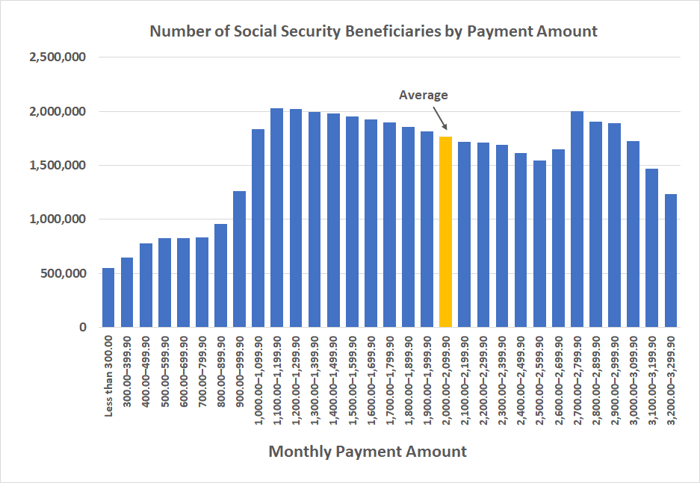
Data source: Social Security Administration. Chart by author.
Point being, if you're planning on retiring in 2026 and initiating your Social Security benefits when you do, you might want to check with the Social Security Administration now to get your specific projected monthly payment under a range of scenarios (which it can do pretty quickly, and it's free!). You may end up deciding not to retire just yet, since delaying your benefits will increase them once they do begin. Or, it's possible you'll end up receiving even more than you've been anticipating.
The plan
However much Social Security you'll be receiving in 2026, if you're asking or thinking about it all then it's likely you're already near retirement age if not already retired. If that's the case and your payment just isn't going to be enough to cover your ever-growing cost of living, there's little you can do now to improve the size of your monthly check.
You're certainly not out of options though. Several different Medicare insurance options are available in most states, for instance. It might be worth shopping around.
Folks in their 60s and 70s (or even older) can -- and should -- also do the things most everyone else of any other age is doing right now. That's culling unnecessary costs like rarely used subscriptions, selling an automobile you never drive but still insure, or simply signing up for the discounts on goods and services that most companies are willing to offer seniors.

Image source: Getty Images.
Perhaps more than anything though, while it may not have been your plan at this stage of your life, working is still a viable possibility for most. And it doesn't even have to be much. In some cases a few extra hundred bucks per month can be enough to make a big difference.
You won't necessarily undermine your benefits by earning a taxable income at the same time your collecting Social Security either... contrary to a common belief. If you're already at or beyond your official full retirement age at the time, for 2026 you can earn up to $24,480 without any impact to your benefit payment, and even then the Social Security Administration only reduces your benefits by $1 for every $2 earned above that $24,480 threshold.
Also know that while working in retirement has the potential to reduce the size of your monthly benefit payment, this isn't a permeant reduction. You'll receive credit for these deductions while they're imposed, and then get them back later.
Where to invest $1,000 right now
When our analyst team has a stock tip, it can pay to listen. After all, Stock Advisor’s total average return is 972%* — a market-crushing outperformance compared to 193% for the S&P 500.
They just revealed what they believe are the 10 best stocks for investors to buy right now, available when you join Stock Advisor.
See the stocks »
*Stock Advisor returns as of December 21, 2025.
The Motley Fool has a disclosure policy.
Recommended Articles


