

The Stock Market Is Doing Something It's Only Done Twice Since 1871 -- Should You Be Worried for 2026?
Key Points
The S&P 500 is set to close 2025 with a double-digit gain.
But the market index's Shiller P/E is hovering near a level previously reached just before the dot-com bubble burst.
History shows extreme valuations tend to cool over time.
- 10 stocks we like better than S&P 500 Index ›
Ah, 1871. Those were different times, weren't they? The Second Industrial Revolution was gathering steam, the telegraph was all the rage in technology, and J.P. Morgan (the financier) was getting the ball rolling on a firm that would eventually bear his name.
Aside from these milestones, 1871 is significant for another reason: It's the first year in economist Robert Shiller's long-running U.S. stock market dataset, which also serves as the historical backbone for the Shiller price-to-earnings (P/E), also known as the CAPE ratio.
Where to invest $1,000 right now? Our analyst team just revealed what they believe are the 10 best stocks to buy right now, when you join Stock Advisor. See the stocks »
Image source: Getty Images.
The Shiller P/E compares the price of a broad market index, such as the S&P 500 (SNPINDEX: ^GSPC), to its average inflation-adjusted earnings per share over the past 10 years. Its purpose is to give investors a long-term sense of whether the index looks expensive (or cheap) by smoothing out short-term profit swings.
The CAPE ratio was one of the metrics that helped Shiller identify the dot-com bubble just before it popped in March 2000. Now, in December 2025, the market is back in the same range, which has some investors feeling very, very uneasy.
The CAPE ratio may be flashing a warning sign
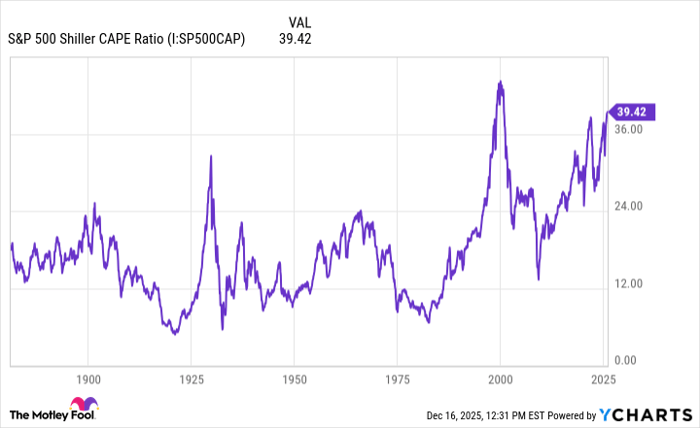
Since the early 1870s, the Shiller P/E has historically been in the double-digit range, yet only twice has it exceeded 40.
The first was during the dot-com bubble, when the Shiller P/E reached as high as 44 before the market crumbled.
The second is happening right now. After a strong 2025 performance, fueled by artificial intelligence and the Magnificent Seven, the S&P 500's Shiller P/E has been hovering around 39 to 40.
Data by YCharts.
As you can see from the graph above, very high CAPE readings don't last very long, and they're historically followed by sharp reversals.
Of course, that doesn't mean the market is about to repeat 2000. But it may be a sign that irrational exuberance may be ahead of fundamentals. It's a reminder, as we approach 2026, to be selective and patient, though certainly not a call to abandon high-quality stocks altogether.
Should you buy stock in S&P 500 Index right now?
Before you buy stock in S&P 500 Index, consider this:
The Motley Fool Stock Advisor analyst team just identified what they believe are the 10 best stocks for investors to buy now… and S&P 500 Index wasn’t one of them. The 10 stocks that made the cut could produce monster returns in the coming years.
Consider when Netflix made this list on December 17, 2004... if you invested $1,000 at the time of our recommendation, you’d have $509,039!* Or when Nvidia made this list on April 15, 2005... if you invested $1,000 at the time of our recommendation, you’d have $1,109,506!*
Now, it’s worth noting Stock Advisor’s total average return is 972% — a market-crushing outperformance compared to 193% for the S&P 500. Don't miss the latest top 10 list, available with Stock Advisor, and join an investing community built by individual investors for individual investors.
See the 10 stocks »
*Stock Advisor returns as of December 21, 2025.
Steven Porrello has no position in any of the stocks mentioned. The Motley Fool has no position in any of the stocks mentioned. The Motley Fool has a disclosure policy.
Recommended Articles


