

Should You Buy Artificial Intelligence (AI) Stocks In 2026?
Key Points
Stocks like Nvidia and Microsoft have struggled in the last few months, bringing their valuations down with them.
Other AI stocks like Amazon still look cheaper at today's prices.
Cyclicality risks should keep investors away from Nvidia stock in 2026. Amazon looks like a better buy.
- 10 stocks we like better than Nvidia ›
The artificial intelligence (AI) trade began to sputter in late 2025. Stocks like Nvidia (NASDAQ: NVDA) are flat since August of this year after seemingly going up at an insatiable rate for three straight years. Similar results have occurred for Microsoft (NASDAQ: MSFT) shareholders, with its stock actually down over the last six months.
Investors have begun to lose faith in the growth-at-any-cost mindset among these AI start-ups even though underlying revenue growth is still strong for the sector.
Where to invest $1,000 right now? Our analyst team just revealed what they believe are the 10 best stocks to buy right now. Continue »
Does that make now a perfect time to buy AI stocks for 2026? Let's take a look at the numbers and find out.

Image source: Getty Images.
High multiples and fast-growing businesses
Stagnant share prices have helped some of the fundamentals for these AI stocks catch up to their share prices. Last quarter, Nvidia's revenue grew 62% year over year to $57 billion, with net income up 65% to $31.9 billion. Microsoft's revenue was up 18%, with 24% growth in operating income.
AI companies are still paying big paychecks to buy Nvidia's advanced computer chips or to utilize them in AI data centers run by cloud providers such as Microsoft. OpenAI is the leader in AI spending, with commitments in the hundreds of billions of dollars across various sources. A lot of this spending will go to Nvidia computer chips.
Still, even with soaring earnings, both Microsoft and Nvidia (two of the largest companies in the world by market cap) do not have dirt cheap earnings ratios. Nvidia has a price-to-earnings ratio (P/E) of 44, while Microsoft's is 34. If earnings keep growing quickly, these ratios will come down in a hurry, but it puts high expectations on future growth.
More exposure to AI and cyclicality than others
Booming spending in any industry can lead to supply gluts. This has happened in the computer chip space many times throughout history, as well as in other infrastructure build-outs like telecommunications and railroads.
Don't ignore this risk with the AI winners like Nvidia. There is a major downside risk to Nvidia's earnings power if the company's revenue growth declines along with its profit margin, a double whammy to net income.
Some stocks are more exposed to the AI trade than others, such as Nvidia, Microsoft, or Oracle. Others have been less aggressive on spending or winning contracts, such as Amazon, and are therefore less at risk to an AI or computer chip spending downcycle. With a P/E ratio of 31, Amazon's valuation is lower based on its trailing earnings as well.
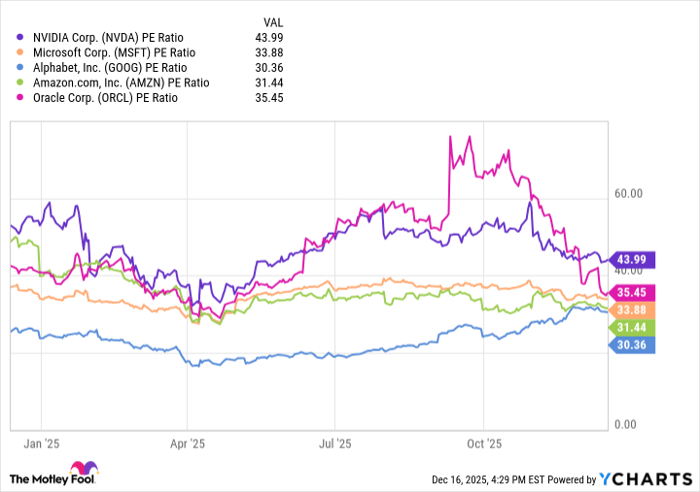
NVDA PE Ratio data by YCharts.
Don't ask whether you should buy AI stocks
Investors shouldn't ask whether they should buy AI stocks, as there are dozens, if not hundreds, of stocks exposed to the AI trade, all with different stories and valuations. You have direct beneficiaries such as Nvidia that may be a risky bet right now, or even wilder companies like CoreWeave, laden with debt.
Don't ask if you should buy AI stocks. Ask which AI stocks you should buy today. Amazon looks like a good candidate at today's prices because of its lower P/E ratio, dual growth engines from cloud computing and e-commerce, as well as its growing relationship with start-up Anthropic. Amazon has not gotten as much enthusiasm from Wall Street in 2025, which just might make it a good pick for 2026.
Should you buy stock in Nvidia right now?
Before you buy stock in Nvidia, consider this:
The Motley Fool Stock Advisor analyst team just identified what they believe are the 10 best stocks for investors to buy now… and Nvidia wasn’t one of them. The 10 stocks that made the cut could produce monster returns in the coming years.
Consider when Netflix made this list on December 17, 2004... if you invested $1,000 at the time of our recommendation, you’d have $509,039!* Or when Nvidia made this list on April 15, 2005... if you invested $1,000 at the time of our recommendation, you’d have $1,109,506!*
Now, it’s worth noting Stock Advisor’s total average return is 972% — a market-crushing outperformance compared to 193% for the S&P 500. Don't miss the latest top 10 list, available with Stock Advisor, and join an investing community built by individual investors for individual investors.
See the 10 stocks »
*Stock Advisor returns as of December 20, 2025.
Brett Schafer has no position in any of the stocks mentioned. The Motley Fool has positions in and recommends Amazon, Microsoft, Nvidia, and Oracle. The Motley Fool recommends the following options: long January 2026 $395 calls on Microsoft and short January 2026 $405 calls on Microsoft. The Motley Fool has a disclosure policy.
Recommended Articles


