
Musk’s Next Ambition: Building a Space-Based AI Data Center

Source Tradingkey

TradingKey - Last week, Bloomberg reported that Elon Musk’s SpaceX may soon seek a new funding round based on a staggering $1.5 trillion valuation—potentially raising over $30 billion in fresh capital. The announcement reignited interest in the entire “new space” sector and raised a question: why now?

Musk has long resisted the idea of taking SpaceX public. After the Tesla take-private drama and the resulting SEC penalties (which cost him the chairmanship), he’s been wary of public market entanglements. But something’s changed—and fast.

According to Eric Berger, a senior space writer at Ars Technica, that “something” may be Musk’s vision of a space-based AI future. Berger summarized his thesis in an article and tweet on X—and an hour later, Musk replied directly: “As always, Eric is accurate.”

The Sky Isn’t the Limit—The Data Center Is Going Up

Musk now publicly says he plans to use SpaceX’s Gen-3 Starlink satellites to build orbital data centers—powered by solar energy and optimized for AI processing. This effort is reportedly tied to a new initiative called Project “Heart of the Galaxy,” intended to integrate the capabilities of SpaceX, Tesla, and xAI into a unified vision for deep-space infrastructure.
spacex2_optimized_150-f44e587cbef5403d80c1a7f88f6fb76f

As Musk explained that as computing clusters scale further, the combined demands on electricity and cooling will soon outpace what Earth-based infrastructure can handle.

In space, these constraints change. He noted that sunlight is continuous, eliminating the need for batteries; solar panels can also be made more cheaply, since no glass or framing is required. Cooling, he added, comes naturally in the vacuum through radiative heat dissipation.

He’s not alone in this bet.

On November 4, Google (GOOG) announced Project Suncatcher—aimed at launching two prototype satellites in early 2027 that carry its in-house TPU AI chips, in partnership with satellite firm Planet Labs. CEO Sundar Pichai said initial tests show the chips can survive low-Earth orbit’s radiation.

Amazon founder Jeff Bezos has also predicted the arrival of gigawatt-scale data centers in space within a decade. Startups like Starcloud have already launched prototype Nvidia-GPU-equipped satellites.

Even OpenAI reportedly explored partnering with or acquiring a rocket company earlier this year. Sam Altman has long believed that AI’s boundless computational appetite will eventually require orbital infrastructure—especially as its environmental footprint on Earth grows.

Elon Musk’s stated ambition has brought new visibility—and credibility—to the niche but rapidly expanding field of orbital data infrastructure. Wall Street is now paying attention.

Morgan Stanley and Deutsche Bank have both published research this month on the feasibility of space-based AI clusters. Analysts point to several structural advantages:

1) Solar irradiance in orbit is ~40% higher than on Earth, allowing for continuous 24/7 generation; 2)Vacuum cooling enables passive radiative heat management (critical for AI workloads); 3) Optical laser interlinks could deliver speeds up to 40% faster than terrestrial fiber.

While the physics are favorable, the engineering remains brutal. Chips in orbit face radiation bombardment that shortens lifespan. Thermal dissipation is challenging in an enclosed space. Hardware must meet “space-grade” standards, adding cost and weight.

Launch costs remain painfully high. At current prices, orbital data centers are still economically unviable without subsidies or massive tech breakthroughs.

SpaceX’s Cash Flow Is Strong—So Why Raise Capital?

Estimates suggest SpaceX could generate $22–24 billion in revenue next year—roughly on par with NASA’s annual budget.

spacex_optimized_150-f2cb913157ef4524b50c36a6a2826a7c

The company’s top-line is powered by two engines: Falcon-based launch services and the growing Starlink satellite broadband division.

While its reusable launch system lowers cost-per-launch, Musk has made clear: by 2026, less than 5% of revenue will come from NASA contracts. The future lies in Starlink.

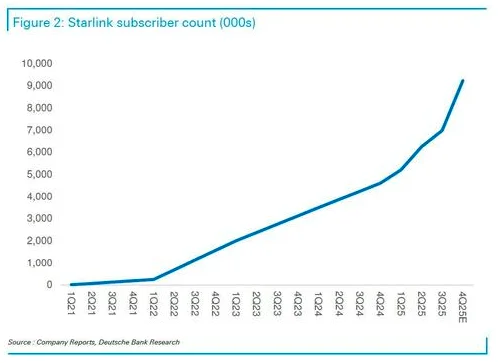
Starlink uses SpaceX rockets to deploy a low-Earth orbital constellation and deliver high-speed satellite internet. Deutsche Bank believes Starlink will cross 9 million users by the end of 2025—doubling year over year.
spacex1-de4441e327c344b0815a4ebdf68461e0

Even though SpaceX has consistently run positive free cash flow and boasts far higher capital efficiency than any public space agency, its ambitions require scale. Resources are being poured relentlessly into: acquiring spectrum rights (e.g. EchoStar for direct-to-device), scaling Starship for lower-cost launch, expanding global Starlink operations, and prototyping orbit-grade compute platforms. Each initiative is capital-intensive, and SpaceX wants to move faster than internal funding allows.

Loading the Next Stage: Starlink v3 Satellites

At the most tactical level, Musk’s next goal is upgrading the Starlink satellite fleet.

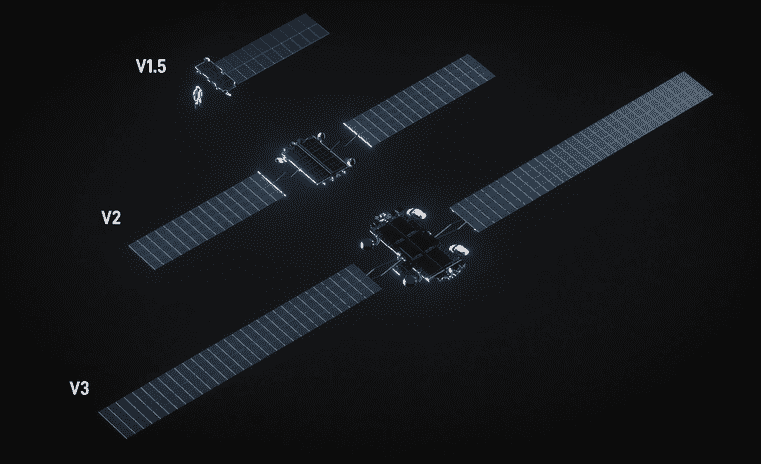
Today’s Starlink v2 “mini” satellites support maximum downlink speeds of ~100 Gbps. The upcoming v3 series is set to increase that tenfold—up to 1 Tbps—equipped with high-speed optical laser links.

The leap isn’t unprecedented in capacity—but on a mass-deployment scale, it is unmatched.

SpaceX plans to launch 60 v3 satellites at a time aboard its Starship system as early as 2026, with testing of satellite separation hardware already underway.

Unlike prior generations optimized for communications alone, the new v3 units are being engineered as compute-capable infrastructure—fitted with larger solar arrays, edge inferencing modules, enhanced thermal controls, and modular “drop-in” GPU/ASIC housings.

Alphabet’s Stake Rises with the Rocket

SpaceX’s rise doesn’t just benefit Musk. It significantly boosts Alphabet too.

Google isn’t just an AI company—it’s also SpaceX’s second-largest equity holder. This year, Alphabet disclosed over $10 billion in “unlisted equity gains,” most of which the market believes came from SpaceX revaluation.

Meanwhile, Google Cloud has signed contracts to provide computing, networking, and ground infrastructure for Starlink’s enterprise products.

Google is doubling down on space—both as a compute frontier and an imagery/data business. Project Suncatcher builds on this thesis. So does its continued collaboration with Planet Labs and its reliance on SpaceX to deploy proprietary satellites.

Alphabet’s strategy hedges competition. Whether SpaceX dominates or the broader space ecosystem expands, Google wins either way.

The Ripple Effects Are Already Here

News of a potential SpaceX IPO has lifted the entire space equity complex—but it’s not just that.

Investors are waking up to the broader monetization roadmap of commercial aerospace. SpaceX has reached scale and is proving margin viability in both launch and telecom. Now smaller firms in the ecosystem are being bid up as “underpriced beneficiaries” of the same demand curve—including satellite manufacturers and niche ground services.

Meanwhile, big tech’s real commitment to orbital AI—backed by concrete satellite deployments from Google, and reusable rocket platforms like Stoke Space’s Nova (set for 2026)—has shifted the imagination frontier again.

This is no longer just about optics. It’s about architecture economics. Laser interconnects, zero-latency cooling, orbital energy.

SpaceX is also on pace for over 100 U.S. rocket launches in 2025. Falcon 9 reuse is nearing 100%. Starship test cadence is accelerating. Collectively, this is crushing the cost floor—and validating the case for reusable launch as an industrial standard.

The policy backdrop adds fuel. A second Trump administration would likely favor expanded defense spending and space infrastructure procurement—where SpaceX and Rocket Lab (RKLB) are already active bidders for direct space-to-space freight contracts under DOD partnerships.

How the Market Is Segmenting the Opportunity

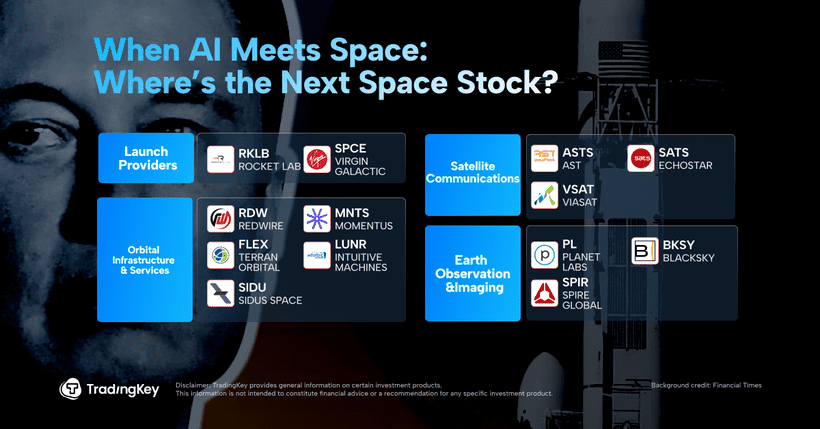
“New Space” is no longer a concept—it’s a cross-sector thematic with real equity candidates. Here are a few:
musk-en_1_optimized_150-2463a1d937a442a8852e8ade93249b93

Launch providers

Rocket Lab (RKLB): The world’s busiest small sat launcher, 18 successful launches in 2025

Virgin Galactic (SPCE): Commercial space tourism leader, Delta-class ship re-launching 2026

Orbital infrastructure & services

Redwire (RDW): Supplies solar panels and robotic limbs for SpaceX and Blue Origin

Momentus (MNTS): “Space tug” systems moving satellites into position

Terran Orbital: Frequent contractor to U.S. defense for smallsat production

Intuitive Machines (LUNR): First private entrant into lunar south pole missions

Sidus Space (SIDU): Edge-AI hardware and lunar infrastructure tooling

Satellite communications

AST SpaceMobile (ASTS): Direct-to-smartphone satellite network, in deals with AT&T and Vodafone

EchoStar (SATS): Traditional satellite internet firm

Iridium (IRDM): Global satellite phone + IoT coverage network

Viasat (VSAT): Leading aviation WiFi and defense-link provider

Earth observation & imaging

Planet Labs (PL): Daily Earth imaging partner, ~10% owned by Alphabet

BlackSky (BKSY): Real-time geospatial intelligence with high revisit rate

Spire Global (SPIR): Space-based weather, ocean, and climate platform


Disclaimer: For information purposes only. Past performance is not indicative of future results.
placeholder
Ethereum Price Slips Lower — $3,000 Looms as the Key BattlegroundEthereum is attempting to recover from a $3,026 low but remains below $3,200 and the 100-hour SMA, with a bearish trend line near $3,175 capping rebounds as bulls need a clean break above $3,200 to target $3,250–$3,400, while a drop below $3,050 risks a retest of $3,000 and $2,940.
Author  Mitrade
Dec 15, Mon
Ethereum is attempting to recover from a $3,026 low but remains below $3,200 and the 100-hour SMA, with a bearish trend line near $3,175 capping rebounds as bulls need a clean break above $3,200 to target $3,250–$3,400, while a drop below $3,050 risks a retest of $3,000 and $2,940.
placeholder
Bitcoin Slides 5% as Sellers Lean In — Can BTC Reclaim $88,000?Bitcoin has dropped back below $88,000 after rolling over from $90,500, with price still trading under the 100-hour Simple Moving Average. The sell-off found a floor at $85,151, and BTC is now consolidating near that base, but rebounds are facing pressure from a bearish trend line around $89,000. Bulls need to retake $88,000–$89,000 to ease downside risk; failure to do so keeps $85,500–$85,000 and then $83,500 in play, with $80,000 as the deeper “line in the sand.” Bitcoin (BTC) is back in damage-control mode after a sharp pullback wiped out recent gains. The price failed to reclaim the $90,000–$90,500 band, rolled over, and slid through $88,500 before briefly dipping under $87,000. Buyers did show up around $85,000, but the rebound so far looks more like stabilization than a clear trend reversal. Bitcoin dips hard, finds a bid near $85,000(h3) BTC’s latest move lower began when it couldn’t build follow-through above $90,000 and $90,500. Once that upside stalled, sellers took control and pushed price down through $88,500. The slide accelerated enough to spike below $87,000, but the market didn’t free-fall. Bulls defended the $85,000 zone, printing a low at $85,151. Since then, Bitcoin has been consolidating below the 23.6% Fibonacci retracement of the drop from the $93,560 swing high to the $85,151 low — a clue that the bounce is still shallow and that sellers haven’t fully backed off yet. Structurally, BTC is still on the back foot: It’s trading below $88,000, and It remains below the 100-hour Simple Moving Average, keeping short-term trend pressure pointed downward. Resistance is layered, and $89,000 is the problem area(h3) If bulls try to turn this into a recovery, they’ll have to climb through multiple ceilings in quick succession. First, BTC faces resistance around $87,150, followed by a more meaningful barrier near $87,500. From there, the market’s attention snaps back to $88,000 — the level BTC just lost and now needs to reclaim. A close back above $88,000 would improve the tone, but it doesn’t solve the bigger issue: there’s a bearish trend line on the hourly BTC/USD chart (Kraken feed) with resistance near $89,000, which also lines up with the next technical hurdle. If BTC can push through $89,000 and hold, the rebound could extend toward $90,000, with follow-through targets at $91,000 and $91,500. But until price clears that $88,000–$89,000 zone, rallies are at risk of being sold rather than chased. If BTC fails to reclaim resistance, the downside path is clear(h3) The near-term bear case is simple: if Bitcoin can’t climb back above the $87,000 area and keep traction, sellers may attempt another leg lower. Support levels line up like this: Immediate support: $85,500 First major support: $85,000 Next support: $83,500 Then $82,500 in the near term Below that, the major “don’t break this” level is still $80,000. If BTC slips under $80,000, the risk of acceleration to the downside increases significantly — not because it’s magic, but because it’s the kind of psychological and structural level that tends to trigger forced de-risking. Indicators: momentum still leans bearish(h3) The intraday indicators aren’t offering much comfort yet: Hourly MACD is losing pace in the bearish zone. Hourly RSI remains below 50, suggesting sellers still have the upper hand on short timeframes. So while the $85,000 defense held for now, the market hasn’t flipped bullish — it’s just stopped bleeding.
Author  Mitrade
Dec 16, Tue
Bitcoin has dropped back below $88,000 after rolling over from $90,500, with price still trading under the 100-hour Simple Moving Average. The sell-off found a floor at $85,151, and BTC is now consolidating near that base, but rebounds are facing pressure from a bearish trend line around $89,000. Bulls need to retake $88,000–$89,000 to ease downside risk; failure to do so keeps $85,500–$85,000 and then $83,500 in play, with $80,000 as the deeper “line in the sand.” Bitcoin (BTC) is back in damage-control mode after a sharp pullback wiped out recent gains. The price failed to reclaim the $90,000–$90,500 band, rolled over, and slid through $88,500 before briefly dipping under $87,000. Buyers did show up around $85,000, but the rebound so far looks more like stabilization than a clear trend reversal. Bitcoin dips hard, finds a bid near $85,000(h3) BTC’s latest move lower began when it couldn’t build follow-through above $90,000 and $90,500. Once that upside stalled, sellers took control and pushed price down through $88,500. The slide accelerated enough to spike below $87,000, but the market didn’t free-fall. Bulls defended the $85,000 zone, printing a low at $85,151. Since then, Bitcoin has been consolidating below the 23.6% Fibonacci retracement of the drop from the $93,560 swing high to the $85,151 low — a clue that the bounce is still shallow and that sellers haven’t fully backed off yet. Structurally, BTC is still on the back foot: It’s trading below $88,000, and It remains below the 100-hour Simple Moving Average, keeping short-term trend pressure pointed downward. Resistance is layered, and $89,000 is the problem area(h3) If bulls try to turn this into a recovery, they’ll have to climb through multiple ceilings in quick succession. First, BTC faces resistance around $87,150, followed by a more meaningful barrier near $87,500. From there, the market’s attention snaps back to $88,000 — the level BTC just lost and now needs to reclaim. A close back above $88,000 would improve the tone, but it doesn’t solve the bigger issue: there’s a bearish trend line on the hourly BTC/USD chart (Kraken feed) with resistance near $89,000, which also lines up with the next technical hurdle. If BTC can push through $89,000 and hold, the rebound could extend toward $90,000, with follow-through targets at $91,000 and $91,500. But until price clears that $88,000–$89,000 zone, rallies are at risk of being sold rather than chased. If BTC fails to reclaim resistance, the downside path is clear(h3) The near-term bear case is simple: if Bitcoin can’t climb back above the $87,000 area and keep traction, sellers may attempt another leg lower. Support levels line up like this: Immediate support: $85,500 First major support: $85,000 Next support: $83,500 Then $82,500 in the near term Below that, the major “don’t break this” level is still $80,000. If BTC slips under $80,000, the risk of acceleration to the downside increases significantly — not because it’s magic, but because it’s the kind of psychological and structural level that tends to trigger forced de-risking. Indicators: momentum still leans bearish(h3) The intraday indicators aren’t offering much comfort yet: Hourly MACD is losing pace in the bearish zone. Hourly RSI remains below 50, suggesting sellers still have the upper hand on short timeframes. So while the $85,000 defense held for now, the market hasn’t flipped bullish — it’s just stopped bleeding.
placeholder
December Santa Claus Rally: New highs in sight for US and European stocks?Historical data show a rising trend of US and European stocks in December. If the momentum is strong, fund managers may rush in with a buying frenzy.
Author  Mitrade
Yesterday 02: 50
Historical data show a rising trend of US and European stocks in December. If the momentum is strong, fund managers may rush in with a buying frenzy.
placeholder
XRP’s Price Action Flashes a Warning Even as ETF Flows Stay PositiveXRP’s structure remains weak despite 18 straight positive closes in spot XRP ETFs, with analysts warning that $1.98 and other nearby resistance zones could cap rebounds unless the YO region is reclaimed, while deeper downside scenarios keep $1.53 on watch as a potential (not guaranteed) accumulation area.
Author  Mitrade
Yesterday 06: 37
XRP’s structure remains weak despite 18 straight positive closes in spot XRP ETFs, with analysts warning that $1.98 and other nearby resistance zones could cap rebounds unless the YO region is reclaimed, while deeper downside scenarios keep $1.53 on watch as a potential (not guaranteed) accumulation area.
placeholder
Gold declines on profit-taking, USD strength ahead of US CPI releaseGold price (XAU/USD) edges lower below $4,350 during the Asian trading hours on Thursday. The precious metal retreats from seven-week highs amid some profit-taking and a rebound in the US Dollar (USD).
Author  FXStreet
5 hours ago
Gold price (XAU/USD) edges lower below $4,350 during the Asian trading hours on Thursday. The precious metal retreats from seven-week highs amid some profit-taking and a rebound in the US Dollar (USD).
goTop
quote