
Should You Forget Bitcoin and Buy MARA Holdings Instead?

Source The Motley Fool

Key Points

  • Bitcoin is down about 31% from its October 2025 peak, and MARA Holdings is down even more over the same stretch.

  • Even with higher Bitcoin prices, MARA’s cost to produce Bitcoin has risen sharply, squeezing its bottom line.

  • Bitcoin exposure can be simpler than owning MARA, and there's nothing wrong with grabbing more of the actual cryptocurrency in this dip.

  • 10 stocks we like better than Bitcoin ›

After peaking at $124,774 per coin on Oct. 7, 2025, Bitcoin (CRYPTO: BTC) has taken a tumble. As of the market close on Dec. 16, the leading cryptocurrency has dropped 31% to $86,413.

At the same time, Bitcoin mining veteran MARA Holdings (NASDAQ: MARA) has plunged 53% since mid-October. Assuming you see brighter days ahead for Bitcoin and the broader crypto market, should you forget about Bitcoin and invest in MARA's deeper discount today?

Where to invest $1,000 right now? Our analyst team just revealed what they believe are the 10 best stocks to buy right now, when you join Stock Advisor. See the stocks »

How MARA became a Bitcoin-first business

MARA has been a cryptocurrency mining specialist for a few years now. Then known as Marathon Patent Group, the company had built expertise in encryption technologies for more than a decade. It bought its first $150 million of Bitcoin and some mining equipment in January 2021, changed its name to Marathon Digital Holdings to reflect its newfound cryptocurrency focus, and set off on new adventures.

Marathon Digital Holdings often amplified whatever market moves Bitcoin was making. If the crypto was up, Marathon gained more. On a bearish Bitcoin day, Marathon posted a deeper dive. Generally speaking, the stock was just a more volatile version of owning Bitcoin.

The math changed for MARA

That tight correlation snapped in the spring of 2024:
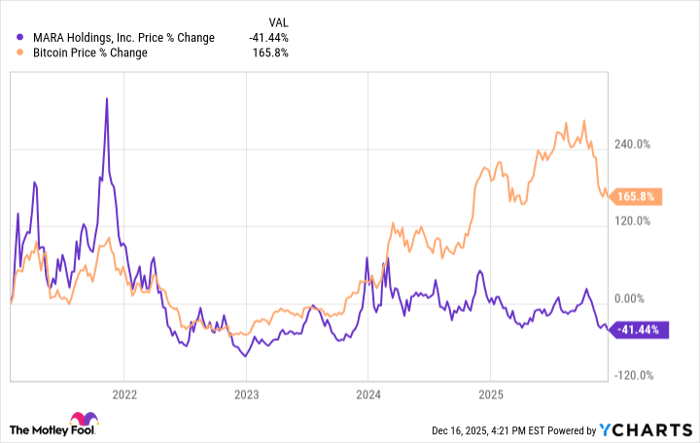
MARA Chart

MARA data by YCharts

Bitcoin had a couple of forces working in its favor.

  • The U.S. Securities and Exchange Commission (SEC) approved the first spot Bitcoin exchange-traded funds (ETFs) in January that year, fueling an inrush of capital into leading funds such as the iShares Bitcoin ETF (NASDAQ: IBIT) and the Bitwise Bitcoin ETF (NYSEMKT: BITB).
  • Three months later, Bitcoin miners started receiving 3.125 Bitcoin instead of 6.25 Bitcoin as a reward for validating the next block of transaction data. The fourth halving in Bitcoin's history lowered its effective inflation rate and disrupted the economic model of Bitcoin mining operations.

As you might imagine, the halving event made Marathon's mining efforts less profitable. The costs of buying number-crunching equipment remained the same, and the electric bills increased. Sure, Bitcoin prices more than doubled over the next year and a half, but the competition for those sweet mining rewards also increased.

On average, Marathon produced about 28.8 Bitcoin per day in March 2024. The production rate fell to 24.5 Bitcoin per day 18 months later. Thanks to the increasing Bitcoin prices, Marathon's quarterly crypto-mining revenue rose 37% over this period. At the same time, the cost of producing the Bitcoin jumped 82% higher.

A silver Bitcoin-logo figurine on a large red question mark.

Image source: Getty Images.

MARA's next new plan: data centers, power sales, and AI

Marathon is no stranger to trying new ideas. The company changed names again in August 2024, and the revamped MARA Holdings company has expanded its business plan to include selling electric energy and data center space to other companies. That's mainly a play on the ongoing artificial intelligence (AI) boom, which shares much of its infrastructure with the crypto-mining community.

So you may see MARA's stock chart continue to loosen its Bitcoin bands over time. The company is still mining Bitcoin and buying more coins on the open market, and it's early days for its installation of AI-computing hardware in the Bitcoin mining centers, but MARA takes this alternative business seriously.

MARA's discount comes with strings attached

MARA Holdings is a distinctly different company again, and its flexible operating plan could set the company up for Bitcoin-beating success over time. The idea is simple: Lean into AI computing when that's the more lucrative business, and refocus on Bitcoin mining when the AI demand is low, or Bitcoin prices are deeply discounted, or both.

However, MARA is entering another heavily contested market. It's not the only former Bitcoin mining specialist making this switch, and the repurposed miners face off against a plethora of much larger companies. Until further notice, I will continue to see MARA as a Bitcoin mining company, because it doesn't have any AI-related contracts to speak of yet.

I own a few MARA shares, but they are a microscopic part of my diversified portfolio. My direct exposure to Bitcoin is significantly larger, and that won't change anytime soon.

MARA's more sustainable long-term plan may make it a decent investment at today's low prices, but I'm in no hurry to forget about Bitcoin. If anything, I'm more likely to double down on my Bitwise Bitcoin ETF and direct Bitcoin holdings than to grow my MARA position in this dip. MARA's business is still primarily focused on Bitcoin-related activities, and the costs are rising faster than the mining rewards.

Should you buy stock in Bitcoin right now?

Before you buy stock in Bitcoin, consider this:

The Motley Fool Stock Advisor analyst team just identified what they believe are the 10 best stocks for investors to buy now… and Bitcoin wasn’t one of them. The 10 stocks that made the cut could produce monster returns in the coming years.

Consider when Netflix made this list on December 17, 2004... if you invested $1,000 at the time of our recommendation, you’d have $509,955!* Or when Nvidia made this list on April 15, 2005... if you invested $1,000 at the time of our recommendation, you’d have $1,089,460!*

Now, it’s worth noting Stock Advisor’s total average return is 968% — a market-crushing outperformance compared to 193% for the S&P 500. Don't miss the latest top 10 list, available with Stock Advisor, and join an investing community built by individual investors for individual investors.

See the 10 stocks »

*Stock Advisor returns as of December 18, 2025.

Anders Bylund has positions in Bitcoin, Bitwise Bitcoin ETF Trust, Mara Holdings, and iShares Bitcoin Trust. The Motley Fool has positions in and recommends Bitcoin and iShares Bitcoin Trust. The Motley Fool has a disclosure policy.

Disclaimer: For information purposes only. Past performance is not indicative of future results.
placeholder
Gold Price Forecast: XAU/USD drifts higher above $4,200 as Fed delivers expected cutGold price (XAU/USD) gains momentum to around $4,235 during the early Asian session on Thursday. The precious metal extends its upside after the US Federal Reserve (Fed) delivered an expected third consecutive interest rate cut and maintained its outlook for just one cut in 2026.
Author  FXStreet
Dec 11, Thu
Gold price (XAU/USD) gains momentum to around $4,235 during the early Asian session on Thursday. The precious metal extends its upside after the US Federal Reserve (Fed) delivered an expected third consecutive interest rate cut and maintained its outlook for just one cut in 2026.
placeholder
Ethereum Price Slips Lower — $3,000 Looms as the Key BattlegroundEthereum is attempting to recover from a $3,026 low but remains below $3,200 and the 100-hour SMA, with a bearish trend line near $3,175 capping rebounds as bulls need a clean break above $3,200 to target $3,250–$3,400, while a drop below $3,050 risks a retest of $3,000 and $2,940.
Author  Mitrade
Dec 15, Mon
Ethereum is attempting to recover from a $3,026 low but remains below $3,200 and the 100-hour SMA, with a bearish trend line near $3,175 capping rebounds as bulls need a clean break above $3,200 to target $3,250–$3,400, while a drop below $3,050 risks a retest of $3,000 and $2,940.
placeholder
Bitcoin Slides 5% as Sellers Lean In — Can BTC Reclaim $88,000?Bitcoin has dropped back below $88,000 after rolling over from $90,500, with price still trading under the 100-hour Simple Moving Average. The sell-off found a floor at $85,151, and BTC is now consolidating near that base, but rebounds are facing pressure from a bearish trend line around $89,000. Bulls need to retake $88,000–$89,000 to ease downside risk; failure to do so keeps $85,500–$85,000 and then $83,500 in play, with $80,000 as the deeper “line in the sand.” Bitcoin (BTC) is back in damage-control mode after a sharp pullback wiped out recent gains. The price failed to reclaim the $90,000–$90,500 band, rolled over, and slid through $88,500 before briefly dipping under $87,000. Buyers did show up around $85,000, but the rebound so far looks more like stabilization than a clear trend reversal. Bitcoin dips hard, finds a bid near $85,000(h3) BTC’s latest move lower began when it couldn’t build follow-through above $90,000 and $90,500. Once that upside stalled, sellers took control and pushed price down through $88,500. The slide accelerated enough to spike below $87,000, but the market didn’t free-fall. Bulls defended the $85,000 zone, printing a low at $85,151. Since then, Bitcoin has been consolidating below the 23.6% Fibonacci retracement of the drop from the $93,560 swing high to the $85,151 low — a clue that the bounce is still shallow and that sellers haven’t fully backed off yet. Structurally, BTC is still on the back foot: It’s trading below $88,000, and It remains below the 100-hour Simple Moving Average, keeping short-term trend pressure pointed downward. Resistance is layered, and $89,000 is the problem area(h3) If bulls try to turn this into a recovery, they’ll have to climb through multiple ceilings in quick succession. First, BTC faces resistance around $87,150, followed by a more meaningful barrier near $87,500. From there, the market’s attention snaps back to $88,000 — the level BTC just lost and now needs to reclaim. A close back above $88,000 would improve the tone, but it doesn’t solve the bigger issue: there’s a bearish trend line on the hourly BTC/USD chart (Kraken feed) with resistance near $89,000, which also lines up with the next technical hurdle. If BTC can push through $89,000 and hold, the rebound could extend toward $90,000, with follow-through targets at $91,000 and $91,500. But until price clears that $88,000–$89,000 zone, rallies are at risk of being sold rather than chased. If BTC fails to reclaim resistance, the downside path is clear(h3) The near-term bear case is simple: if Bitcoin can’t climb back above the $87,000 area and keep traction, sellers may attempt another leg lower. Support levels line up like this: Immediate support: $85,500 First major support: $85,000 Next support: $83,500 Then $82,500 in the near term Below that, the major “don’t break this” level is still $80,000. If BTC slips under $80,000, the risk of acceleration to the downside increases significantly — not because it’s magic, but because it’s the kind of psychological and structural level that tends to trigger forced de-risking. Indicators: momentum still leans bearish(h3) The intraday indicators aren’t offering much comfort yet: Hourly MACD is losing pace in the bearish zone. Hourly RSI remains below 50, suggesting sellers still have the upper hand on short timeframes. So while the $85,000 defense held for now, the market hasn’t flipped bullish — it’s just stopped bleeding.
Author  Mitrade
Dec 16, Tue
Bitcoin has dropped back below $88,000 after rolling over from $90,500, with price still trading under the 100-hour Simple Moving Average. The sell-off found a floor at $85,151, and BTC is now consolidating near that base, but rebounds are facing pressure from a bearish trend line around $89,000. Bulls need to retake $88,000–$89,000 to ease downside risk; failure to do so keeps $85,500–$85,000 and then $83,500 in play, with $80,000 as the deeper “line in the sand.” Bitcoin (BTC) is back in damage-control mode after a sharp pullback wiped out recent gains. The price failed to reclaim the $90,000–$90,500 band, rolled over, and slid through $88,500 before briefly dipping under $87,000. Buyers did show up around $85,000, but the rebound so far looks more like stabilization than a clear trend reversal. Bitcoin dips hard, finds a bid near $85,000(h3) BTC’s latest move lower began when it couldn’t build follow-through above $90,000 and $90,500. Once that upside stalled, sellers took control and pushed price down through $88,500. The slide accelerated enough to spike below $87,000, but the market didn’t free-fall. Bulls defended the $85,000 zone, printing a low at $85,151. Since then, Bitcoin has been consolidating below the 23.6% Fibonacci retracement of the drop from the $93,560 swing high to the $85,151 low — a clue that the bounce is still shallow and that sellers haven’t fully backed off yet. Structurally, BTC is still on the back foot: It’s trading below $88,000, and It remains below the 100-hour Simple Moving Average, keeping short-term trend pressure pointed downward. Resistance is layered, and $89,000 is the problem area(h3) If bulls try to turn this into a recovery, they’ll have to climb through multiple ceilings in quick succession. First, BTC faces resistance around $87,150, followed by a more meaningful barrier near $87,500. From there, the market’s attention snaps back to $88,000 — the level BTC just lost and now needs to reclaim. A close back above $88,000 would improve the tone, but it doesn’t solve the bigger issue: there’s a bearish trend line on the hourly BTC/USD chart (Kraken feed) with resistance near $89,000, which also lines up with the next technical hurdle. If BTC can push through $89,000 and hold, the rebound could extend toward $90,000, with follow-through targets at $91,000 and $91,500. But until price clears that $88,000–$89,000 zone, rallies are at risk of being sold rather than chased. If BTC fails to reclaim resistance, the downside path is clear(h3) The near-term bear case is simple: if Bitcoin can’t climb back above the $87,000 area and keep traction, sellers may attempt another leg lower. Support levels line up like this: Immediate support: $85,500 First major support: $85,000 Next support: $83,500 Then $82,500 in the near term Below that, the major “don’t break this” level is still $80,000. If BTC slips under $80,000, the risk of acceleration to the downside increases significantly — not because it’s magic, but because it’s the kind of psychological and structural level that tends to trigger forced de-risking. Indicators: momentum still leans bearish(h3) The intraday indicators aren’t offering much comfort yet: Hourly MACD is losing pace in the bearish zone. Hourly RSI remains below 50, suggesting sellers still have the upper hand on short timeframes. So while the $85,000 defense held for now, the market hasn’t flipped bullish — it’s just stopped bleeding.
placeholder
December Santa Claus Rally: New highs in sight for US and European stocks?Historical data show a rising trend of US and European stocks in December. If the momentum is strong, fund managers may rush in with a buying frenzy.
Author  Mitrade
Yesterday 02: 50
Historical data show a rising trend of US and European stocks in December. If the momentum is strong, fund managers may rush in with a buying frenzy.
placeholder
XRP’s Price Action Flashes a Warning Even as ETF Flows Stay PositiveXRP’s structure remains weak despite 18 straight positive closes in spot XRP ETFs, with analysts warning that $1.98 and other nearby resistance zones could cap rebounds unless the YO region is reclaimed, while deeper downside scenarios keep $1.53 on watch as a potential (not guaranteed) accumulation area.
Author  Mitrade
Yesterday 06: 37
XRP’s structure remains weak despite 18 straight positive closes in spot XRP ETFs, with analysts warning that $1.98 and other nearby resistance zones could cap rebounds unless the YO region is reclaimed, while deeper downside scenarios keep $1.53 on watch as a potential (not guaranteed) accumulation area.
goTop
quote