




Will the Bank of England Continue Rate Cuts? What's the Pound's Trajectory in 2026?
TradingKey - The Bank of England decided to keep interest rates unchanged at its meeting last month with a narrow 5-4 vote. This Thursday, the market will once again focus on the Bank of England's interest rate decision. As the UK's November CPI data fell to 3.2% and the labor market cooled, with the UK's three-month ILO unemployment rate rising to 5.1% in October, a 0.1 percentage point increase from the previous quarter, this has cleared the way for a potential rate cut by the Bank of England. GBP/USD has shown strong performance over the past month, rising from around 1.30 to 1.34, and has not declined despite expectations of a central bank rate cut. In the upcoming year 2026, GBP/USD may experience volatile pullbacks, testing support levels near 1.25.
The UK labor market continues to cool, further softening under the impact of weak economic growth, leading to persistently high unemployment. Data released by the UK's Office for National Statistics (ONS) on the 16th showed that the UK unemployment rate for August-October 2025 was 5.1%, higher than the same period a year ago and also above the level of the preceding three months. Concurrently, the UK employment rate for August-October stood at 74.9%, roughly flat compared to the same period last year but lower than the preceding three months.
Amidst the slowdown in the job market, the growth rate of employee earnings in the UK is also decelerating. Excluding bonuses, UK employee wages grew by 4.6% year-on-year in August-October; including bonuses, the growth was 4.7%. Wage growth in the private sector decreased from the previous 4.2% to 3.9%, while public sector earnings growth rose from 6.6% to 7.6%.
UK inflation is slowing, with the latest data showing that the UK Consumer Price Index (CPI) rose 3.2% year-on-year in November, a notable decrease from 3.6% in October, marking an eight-month low. This figure was also below economists' expectations of 3.5% and the Bank of England's own forecast of 3.4%. During the same period, core CPI annual growth also fell to 3.2%, and services prices increased by 4.4% year-on-year, slightly below the central bank's previous expectation of 4.5%. The weak data could prompt the Bank of England to resume its rate-cutting cycle this Thursday, following pauses in September and November.
Bank of England Governor Andrew Bailey had previously signaled a policy shift, emphasizing the need for more evidence of declining inflation before considering further rate cuts. Furthermore, the Bank of England's Monetary Policy Committee (MPC) departed from its previous "hawkish" stance at its November meeting, voting 5-4 to keep interest rates unchanged, with 5 votes to maintain rates and 4 votes for a cut, and acknowledging that inflation risks were becoming balanced. Economists anticipate the Bank of England will cut rates in December by a narrow 5-4 margin.
Morgan Stanley no longer expects the Bank of England to cut rates in March 2026, but continues to forecast rate cuts in February, April, and June 2026, with the terminal rate revised up to 3%, higher than its previous forecast of 2.75%.
Nomura expects the Bank of England to cut rates by 25 basis points in April 2026, previously forecasting a cut in February; it maintains its terminal rate forecast at 3.50%. In addition, UBS anticipates three 25 basis point rate cuts by the Bank of England in 2026, bringing the interest rate down to 3% by July 2026.
The weakening labor market, coupled with receding inflation, will likely compel the Bank of England to maintain its rate-cutting trajectory in 2026. This will put pressure on the pound, reversing the volatile rebound seen in 2025, with GBP/USD potentially retesting the support level at 1.25.
The U.S. labor market is also slowing down; data showed that seasonally adjusted non-farm payrolls in the U.S. recorded 64,000 in November, higher than the market consensus expectation of 45,000. In contrast, October saw a decrease of 105,000 jobs, with expectations of a 25,000 decline. Furthermore, the U.S. unemployment rate rose to 4.6% in November, exceeding market expectations of 4.4% and reaching its highest level since September 2021.
The Federal Reserve conducted its third rate cut of the year in December, by 25 basis points, extending this easing cycle. New York Fed President John Williams stated that following last week's rate cut, monetary policy is well-positioned for the coming year, facing rising employment risks and slightly diminished inflation risks.
Wells Fargo, meanwhile, indicated that its base forecast projects two 25 basis point rate cuts by the Federal Reserve in the first half of 2026, at the March and June FOMC meetings, with the possibility of further cuts.
Philip Marey, Senior Strategist at Rabobank, noted that to stimulate the economy ahead of the U.S. midterm elections, the Federal Reserve is expected to lower interest rates to neutral or even lower levels by November 2026, with the federal funds rate target range reaching 2.75%-3.00% by September 2026. The current range is 3.5%-3.75%.
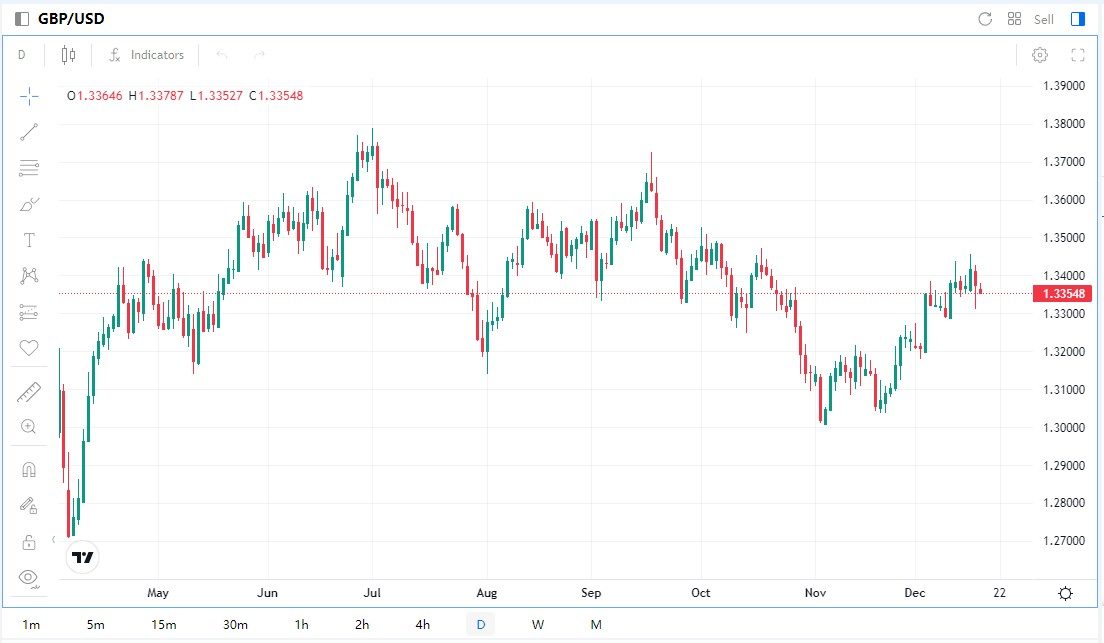
Source: Mitrade GBP/USD Performance
Technically, GBP/USD began to strengthen with volatile upward movements in late November, rising from around 1.30 to 1.34, indicating a strengthening trend. However, there is strong resistance near 1.35; if it fails to break above this level effectively, it could still face pressure to reverse downwards. On the daily chart, various moving averages continue to point upwards, suggesting that the short-term trend remains bullish. However, the KDJ indicator has started to turn downwards, indicating a strengthening of bearish market forces, which could suppress GBP/USD's performance, potentially testing the 1.32 level before the end of December.
For GBP/USD, initial upward resistance is located at 1.3500, with further resistance at 1.3700, and key resistance at 1.4000. Initial downward support for GBP/USD is at 1.3100, with further support at 1.2900, and a more critical support level at 1.2600.
Recommended Articles


