
What Are 3 of the Best AI Stocks to Hold for the Next 10 Years?

Source The Motley Fool

Key Points

  • TSMC has a technological monopoly on advanced AI chip manufacturing.

  • Nvidia is responsible for designing critical pieces of the modern data center.

  • Microsoft can easily monetize AI by inserting it into its software ecosystem.

  • 10 stocks we like better than Taiwan Semiconductor Manufacturing ›

While artificial intelligence (AI) is solidifying its mark in the world, it would be naive not to expect that some of today's AI-focused companies won't stand the test of time. In some cases, these companies may be too niche to remain independent and will ultimately become acquisition targets. Others simply won't survive.

When I think about AI stocks I want to hold for the next decade, I look for companies that are key players in different phases of the AI pipeline. The following three companies fit that description and appear to be good long-term investments.

Where to invest $1,000 right now? Our analyst team just revealed what they believe are the 10 best stocks to buy right now. Continue »

Glowing "AI" letters at the center of a futuristic circuit board.

Image source: Getty Images.

1. Taiwan Semiconductor Manufacturing Company

Taiwan Semiconductor Manufacturing Company (NYSE: TSM) isn't an AI stock in the traditional sense, but it's one of the more important companies in the space. As the world's leading third-party semiconductor foundry, TSMC manufactures chips designed by "fabless" companies that don't own the facilities to produce them themselves.

When it comes to manufacturing the types of advanced AI chips used in data centers, TSMC essentially has a monopoly. With its superior technology and efficiency, it's the go-to company, and there's not a close second.

Companies like Intel and Samsung also operate foundries that can deliver chips using some of the most cutting-edge process nodes, but they have issues -- such as production delays and low yields -- that make them far less reliable. Not only has this made AI chips a large part of TSMC's business, but it has also given it more pricing power.

Both TSMC's revenue and operating income (profit from core operations) have grown impressively over the past couple of years; however, its dominance in advanced AI chips has enabled it to grow its profits at a significantly faster pace.
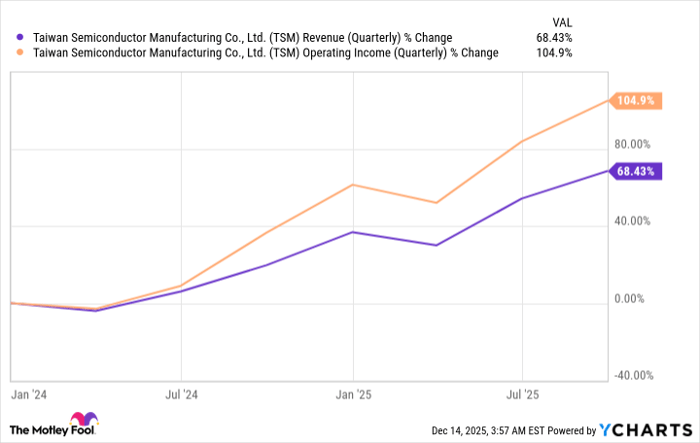
TSM Revenue (Quarterly) Chart

TSM Revenue (Quarterly) data by YCharts.

2. Nvidia

Whereas TSMC is the manufacturer that brings chips to life, Nvidia (NASDAQ: NVDA) is the designer behind critical parts of the AI ecosystem. Its lead in the parallel processor market, in particular, is why the stock skyrocketed over the past few years, turning it into the world's most valuable public company, with a market cap of nearly $4.2 trillion.

For a time, Nvidia was known for making graphics processing units (GPUs) that were primarily used to improve the performance of video games. However, the company and other clients realized that its parallel processors were useful for other types of computing workloads, and it began to pivot its focus toward those markets. Its latest pivot came as the AI trend picked up steam, and demand soared for hardware capable of handling the massive data sets involved in that technology. Many of the data center chips used for training and operating AI systems come from Nvidia.

Of the $57 billion in revenue Nvidia made in the third quarter (up 62% year over year), $51.2 billion (up 66%) came from its data center segment.
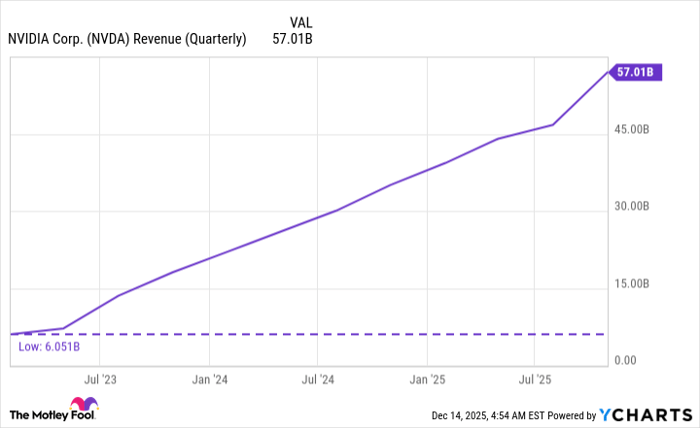
NVDA Revenue (Quarterly) Chart

NVDA Revenue (Quarterly) data by YCharts.

While Nvidia's GPUs and other hardware have gotten a lot of attention, CUDA -- its parallel computing platform and application programming interface -- has flown under the radar a bit. CUDA allows Nvidia's chips to be programmed for specific tasks, and the developers who work in AI are widely familiar with it, which adds to the company's moat. Moreover, CUDA programs only run on Nvidia chips, which further increases the switching costs associated with purchasing AI accelerator chips from competitors.

Other major tech companies, including Alphabet and Amazon, have begun designing their own AI chips, often with the assistance of Broadcom; however, Nvidia has a significant head start. It will inevitably lose some market share over the next decade, but as the size of the overall AI chip market continues to grow, it should remain relatively stable.

3. Microsoft

Microsoft (NASDAQ: MSFT) has two major things working in its favor regarding AI. First, Microsoft Azure is the second-largest cloud infrastructure platform in the world, and a go-to choice for many companies to build and host their own AI apps. Azure's AI capabilities have helped it close the gap a bit with segment leader Amazon Web Services.

The second major factor is that Microsoft's software portfolio comprises numerous titles and services that hundreds of millions of people use regularly, including Microsoft 365 (Excel, Word, Teams, PowerPoint, Outlook, etc.), LinkedIn, GitHub, and the Windows operating system, among others.

This allows Microsoft to act as a seamless AI distributor because it can easily add this new technology to software that people are already using, and then monetize it. For many corporations and individuals, paying a relatively small additional fee for Microsoft 365 Copilot is a straightforward decision. It has become another reliable revenue source for Microsoft, and it should only get better as adopting these tools becomes the norm for corporations.

While pure-play AI companies, by definition, rely solely on this new tech for their revenues, for Microsoft, AI is more of a bonus. The company's business is well-diversified, spanning software, tech hardware, gaming, cloud computing, and professional networking. Even if the AI hype cools over the next decade, Microsoft's business will remain strong and highly profitable.

Should you buy stock in Taiwan Semiconductor Manufacturing right now?

Before you buy stock in Taiwan Semiconductor Manufacturing, consider this:

The Motley Fool Stock Advisor analyst team just identified what they believe are the 10 best stocks for investors to buy now… and Taiwan Semiconductor Manufacturing wasn’t one of them. The 10 stocks that made the cut could produce monster returns in the coming years.

Consider when Netflix made this list on December 17, 2004... if you invested $1,000 at the time of our recommendation, you’d have $509,955!* Or when Nvidia made this list on April 15, 2005... if you invested $1,000 at the time of our recommendation, you’d have $1,089,460!*

Now, it’s worth noting Stock Advisor’s total average return is 968% — a market-crushing outperformance compared to 193% for the S&P 500. Don't miss the latest top 10 list, available with Stock Advisor, and join an investing community built by individual investors for individual investors.

See the 10 stocks »

*Stock Advisor returns as of December 17, 2025.

Stefon Walters has positions in Microsoft and Taiwan Semiconductor Manufacturing. The Motley Fool has positions in and recommends Alphabet, Amazon, Intel, Microsoft, Nvidia, and Taiwan Semiconductor Manufacturing. The Motley Fool recommends the following options: long January 2026 $395 calls on Microsoft and short January 2026 $405 calls on Microsoft. The Motley Fool has a disclosure policy.

Disclaimer: For information purposes only. Past performance is not indicative of future results.
placeholder
Ethereum Price Slips Lower — $3,000 Looms as the Key BattlegroundEthereum is attempting to recover from a $3,026 low but remains below $3,200 and the 100-hour SMA, with a bearish trend line near $3,175 capping rebounds as bulls need a clean break above $3,200 to target $3,250–$3,400, while a drop below $3,050 risks a retest of $3,000 and $2,940.
Author  Mitrade
Dec 15, Mon
Ethereum is attempting to recover from a $3,026 low but remains below $3,200 and the 100-hour SMA, with a bearish trend line near $3,175 capping rebounds as bulls need a clean break above $3,200 to target $3,250–$3,400, while a drop below $3,050 risks a retest of $3,000 and $2,940.
placeholder
Bitcoin Slides 5% as Sellers Lean In — Can BTC Reclaim $88,000?Bitcoin has dropped back below $88,000 after rolling over from $90,500, with price still trading under the 100-hour Simple Moving Average. The sell-off found a floor at $85,151, and BTC is now consolidating near that base, but rebounds are facing pressure from a bearish trend line around $89,000. Bulls need to retake $88,000–$89,000 to ease downside risk; failure to do so keeps $85,500–$85,000 and then $83,500 in play, with $80,000 as the deeper “line in the sand.” Bitcoin (BTC) is back in damage-control mode after a sharp pullback wiped out recent gains. The price failed to reclaim the $90,000–$90,500 band, rolled over, and slid through $88,500 before briefly dipping under $87,000. Buyers did show up around $85,000, but the rebound so far looks more like stabilization than a clear trend reversal. Bitcoin dips hard, finds a bid near $85,000(h3) BTC’s latest move lower began when it couldn’t build follow-through above $90,000 and $90,500. Once that upside stalled, sellers took control and pushed price down through $88,500. The slide accelerated enough to spike below $87,000, but the market didn’t free-fall. Bulls defended the $85,000 zone, printing a low at $85,151. Since then, Bitcoin has been consolidating below the 23.6% Fibonacci retracement of the drop from the $93,560 swing high to the $85,151 low — a clue that the bounce is still shallow and that sellers haven’t fully backed off yet. Structurally, BTC is still on the back foot: It’s trading below $88,000, and It remains below the 100-hour Simple Moving Average, keeping short-term trend pressure pointed downward. Resistance is layered, and $89,000 is the problem area(h3) If bulls try to turn this into a recovery, they’ll have to climb through multiple ceilings in quick succession. First, BTC faces resistance around $87,150, followed by a more meaningful barrier near $87,500. From there, the market’s attention snaps back to $88,000 — the level BTC just lost and now needs to reclaim. A close back above $88,000 would improve the tone, but it doesn’t solve the bigger issue: there’s a bearish trend line on the hourly BTC/USD chart (Kraken feed) with resistance near $89,000, which also lines up with the next technical hurdle. If BTC can push through $89,000 and hold, the rebound could extend toward $90,000, with follow-through targets at $91,000 and $91,500. But until price clears that $88,000–$89,000 zone, rallies are at risk of being sold rather than chased. If BTC fails to reclaim resistance, the downside path is clear(h3) The near-term bear case is simple: if Bitcoin can’t climb back above the $87,000 area and keep traction, sellers may attempt another leg lower. Support levels line up like this: Immediate support: $85,500 First major support: $85,000 Next support: $83,500 Then $82,500 in the near term Below that, the major “don’t break this” level is still $80,000. If BTC slips under $80,000, the risk of acceleration to the downside increases significantly — not because it’s magic, but because it’s the kind of psychological and structural level that tends to trigger forced de-risking. Indicators: momentum still leans bearish(h3) The intraday indicators aren’t offering much comfort yet: Hourly MACD is losing pace in the bearish zone. Hourly RSI remains below 50, suggesting sellers still have the upper hand on short timeframes. So while the $85,000 defense held for now, the market hasn’t flipped bullish — it’s just stopped bleeding.
Author  Mitrade
Dec 16, Tue
Bitcoin has dropped back below $88,000 after rolling over from $90,500, with price still trading under the 100-hour Simple Moving Average. The sell-off found a floor at $85,151, and BTC is now consolidating near that base, but rebounds are facing pressure from a bearish trend line around $89,000. Bulls need to retake $88,000–$89,000 to ease downside risk; failure to do so keeps $85,500–$85,000 and then $83,500 in play, with $80,000 as the deeper “line in the sand.” Bitcoin (BTC) is back in damage-control mode after a sharp pullback wiped out recent gains. The price failed to reclaim the $90,000–$90,500 band, rolled over, and slid through $88,500 before briefly dipping under $87,000. Buyers did show up around $85,000, but the rebound so far looks more like stabilization than a clear trend reversal. Bitcoin dips hard, finds a bid near $85,000(h3) BTC’s latest move lower began when it couldn’t build follow-through above $90,000 and $90,500. Once that upside stalled, sellers took control and pushed price down through $88,500. The slide accelerated enough to spike below $87,000, but the market didn’t free-fall. Bulls defended the $85,000 zone, printing a low at $85,151. Since then, Bitcoin has been consolidating below the 23.6% Fibonacci retracement of the drop from the $93,560 swing high to the $85,151 low — a clue that the bounce is still shallow and that sellers haven’t fully backed off yet. Structurally, BTC is still on the back foot: It’s trading below $88,000, and It remains below the 100-hour Simple Moving Average, keeping short-term trend pressure pointed downward. Resistance is layered, and $89,000 is the problem area(h3) If bulls try to turn this into a recovery, they’ll have to climb through multiple ceilings in quick succession. First, BTC faces resistance around $87,150, followed by a more meaningful barrier near $87,500. From there, the market’s attention snaps back to $88,000 — the level BTC just lost and now needs to reclaim. A close back above $88,000 would improve the tone, but it doesn’t solve the bigger issue: there’s a bearish trend line on the hourly BTC/USD chart (Kraken feed) with resistance near $89,000, which also lines up with the next technical hurdle. If BTC can push through $89,000 and hold, the rebound could extend toward $90,000, with follow-through targets at $91,000 and $91,500. But until price clears that $88,000–$89,000 zone, rallies are at risk of being sold rather than chased. If BTC fails to reclaim resistance, the downside path is clear(h3) The near-term bear case is simple: if Bitcoin can’t climb back above the $87,000 area and keep traction, sellers may attempt another leg lower. Support levels line up like this: Immediate support: $85,500 First major support: $85,000 Next support: $83,500 Then $82,500 in the near term Below that, the major “don’t break this” level is still $80,000. If BTC slips under $80,000, the risk of acceleration to the downside increases significantly — not because it’s magic, but because it’s the kind of psychological and structural level that tends to trigger forced de-risking. Indicators: momentum still leans bearish(h3) The intraday indicators aren’t offering much comfort yet: Hourly MACD is losing pace in the bearish zone. Hourly RSI remains below 50, suggesting sellers still have the upper hand on short timeframes. So while the $85,000 defense held for now, the market hasn’t flipped bullish — it’s just stopped bleeding.
placeholder
December Santa Claus Rally: New highs in sight for US and European stocks?Historical data show a rising trend of US and European stocks in December. If the momentum is strong, fund managers may rush in with a buying frenzy.
Author  Mitrade
Yesterday 02: 50
Historical data show a rising trend of US and European stocks in December. If the momentum is strong, fund managers may rush in with a buying frenzy.
placeholder
XRP’s Price Action Flashes a Warning Even as ETF Flows Stay PositiveXRP’s structure remains weak despite 18 straight positive closes in spot XRP ETFs, with analysts warning that $1.98 and other nearby resistance zones could cap rebounds unless the YO region is reclaimed, while deeper downside scenarios keep $1.53 on watch as a potential (not guaranteed) accumulation area.
Author  Mitrade
Yesterday 06: 37
XRP’s structure remains weak despite 18 straight positive closes in spot XRP ETFs, with analysts warning that $1.98 and other nearby resistance zones could cap rebounds unless the YO region is reclaimed, while deeper downside scenarios keep $1.53 on watch as a potential (not guaranteed) accumulation area.
placeholder
Gold declines on profit-taking, USD strength ahead of US CPI releaseGold price (XAU/USD) edges lower below $4,350 during the Asian trading hours on Thursday. The precious metal retreats from seven-week highs amid some profit-taking and a rebound in the US Dollar (USD).
Author  FXStreet
6 hours ago
Gold price (XAU/USD) edges lower below $4,350 during the Asian trading hours on Thursday. The precious metal retreats from seven-week highs amid some profit-taking and a rebound in the US Dollar (USD).
goTop
quote