
Better Dividend Stock: Annaly Capital vs. Realty Income

Source The Motley Fool

Key Points

  • Annaly Capital boasts a massive dividend yield that demands investor attention.

  • Realty Income's dividend yield is smaller, but it pays out monthly and is growing.

  • The $23,760 Social Security bonus most retirees completely overlook ›

When you're considering what kind of dividend stocks you want to buy, you really need to decide what kind of investor you are. Do you want a set-it-and-forget-it stock? Are you seeking a substantial yield and willing to accept some volatility? Are you looking for your dividend payments to grow over time? And how do you plan to use your dividend -- as monthly or quarterly income, or will you reinvest into your portfolio?

Where to invest $1,000 right now? Our analyst team just revealed what they believe are the 10 best stocks to buy right now, when you join Stock Advisor. See the stocks »

In the world of dividend stocks, there are literally hundreds from which to choose -- blue chip names, growth stocks, high-yield stocks, and real estate investment trusts. Some stocks that find a way to grow their dividend for at least 50 consecutive years earn the distinction of Dividend King. Even among those buckets of dividend stocks, you'll find companies that are vastly different.

For instance, Annaly Capital Management (NYSE: NLY) and Realty Income (NYSE: O) are both REITs, which means they are required to pay out 90% of income in the form of dividends. REITs are popular dividend stocks, but Annaly Capital and Realty Income couldn't be more different. Let's take a closer look at these two and choose which is the superior real estate dividend stock.

REIT spelled out on wooden coins, and the text Real Estate Investment Trust.

Image source: Getty Images.

About Annaly Capital

Annaly Capital, which is based in New York, is one of the largest mortgage-backed REITs. Rather than dealing specifically with property, Annaly owns and manages real estate-related investment securities, including mortgage pass-through certificates and collateralized mortgage obligations.

Its largest segment is Annaly Agency Group, which has $87.3 billion in assets and works in the mortgage-backed securities (MBS) market. Through this segment, Annaly invests in residential and commercial mortgages that are guaranteed by the Federal National Mortgage Association (Fannie Mae) and the Federal Home Loan Mortgage Corporation (Freddie Mac), or through the U.S. Department of Housing and Urban Development's Ginnie Mae program.

It also has a mortgage servicing program that provides complementary cash flow to Annaly's MBS work, and a residential credit division that provides direct financing to residential homeowners. Overall, the company has financed more than 1 million homes.

Its third-quarter earnings report showed that the company's portfolio has a $97.8 billion investment portfolio, with a book value per share of $19.25. Earnings per share came to $1.20, versus just $0.05 per share a year ago.

The company offers a quarterly dividend of $0.70 per share, which equates to a massive dividend yield of 12.6%.

About Realty Income

Unlike Annaly Capital, Realty Income is in the property business. It has a portfolio of more than 15,500 properties stretching in every U.S. state, plus the United Kingdom and seven other European countries. The company's holdings are commercial, not residential, but they are diversified across multiple sectors. Its customers include Dollar General, Wynn Resorts, AMC Entertainment, CVS Health, and Walmart.

Top Industries

Percentage of Reality Income Portfolio

Grocery stores

10.8%

Convenience stores

9.7%

Home improvement stores

6.4%

Dollar stores

6.2%

Quick-service restaurants

4.8%

Data source: Realty Income.

The company reported revenue of $1.47 billion in the third quarter, up from $1.33 billion. Adjusted funds from operations were $922 million and $1.08 per share, up from $915.6 million and $1.05 per share a year ago.

Realty Income's dividend yield is smaller than Annaly's, but it's still a very respectable 5.6%. Reality Income pays its dividend on a monthly basis, rather than quarterly, which makes it easier for investors seeking a steady revenue stream.

Which dividend stock is better?

There are two major factors separating these two REITs. The first is dividend growth. Annaly has a consistent dividend in that it pays out every quarter, but it's also been forced to cut the dividend in recent years -- a 26% cut in 2023, and a 12% cut in 2020.

Meanwhile, Reality Income is famous for its history of dividend increases. The company has paid a monthly dividend for 666 consecutive months as of this writing and has recently announced its 133rd consecutive monthly increase.

All that adds up over time. When you look at the two companies in the last five years, Realty Income has increased its dividend by 46%, while Annaly Capital cut its dividend by nearly 42%.
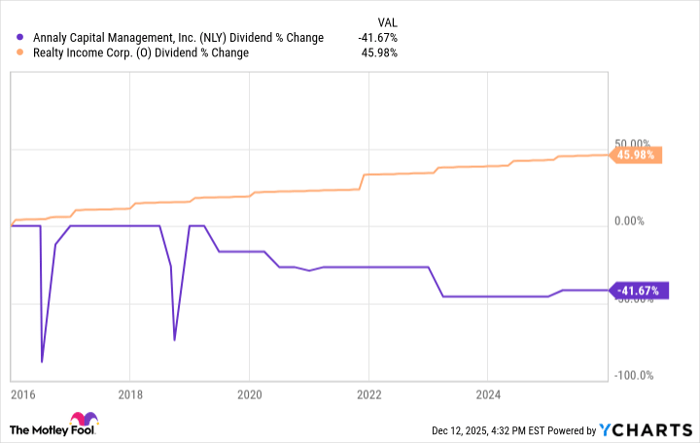
NLY Dividend Chart

NLY Dividend data by YCharts

The second factor for me is the payout schedule. I will always prefer a dividend stock that pays me monthly because the sooner I receive the money, the sooner I can put it to work for me. I would much rather get a payment every month than have to wait 90 days for the next payout -- knowing that money is working for the company, not its investors.

So, despite the massive yield provided by Annaly Capital, my choice in this head-to-head battle of REITs is Realty Income. The payout schedule and dividend growth are massive advantages that the mortgage REIT can't overcome.

The $23,760 Social Security bonus most retirees completely overlook

If you're like most Americans, you're a few years (or more) behind on your retirement savings. But a handful of little-known "Social Security secrets" could help ensure a boost in your retirement income.

One easy trick could pay you as much as $23,760 more... each year! Once you learn how to maximize your Social Security benefits, we think you could retire confidently with the peace of mind we're all after. Join Stock Advisor to learn more about these strategies.

View the "Social Security secrets" »

Patrick Sanders has no position in any of the stocks mentioned. The Motley Fool has positions in and recommends Realty Income and Walmart. The Motley Fool recommends CVS Health. The Motley Fool has a disclosure policy.

Disclaimer: For information purposes only. Past performance is not indicative of future results.
placeholder
U.S. November Nonfarm Payrolls: What Does the Rare "Weak Jobs, Strong Economy" Mix Mean for U.S. Equities?1. IntroductionAfter retreating from the late-October highs, U.S. equities embarked on a bottoming rebound in mid-to-late November, a trend driven by the interplay of multiple factors. That said, it i
Author  TradingKey
10 hours ago
1. IntroductionAfter retreating from the late-October highs, U.S. equities embarked on a bottoming rebound in mid-to-late November, a trend driven by the interplay of multiple factors. That said, it i
placeholder
Senate Delays Crypto Market Structure Hearings to Early 2026The Senate Banking Committee has postponed cryptocurrency market structure hearings until 2026, citing ongoing bipartisan negotiations.
Author  Mitrade
15 hours ago
The Senate Banking Committee has postponed cryptocurrency market structure hearings until 2026, citing ongoing bipartisan negotiations.
placeholder
Bitcoin Slides 5% as Sellers Lean In — Can BTC Reclaim $88,000?Bitcoin has dropped back below $88,000 after rolling over from $90,500, with price still trading under the 100-hour Simple Moving Average. The sell-off found a floor at $85,151, and BTC is now consolidating near that base, but rebounds are facing pressure from a bearish trend line around $89,000. Bulls need to retake $88,000–$89,000 to ease downside risk; failure to do so keeps $85,500–$85,000 and then $83,500 in play, with $80,000 as the deeper “line in the sand.” Bitcoin (BTC) is back in damage-control mode after a sharp pullback wiped out recent gains. The price failed to reclaim the $90,000–$90,500 band, rolled over, and slid through $88,500 before briefly dipping under $87,000. Buyers did show up around $85,000, but the rebound so far looks more like stabilization than a clear trend reversal. Bitcoin dips hard, finds a bid near $85,000(h3) BTC’s latest move lower began when it couldn’t build follow-through above $90,000 and $90,500. Once that upside stalled, sellers took control and pushed price down through $88,500. The slide accelerated enough to spike below $87,000, but the market didn’t free-fall. Bulls defended the $85,000 zone, printing a low at $85,151. Since then, Bitcoin has been consolidating below the 23.6% Fibonacci retracement of the drop from the $93,560 swing high to the $85,151 low — a clue that the bounce is still shallow and that sellers haven’t fully backed off yet. Structurally, BTC is still on the back foot: It’s trading below $88,000, and It remains below the 100-hour Simple Moving Average, keeping short-term trend pressure pointed downward. Resistance is layered, and $89,000 is the problem area(h3) If bulls try to turn this into a recovery, they’ll have to climb through multiple ceilings in quick succession. First, BTC faces resistance around $87,150, followed by a more meaningful barrier near $87,500. From there, the market’s attention snaps back to $88,000 — the level BTC just lost and now needs to reclaim. A close back above $88,000 would improve the tone, but it doesn’t solve the bigger issue: there’s a bearish trend line on the hourly BTC/USD chart (Kraken feed) with resistance near $89,000, which also lines up with the next technical hurdle. If BTC can push through $89,000 and hold, the rebound could extend toward $90,000, with follow-through targets at $91,000 and $91,500. But until price clears that $88,000–$89,000 zone, rallies are at risk of being sold rather than chased. If BTC fails to reclaim resistance, the downside path is clear(h3) The near-term bear case is simple: if Bitcoin can’t climb back above the $87,000 area and keep traction, sellers may attempt another leg lower. Support levels line up like this: Immediate support: $85,500 First major support: $85,000 Next support: $83,500 Then $82,500 in the near term Below that, the major “don’t break this” level is still $80,000. If BTC slips under $80,000, the risk of acceleration to the downside increases significantly — not because it’s magic, but because it’s the kind of psychological and structural level that tends to trigger forced de-risking. Indicators: momentum still leans bearish(h3) The intraday indicators aren’t offering much comfort yet: Hourly MACD is losing pace in the bearish zone. Hourly RSI remains below 50, suggesting sellers still have the upper hand on short timeframes. So while the $85,000 defense held for now, the market hasn’t flipped bullish — it’s just stopped bleeding.
Author  Mitrade
18 hours ago
Bitcoin has dropped back below $88,000 after rolling over from $90,500, with price still trading under the 100-hour Simple Moving Average. The sell-off found a floor at $85,151, and BTC is now consolidating near that base, but rebounds are facing pressure from a bearish trend line around $89,000. Bulls need to retake $88,000–$89,000 to ease downside risk; failure to do so keeps $85,500–$85,000 and then $83,500 in play, with $80,000 as the deeper “line in the sand.” Bitcoin (BTC) is back in damage-control mode after a sharp pullback wiped out recent gains. The price failed to reclaim the $90,000–$90,500 band, rolled over, and slid through $88,500 before briefly dipping under $87,000. Buyers did show up around $85,000, but the rebound so far looks more like stabilization than a clear trend reversal. Bitcoin dips hard, finds a bid near $85,000(h3) BTC’s latest move lower began when it couldn’t build follow-through above $90,000 and $90,500. Once that upside stalled, sellers took control and pushed price down through $88,500. The slide accelerated enough to spike below $87,000, but the market didn’t free-fall. Bulls defended the $85,000 zone, printing a low at $85,151. Since then, Bitcoin has been consolidating below the 23.6% Fibonacci retracement of the drop from the $93,560 swing high to the $85,151 low — a clue that the bounce is still shallow and that sellers haven’t fully backed off yet. Structurally, BTC is still on the back foot: It’s trading below $88,000, and It remains below the 100-hour Simple Moving Average, keeping short-term trend pressure pointed downward. Resistance is layered, and $89,000 is the problem area(h3) If bulls try to turn this into a recovery, they’ll have to climb through multiple ceilings in quick succession. First, BTC faces resistance around $87,150, followed by a more meaningful barrier near $87,500. From there, the market’s attention snaps back to $88,000 — the level BTC just lost and now needs to reclaim. A close back above $88,000 would improve the tone, but it doesn’t solve the bigger issue: there’s a bearish trend line on the hourly BTC/USD chart (Kraken feed) with resistance near $89,000, which also lines up with the next technical hurdle. If BTC can push through $89,000 and hold, the rebound could extend toward $90,000, with follow-through targets at $91,000 and $91,500. But until price clears that $88,000–$89,000 zone, rallies are at risk of being sold rather than chased. If BTC fails to reclaim resistance, the downside path is clear(h3) The near-term bear case is simple: if Bitcoin can’t climb back above the $87,000 area and keep traction, sellers may attempt another leg lower. Support levels line up like this: Immediate support: $85,500 First major support: $85,000 Next support: $83,500 Then $82,500 in the near term Below that, the major “don’t break this” level is still $80,000. If BTC slips under $80,000, the risk of acceleration to the downside increases significantly — not because it’s magic, but because it’s the kind of psychological and structural level that tends to trigger forced de-risking. Indicators: momentum still leans bearish(h3) The intraday indicators aren’t offering much comfort yet: Hourly MACD is losing pace in the bearish zone. Hourly RSI remains below 50, suggesting sellers still have the upper hand on short timeframes. So while the $85,000 defense held for now, the market hasn’t flipped bullish — it’s just stopped bleeding.
placeholder
AUD/USD remains depressed below mid-0.6600s; downside seems limited ahead of US NFP reportThe AUD/USD pair attracts some sellers for the fourth straight day on Tuesday and trades around the 0.6630 region, down just over 0.10%, during the Asian session.
Author  FXStreet
19 hours ago
The AUD/USD pair attracts some sellers for the fourth straight day on Tuesday and trades around the 0.6630 region, down just over 0.10%, during the Asian session.
placeholder
Macro Analysts: Hawkish Japan Could Push Bitcoin Below $70KAnalysts predict Bitcoin may face further declines towards the $70,000 mark if the Bank of Japan raises interest rates as expected.
Author  Mitrade
Yesterday 05: 48
Analysts predict Bitcoin may face further declines towards the $70,000 mark if the Bank of Japan raises interest rates as expected.
goTop
quote