

Gold eases below $4,300 as traders unwind post-NFP gains
- Gold spikes to $4,335 on weak jobs signals, then reverses as traders reassess Fed easing prospects.
- Higher unemployment but firmer hiring and resilient retail spending temper dovish Fed expectations.
- Geopolitical uncertainty persists, though stalled Russia–Ukraine talks briefly dampen safe-haven demand.
Gold (XAU/USD) reverses its course on Tuesday after traders digested the latest US jobs report, which highlighted the labor market weakness and pushed the yellow metal towards a daily high at $4,335 before reversing course, losing 0.23% at the time of writing. XAU/USD trades at $4,296.
Bullion pares gains after mixed US jobs data lifts yields sentiment, while peace-talk headlines and steady spending cap upside
Data from the US Bureau of Labor Statistics (BLS) was mixed: The economy added more people than expected to the workforce in November, but the Unemployment Rate rose to its highest level since 2021. Although the report justifies further easing, expectations for a rate cut in January 2026 remained low at around 25%, as shown by Capital Edge data.
At the same time, delayed Retail Sales data showed that American consumer spending remains slightly strong as Retail Sales were unchanged in October, according to the US Census Bureau. The report showed that people are facing higher prices in food, furniture and a range of other imported foods due to tariffs imposed by the White House.
The yellow metal reclaimed the $4,300 figure ahead of the Federal Reserve meeting last week. Ongoing developments for a possible peace agreement between Russia and Ukraine pressured the precious metal. However, discussions halted after Kyiv drafted a 20-point plan that the Kremlin has not accepted.
Traders will be eyeing the release of inflation figures and Initial Jobless Claims on Thursday, ahead of the Personal Consumption Expenditures (PCE) Price Index on Friday.
Daily digest market movers: Gold tumbles amid mixed US jobs report
- US Nonfarm Payrolls rose by 64K in November, beating expectations of 50K and marking an improvement from October’s –105K print. However, the Unemployment Rate climbed in November to 4.6% from 4.4%, exceeding markets' forecast.
- US Retail Sales were flat in October (0.0% MoM), easing from September’s 0.1% gain and missing forecasts for a 0.1% increase. In contrast, Control Group sales —used to calculate the consumer spending component of GDP— rebounded sharply, rising 0.8% after a 0.1% contraction previously.
- US Treasury yields are falling, with the 10-year benchmark note rate down nearly two basis points at 4.159%. US real yields, which correlate inversely with Gold prices, are firm at 1.909%.
- The US Dollar Index (DXY), which tracks the Greenbacks’ performance against a basket of six peers, is down 0.08% to 98.17.
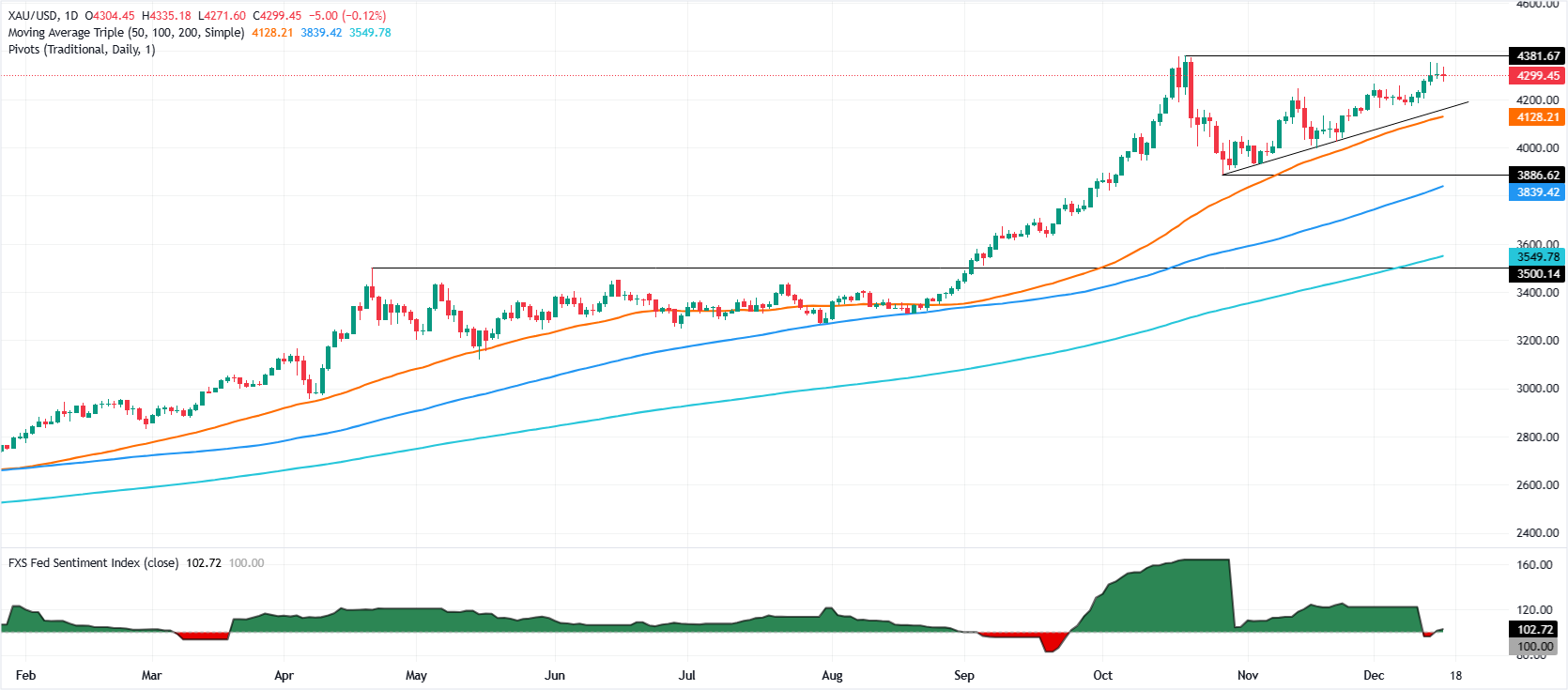
Technical Analysis: Gold’s uptrend intact above $4,300
Gold price uptrend remains intact as long as it ends on a daily basis above $4,300. Bullish momentum stabilized as depicted by the Relative Strength Index (RSI), which, despite being close to overbought conditions, turned flat.
For a bullish continuation, XAU/USD must clear the December 12 high of $4,353. A breach of the latter will expose the all-time high (ATH) at $4,381, followed by $4,400, $4,450, and $4,500.
Conversely, a drop below $4,300 would clear the path to test the December 11 high at $4,285, with further downside seen at $4,250 before diving to $4,200.
Gold FAQs
Gold has played a key role in human’s history as it has been widely used as a store of value and medium of exchange. Currently, apart from its shine and usage for jewelry, the precious metal is widely seen as a safe-haven asset, meaning that it is considered a good investment during turbulent times. Gold is also widely seen as a hedge against inflation and against depreciating currencies as it doesn’t rely on any specific issuer or government.
Central banks are the biggest Gold holders. In their aim to support their currencies in turbulent times, central banks tend to diversify their reserves and buy Gold to improve the perceived strength of the economy and the currency. High Gold reserves can be a source of trust for a country’s solvency. Central banks added 1,136 tonnes of Gold worth around $70 billion to their reserves in 2022, according to data from the World Gold Council. This is the highest yearly purchase since records began. Central banks from emerging economies such as China, India and Turkey are quickly increasing their Gold reserves.
Gold has an inverse correlation with the US Dollar and US Treasuries, which are both major reserve and safe-haven assets. When the Dollar depreciates, Gold tends to rise, enabling investors and central banks to diversify their assets in turbulent times. Gold is also inversely correlated with risk assets. A rally in the stock market tends to weaken Gold price, while sell-offs in riskier markets tend to favor the precious metal.
The price can move due to a wide range of factors. Geopolitical instability or fears of a deep recession can quickly make Gold price escalate due to its safe-haven status. As a yield-less asset, Gold tends to rise with lower interest rates, while higher cost of money usually weighs down on the yellow metal. Still, most moves depend on how the US Dollar (USD) behaves as the asset is priced in dollars (XAU/USD). A strong Dollar tends to keep the price of Gold controlled, whereas a weaker Dollar is likely to push Gold prices up.
Recommended Articles


