

The Stock Market Flashes a Warning Seen Twice in 40 Years, and the Federal Reserve Has Bad News About President Trump's Tariffs
Key Points
The S&P 500 has advanced 16% year to date despite economic uncertainty created by President Trump's tariffs, but the market environment warrants caution.
A Federal Reserve study suggests President Trump's tariffs will slow economic growth, which itself will be a headwind to the stock market’s performance.
The S&P 500 currently trades at 22.4 times forward earnings; excluding the past year, the index has only been that expensive during two periods in the last 40 years.
- 10 stocks we like better than S&P 500 Index ›
The U.S. stock market is having a terrific year. The benchmark S&P 500 (SNPINDEX: ^GSPC) is up 16% in 2025 despite economic uncertainty created by President Trump's tariffs. But there could be trouble on the horizon.
A Federal Reserve study suggests tariffs will slow economic growth. That is particularly bad news because the S&P 500 currently trades at one its most expensive valuations in the past 40 years. Here are the details.
Where to invest $1,000 right now? Our analyst team just revealed what they believe are the 10 best stocks to buy right now, when you join Stock Advisor. See the stocks »
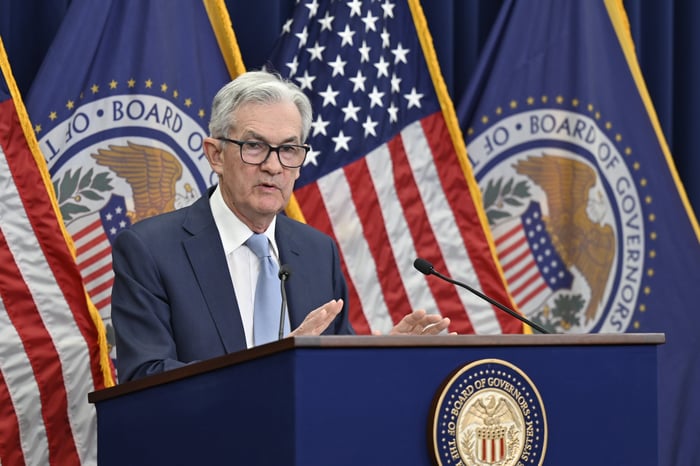
Image source: Official Federal Reserve Photo.
A Federal Reserve study suggests President Trump's tariffs will hurt the economy
President Trump believes tariffs will strengthen the U.S. economy, "Tariff power will bring America national security and wealth the likes of which has never been seen before," he wrote in November. However, a study from the Federal Reserve Bank of San Francisco challenges that opinion.
The researchers examined 150 years' worth of data from the U.S. and abroad, and drew this conclusion: Tariffs will increase unemployment and slow GDP growth. Dozens of economists surveyed by The Wall Street Journal have similar outlooks, and the Budget Lab at Yale estimates tariffs will reduce GDP growth by half a percentage point in 2025 and 2026.
So what? GDP measures total economic output. It equals the sum of consumer spending, business spending, government spending, and net exports. GDP growth is correlated with corporate earnings growth, which in turn influences the stock market's performance, especially over long periods. Consider what happened during the past two decades.
- Between 2005 and 2014, nominal U.S. GDP rose 43% and the S&P 500 achieved a total return of 110%.
- Between 2015 and 2024, nominal U.S. GDP rose 67% and the S&P 500 achieved a total return of 243%.
Here's the big picture: Empirical data says President Trump's tariffs will slow economic growth. That suggests earnings will increase more slowly than they otherwise would have, which is bad news for the stock market. Of course, earnings are not the only variable that influences the stock market's performance. What investors are willing to pay for those earnings (i.e., valuation) also matters.
The S&P 500 is flashing a warning seen twice before in the past 40 years
The S&P 500 had a forward price-to-earnings (PE) multiple of 22.4 as of Dec. 5, according to FactSet Research. That is above the five-year average of 20 and the 10-year average of 18.7. In fact, excluding the past year, the index has traded above 22 times forward earnings during only two periods in the past 40 years, and it declined sharply both times.
The first incident was the dot-com bubble. The S&P 500's forward P/E ratio topped 22 in the late 1990s and generally stayed there until the bubble burst in the early 2000s. The index eventually dropped 49%. The second incident was the COVID-19 pandemic. The S&P 500's forward P/E ratio topped 22 in 2020 and stayed there for about a year. The index eventually dropped 25%.
The Federal Reserve does not take an official position on whether the stock market or any financial asset is priced correctly, but Fed Chair Jerome Powell recently acknowledged the situation. "By many measures... equity prices are fairly highly valued," he commented at a speech in Rhode Island in September.
Of course, forward P/E ratios depend on forward earnings estimates, and Wall Street may be underestimating how fast earnings will grow, which would artificially inflate the forward P/E. That actually happened this year. The consensus estimate in July said S&P 500 earnings would increase 8.5% in 2025, but earnings are on pace to rise 13%, according to LSEG.
Nevertheless, the S&P 500's present valuation is high by historical standards. So, any troubling news about the economy could spark a downturn. Investors should consider selling any stocks in which they lack confidence (i.e., stocks you would not want to hold through a correction or bear market). Now is also a good time to build a cash position.
Should you invest $1,000 in S&P 500 Index right now?
Before you buy stock in S&P 500 Index, consider this:
The Motley Fool Stock Advisor analyst team just identified what they believe are the 10 best stocks for investors to buy now… and S&P 500 Index wasn’t one of them. The 10 stocks that made the cut could produce monster returns in the coming years.
Consider when Netflix made this list on December 17, 2004... if you invested $1,000 at the time of our recommendation, you’d have $521,550!* Or when Nvidia made this list on April 15, 2005... if you invested $1,000 at the time of our recommendation, you’d have $1,133,904!*
Now, it’s worth noting Stock Advisor’s total average return is 981% — a market-crushing outperformance compared to 194% for the S&P 500. Don’t miss out on the latest top 10 list, available when you join Stock Advisor.
See the 10 stocks »
*Stock Advisor returns as of December 8, 2025
Trevor Jennewine has no position in any of the stocks mentioned. The Motley Fool has positions in and recommends FactSet Research Systems. The Motley Fool has a disclosure policy.
Recommended Articles


