

Warren Buffett Sold Over $24 Billion Worth of Stock in 2025, but His Recent $14 Billion in Purchases Sends a Clear Message to Investors
Key Points
Warren Buffett has sold more equities than he bought for Berkshire Hathaway for 12 straight quarters.
Berkshire stepped up its spending in the last few months, including its biggest purchase in three years.
Three purchases totaling $14 billion send a clear message to investors about how to navigate the current market.
- 10 stocks we like better than Berkshire Hathaway ›
Warren Buffett hasn't found a lot to like in the stock market recently. In fact, Berkshire Hathaway (NYSE: BRK.A) (NYSE: BRK.B) has been a net seller of stocks for 12 straight quarters. Through the first nine months of 2025, Buffett and his team of investment managers sold over $24 billion worth of equities. As a result, the company has seen its cash position climb to unprecedented levels, reaching $354 billion as of the end of the third quarter.
Buffett's selling is indicative of his belief that most of the stock market is currently overvalued. The case has grown stronger and stronger each quarter as many stocks have seen their share prices climb faster than their underlying financial results. With broad market valuations climbing toward all-time highs, based on several classic metrics, it's no surprise Buffett is hoarding cash at this point.
Where to invest $1,000 right now? Our analyst team just revealed what they believe are the 10 best stocks to buy right now, when you join Stock Advisor. See the stocks »
However, the Oracle of Omaha has been diligent in his efforts to find new places to put at least some of that capital to work. He made approximately $14 billion in recent investments for Berkshire, sending a clear message to investors about how to invest in today's market.
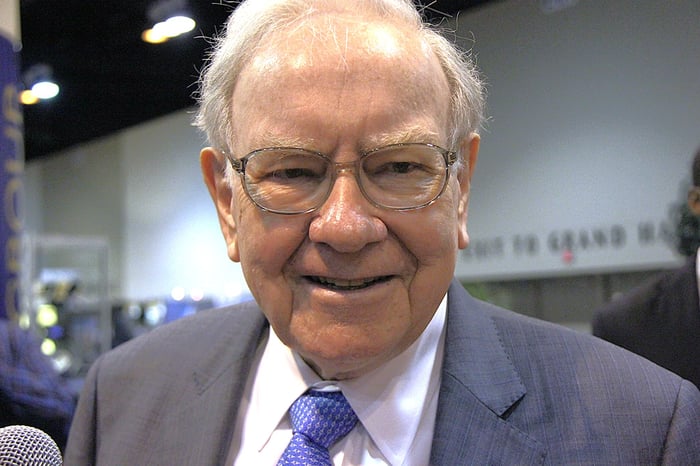
Image source: The Motley Fool.
Buffett's most notable purchases of 2025
Through the first nine months of 2025, Buffett and the team of investment managers at Berkshire Hathaway made a total of $13.4 billion worth of equity purchases. They've also made some moves since closing the books on the third quarter. Here are three of the most notable purchases Berkshire Hathaway made recently.
- 17.8 million shares of Alphabet (NASDAQ: GOOGL) (NASDAQ: GOOG)
- The entirety of OxyChem from Occidental Petroleum (NYSE: OXY) (set to close this month)
- Increased stakes in Japanese trading houses Mitsubishi (OTC: MTSU.Y) (OTC: MSBHF) and Mitsui (OTC: MITSF)
The total spent on those investments in 2025 is estimated to be around $14 billion. While they might look like completely disparate investments from the Oracle of Omaha, they send a clear message from Buffett when you zoom out and look at the bigger picture. It's a message investors should keep in mind in the current market.
Expanding the universe of investable assets
Through his transactions, Buffett has made it clear that the stock market, in general, is extremely expensive. U.S. stocks, in particular, look expensive, based on metrics such as the "Buffett Indicator," which measures the total U.S. stock market capitalization as a percentage of gross domestic product (GDP). At the indicator's current level of around 225%, Buffett says investors are "playing with fire." Similarly, the S&P 500 index has a traditional price-earnings ratio and cyclically adjusted price-earnings (CAPE) ratio that hover around levels similar to the peak of the dot-com bubble.
That doesn't mean it's impossible to find value in today's market, though. However, it might require investors to look beyond the areas they're used to, which is something Buffett's recent purchases all do.
Alphabet stood out in Berkshire's most recent 13F filing -- not just because it was the only new stock purchase, and not because the holding company put around $4 billion into the stock. The reason it stood out is that Buffett has long avoided tech stocks like Alphabet. That's why many believe the purchase was made by one of the other investment managers at Berkshire, Ted Weschler or Todd Combs (who left Berkshire this month to work for JPMorgan Chase).
However, Buffett has shown interest in Alphabet in the past but has failed to pull the trigger. The shares looked particularly attractive last quarter when they traded for less than 20 times forward earnings estimates. That's well below the average multiple of other high-flying AI stocks and even below the current S&P 500 average.
On top of that, the company generates tens of billions in free cash flow every quarter despite spending heavily on new AI data centers. That may have been enough for Buffett to finally buy shares of the stock, despite his aversion to tech.
The announced $9.7 billion purchase of OxyChem was another opportunity for Berkshire to buy a company at a compelling value, but the opportunity wasn't available on the open market. Berkshire Hathaway had to expand the universe of investable assets, honing in on a subsidiary of Occidental Petroleum.
Buffett identified the chemicals industry as undervalued and then secured even better value by acquiring an entire operation at an estimated multiple below that of its biggest peers. The icing on the cake is that Berkshire maintained its position in Occidental preferred shares, which pay an 8% dividend, about twice as much as Treasury bills. The deal should also support the long-term health of Occidental, of which Berkshire owns 28%.
The last set of deals is an increased stake in Japanese trading houses Mitsubishi and Mitsui. Buffett rarely looks beyond the United States for investment opportunities. When he has, it's because of the heavy influence of long-time investing partner Charlie Munger (now deceased).
One investment Munger championed was Berkshire's subsidiary's stake in the five Japanese trading houses, initially purchased in 2020. Buffett continued to add to those investments in 2025, as the Japanese stock market, in general, continues to offer more compelling value than U.S. stocks. Mitsubishi and Mitsui still look attractive, even as their price-to-book values have climbed to about 1.5 times for each stock.
The message for investors
Trying to copy what Buffett and Berkshire Hathaway are doing isn't always a great idea. In many instances, Buffett is playing a different game than most retail investors, which gives him both advantages and disadvantages. On the plus side, Buffett has access to opportunities that the average investor doesn't, such as OxyChem. On the other hand, Berkshire Hathaway is too big to take advantage of many more opportunities that smaller investors have at their disposal.
The message from Buffett is clear, though: There are still opportunities in today's expensive stock market, but you might have to look beyond your normal investments to find them.
That may mean expanding your circle of competence and looking at smaller companies or international stocks. Both small-cap U.S. stocks and European and Japanese stocks look more attractive from a valuation standpoint than large-cap U.S. stocks. However, those companies have less media and analyst coverage, which means you'll have to do some work to uncover values in those markets.
However, if you're willing to do the work, Buffett's latest buys suggest you can still generate great returns going forward, even in an expensive market.
Should you invest $1,000 in Berkshire Hathaway right now?
Before you buy stock in Berkshire Hathaway, consider this:
The Motley Fool Stock Advisor analyst team just identified what they believe are the 10 best stocks for investors to buy now… and Berkshire Hathaway wasn’t one of them. The 10 stocks that made the cut could produce monster returns in the coming years.
Consider when Netflix made this list on December 17, 2004... if you invested $1,000 at the time of our recommendation, you’d have $521,550!* Or when Nvidia made this list on April 15, 2005... if you invested $1,000 at the time of our recommendation, you’d have $1,133,904!*
Now, it’s worth noting Stock Advisor’s total average return is 981% — a market-crushing outperformance compared to 194% for the S&P 500. Don’t miss out on the latest top 10 list, available when you join Stock Advisor.
See the 10 stocks »
*Stock Advisor returns as of December 8, 2025
JPMorgan Chase is an advertising partner of Motley Fool Money. Adam Levy has positions in Alphabet. The Motley Fool has positions in and recommends Alphabet, Berkshire Hathaway, and JPMorgan Chase. The Motley Fool recommends Occidental Petroleum. The Motley Fool has a disclosure policy.
Recommended Articles


