

GameStop: From Epic Short Squeeze to Q3 Earnings, Where Does This Meme Stock Go Next?
Source: TradingKey
Historical Review: r/WallStreetBets, Roaring Kitty, & the Epic Short Squeeze
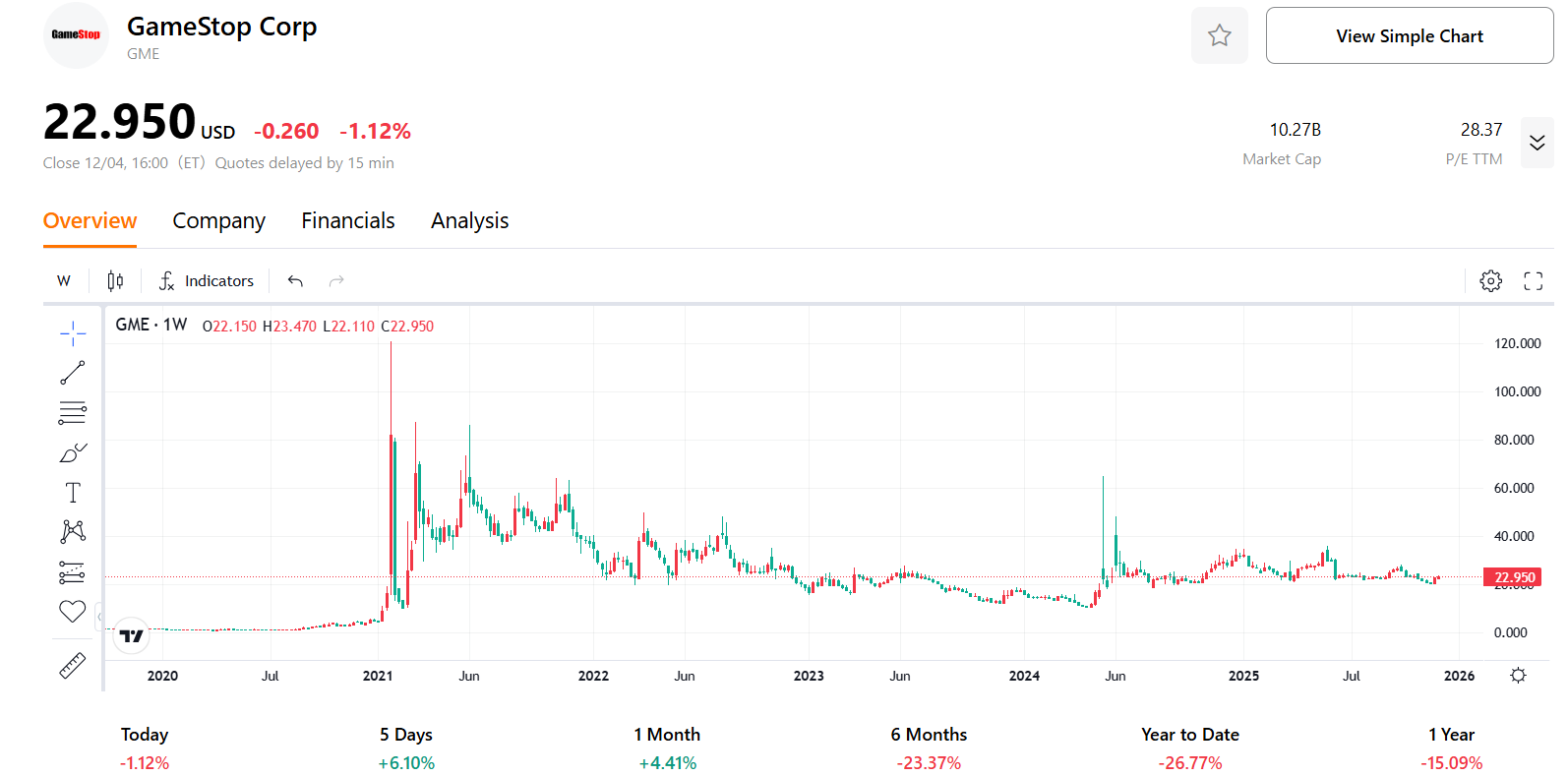
GameStop (GME) was originally a traditional brick-and-mortar game retailer, primarily selling game consoles, physical game software, and related merchandise. With stores throughout North America and Europe, it was long considered a declining sector after the rise of digital game distribution and online retail, and its stock price hovered at low levels for an extended period in 2019–2020. The turning point came from the Reddit community r/WallStreetBets (WSB): a community known for high leverage, heavily leveraged single stocks, memes, and a satirical culture. Users were accustomed to showing off options and unrealized profits, and also to collectively engage in meme-based trading around a few specific assets. It was on this forum that GameStop was gradually shaped into a symbol of betting against Wall Street.
The key figure was Keith Gill, whose Reddit ID was u/DeepFuckingValue, and his YouTube name was Roaring Kitty. Since 2019, he consistently posted screenshots of his long positions in GME and lengthy analytical videos on r/WallStreetBets, emphasizing the market's excessive pessimistic pricing of GameStop and repeatedly mentioning that "extremely high short positions + new console cycle + improved capital structure" could trigger a short squeeze. As the stock price rose, the market value of his publicly disclosed positions ballooned from tens of thousands of dollars to tens of millions of dollars. Fueled by the narrative of a grassroots comeback within the WSB community, a large number of retail investors not only directly bought GME stock but also flooded into short-term, out-of-the-money call options, causing a rapid surge in option trading volume and open interest.
By January 2021, GME's short positions had exceeded 100% of its outstanding shares. This was primarily driven by large-scale active short selling by multiple hedge funds and institutional investors based on the logic that "traditional offline game retail will be eliminated by digital distribution," turning the underlying asset into a highly crowded short position. Under this extremely high short-selling structure, the concentrated buying of call options by retail investors triggered a typical gamma mechanism: option sellers (market makers), in order to hedge short-term gamma and short-term delta, were continuously forced to buy GME underlying stock during the upward trend, passively adding to their floating short positions, thus creating a gamma squeeze on top of the short squeeze. In the most frenzied trading days, the daily trading volume of some near-month, deep out-of-the-money call options exceeded 100,000 contracts, raising the cost of option prices relative to the underlying stock price from a few percentage points to tens of percentage points. The passive hedging buying by market makers, combined with short covering and retail investor spot buying, pushed the stock price to nearly $500 pre-market in a very short period.
Subsequently, as platforms like Robinhood set GME and other stocks to be only open for liquidation at the end of January, restricting new buy orders, coupled with increased regulatory attention and a decline in retail investor sentiment, the stock price rebounded sharply from its extreme highs, bringing this round of short squeeze and gamma-driven market rally to a temporary end. However, this incident permanently branded GameStop as a meme stock and a retail investor's counterattack against Wall Street: whenever discussions in r/WallStreetBets and related sectors heat up, or Roaring Kitty / u/DeepFuckingValue makes new public moves, GME's options and spot trading often see a disproportionate increase, and short-term stock price fluctuations will once again clearly deviate from fundamental logic.
Business Structure: From Selling Games to Selling Geek Culture
Despite the dramatic ups and downs in the stock market, the company remains a retailer, albeit with a changing product mix. GameStop's revenue is still primarily driven by hardware and accessories, which accounted for over 60% of sales revenue in Q2 fiscal year 2026, up from approximately 57% in the same period last year. This growth was mainly driven by the next-generation console cycle, demand for related accessories, and the release of some popular games. Conversely, the traditional software segment (physical game discs, etc.) continued to face pressure, with software revenue accounting for approximately 15%–16% for Q2, a significant decline from approximately 26% in the same period last year. This reflects the structural trend of the entire industry shifting towards digital downloads and subscription models, putting continued pressure on physical software retail.
The real structural highlight lies in collectibles. In Q2 fiscal year 2026, collectibles revenue reached approximately $228 million, representing a year-over-year growth of over 60%. This accounted for slightly over 23% of total revenue, a significant increase from approximately 17% in the same period last year, making it the core growth engine for the quarter. An increasing portion of profits is actually attributed to the high-growth, high-margin collectibles segment offsetting the structural downturn in traditional businesses.
Collectibles include trading cards, dolls, apparel, trendy merchandise, and various IP-licensed items. These products generally have higher gross margins than standard hardware, and demand is driven more by interest, identity, and community than by simple functional needs. This results in repurchase rates and customer loyalty that are fundamentally different from traditional game retail. Management is attempting to upgrade the store positioning from simply selling games to a hub for geek culture and IP fans. By hosting trading card tournaments, new product launches, and offline fan gatherings, the stores are being transformed into social spaces for players and collectors. Exclusive collaborations and limited-edition items are also being used to enhance pricing power.
Profitability & Cash Flow: Recovery is Real, but Limited in Quality
After years of losses and financial pressure, GameStop's profitability has indeed shown a significant recovery in recent quarters. In Q2 fiscal year 2026, the company's sales were approximately $972 million, a year-over-year increase of approximately 22%, exceeding market expectations; net profit for the same period was approximately $168.6 million, far higher than the approximately $14.8 million in the same period of the previous year; adjusted net profit was approximately $138.3 million, compared to approximately $5.2 million in the same period last year; adjusted EPS jumped from $0.01 to approximately $0.25. Thanks to the cumulative effect of the past few quarters, the company has maintained profitability for several consecutive quarters, and its operations have turned from an operating loss of approximately $22 million in the second quarter of the previous fiscal year to an operating profit of approximately $66 million this quarter, indicating that cost control and business restructuring are taking effect.
Behind this improved profitability are:
• Revenue side, hardware sales rebounded, driven by the new console and related accessory cycle, with the high growth rate of the collectibles segment contributing substantial incremental revenue and higher gross margins.
• Expense side, selling and administrative expenses (SG&A) decreased by nearly 20% year-on-year, from approximately $271 million in the same period last year to approximately $219 million, partly due to exiting unprofitable regions such as Canada and optimizing the store network.
However, it's important to note that a significant portion of the increase in this quarter's profit statement came from non-recurring and financial factors: including approximately $28.6 million in unrealized gains from changes in the fair value of digital assets (especially Bitcoin), as well as higher interest income and some one-off items (such as accounting treatment related to market exits) that boosted net profit.
Overall, GameStop has completed a crucial leap from long-term losses to consistent profitability. However, whether the current profitability level can be maintained in the coming quarters, and how resilient it will be under changes in the macroeconomic environment and industry cycles, still needs to be verified through subsequent financial reports.
Bitcoin & New Stories: Increased Risk Complexity
In its search for new narratives and asset returns, GameStop gradually allocated a portion of its cash reserves to digital assets such as Bitcoin in 2025. This led to a higher short-term correlation between the company's stock price and cryptocurrency prices. While this approach amplifies profit performance and attracts market attention in a bull market, it also significantly increases overall risk complexity: GameStop becomes a hybrid of "retail business + digital asset holdings," rather than simply a traditional industry company.
• The company's earnings and stock price will partially reflect the beta of the crypto market, making short-term volatility more akin to a crypto concept stock rather than a stable retail stock.
• When Bitcoin prices experience a rapid correction, this asset allocation can conversely amplify profit volatility and even erode capital buffers, and market sentiment often punishes companies that rely too heavily on narratives with a larger discount.
In short, an already highly volatile meme stock, coupled with the addition of crypto assets, makes the stock's uncertainty even more complex.
Valuation & Market Sentiment: Fundamental Premium + Residual Meme Premium
Following recent quarterly earnings recovery, GameStop's TTM EPS is $0.76, with a P/E ratio fluctuating between 20 and 30, significantly higher than many traditional brick-and-mortar retailers. This indicates that the market has, to some extent, recognized the fundamental story of "collectible growth + cost control + continuous profitability," giving it a clear transformation premium rather than simply pricing it as a declining retail stock. It also implies that the valuation implicitly reflects high expectations for future earnings sustainability.
Looking at the upcoming Q3 FY2026 earnings report, the current consensus expectation is Q3 revenue in the range of approximately $980 million to $1 billion, representing a year-over-year growth of about 15%. Non-GAAP EPS is expected to be between $0.15 and $0.20, a significant improvement from $0.06 in the same period last year, but a slight decline from Q2's $0.25. Market focus is concentrated on three aspects: first, whether collectible revenue can continue to grow significantly faster than the overall market, consolidating the high-margin structure; second, whether SG&A can maintain its compressed new level; and third, how management will explain the logic behind the use of cash and Bitcoin positions and future capital allocation strategies during the earnings call. These will directly impact sentiment and valuation fluctuations on the night of the Q3 announcement and in the following days.
Within this expectation framework, the current pre-earnings stock price has already partially reflected the optimistic scenario of "continued strong Q3 profitability + full-year EPS doubling compared to last year." If the actual data deviates from this optimistic expectation, or if management's statements are conservative, the combination of high valuation and high expectations can easily be amplified into significant price fluctuations within one or two days after the earnings report, a scenario that has played out multiple times in previous earnings seasons.
However, at the same time, GameStop still retains a significant meme premium. The correlation between social media attention and stock price volatility remains significant, especially during periods of heightened discussion and increased options trading volume on platforms like r/WallStreetBets, dedicated GME discussion forums, and X. Short-term stock price fluctuations often far exceed the magnitude explained by any single fundamental news event. Ahead of the Q3 earnings season, trading volume and open interest in GME call options have increased significantly again, indicating that some funds are still using this stock as an "event + volatility" tool, rather than pricing it purely based on earnings expectations.
In the numerous meme volatility events of 2025, it was not uncommon for stocks like GME and AMC to experience 30%–50% fluctuations within a few days. The driving factors were often sentiment, position structure, and changes in expectations, rather than marginal changes in revenue or profit itself. Therefore, the current price of GME can be roughly understood as a combination of two parts: one part is the fundamental pricing based on the growth of collectibles, cost control, and continuous profitability, and the other part is the premium for high volatility, social media buzz, and the possibility of another round of such imagination. The latter determines that this stock still has significant downside and upside potential at key events such as earnings reports.
Risks
Based on historical data, fundamentals, and current situation, GameStop faces at least three key risks that need to be identified:
1. Price volatility significantly higher than typical individual stocks.
Influenced by meme activity, social media, and short-selling positions, GME often experiences double-digit daily fluctuations during earnings seasons and sentiment-driven events. In extreme cases, daily swings can reach tens of percentage points within a few days, necessitating strict position management and stop-loss rules.
2. Highly noisy information sources.
A large proportion of market discussions about GME originate from platforms such as r/WallStreetBets, X, and TikTok. While much of this reflects genuine market sentiment and trading activity, it also includes a significant amount of emotional venting, memes, and biased information. Social media sentiment can easily overwhelm rational analysis during bull markets or periods of euphoria, causing investors to ignore fundamentals and risk control due to FOMO. Similar phenomena are expected to continue to occur in 2025.
3. Structural Limitations in the Business Model.
While profit recovery, collectible growth, and cost control are real, GameStop's essence remains offline retail + IP merchandise. Its competitive advantage is limited, and its long-term ROIC is difficult to compare with excellent platform or software companies. Giving this model an excessively high long-term valuation makes it susceptible to downward valuation repricing during economic cycles or periods of increased business pressure.
In summary, today's GameStop is neither the dying retail stock completely abandoned by the market in 2020, nor the mythical stock that could be torn apart by sentiment alone in 2021. Instead, it is: a retail company with some fundamental recovery and substantial progress in certain business segments and cost control; a meme stock still heavily influenced by r/WallStreetBets culture, Roaring Kitty history, and social media sentiment; and a hybrid asset whose stock price volatility is partly due to its allocation to digital assets such as Bitcoin, compounded by the risks of the crypto market. What might influence tomorrow's stock price isn't financial reporting on mainstream news platforms, but rather a trending post on r/WallStreetBets, public pronouncements from influential figures, or even a significant fluctuation in Bitcoin's price.
Recommended Articles


