


Who's Winning the Intense Battle to Rule the White-Hot GLP-1 Drug Market?
Key Points
Eli Lilly's GLP-1 drug is now the world's best-selling drug.
Novo Nordisk is struggling with declining market share.
Pfizer is desperately trying to get into the GLP-1 game.
- 10 stocks we like better than Eli Lilly ›
The market for GLP-1 drugs is already white-hot and is expected to get even hotter over the next few years. These drugs lower blood sugar levels and promote weight loss, so they're widely prescribed for effective treatment of type 2 diabetes and obesity.
The global GLP-1 market was valued at about $52 billion in 2024. That's expected to rise to $187 billion by 2032, for compound annual growth of almost 17%. And that's a conservative estimate -- some projections of the market's growth are considerably higher.
Where to invest $1,000 right now? Our analyst team just revealed what they believe are the 10 best stocks to buy right now. Continue »
The number of patients in the U.S. alone starting GLP-1 treatments for nondiabetic purposes has increased by 700% since 2019. And GLP-1 drugs have other potential uses as treatment for Parkinson's disease, Alzheimer's disease, arthritis, and addiction, among other illnesses.
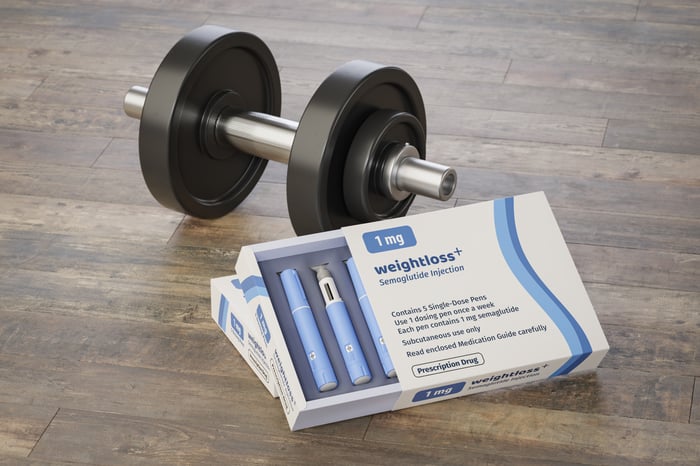
Source: Getty Images.
As you might expect, the competition to win a share of the expanding GLP-1 market is fierce right now, with giants Novo Nordisk (NYSE: NVO) and Eli Lilly (NYSE: LLY) slugging it out, while Pfizer (NYSE: PFE) is looking to enter the fray.
Novo Nordisk makes a GLP-1 drug called semaglutide, which it sells as Wegovy for weight loss and Ozempic for type 2 diabetes. Third-quarter sales of Wegovy were about $3.1 billion, 18% higher than a year ago, while Ozempic sales climbed 9% to $4.7 billion. Last year, Denmark-based Novo Nordisk became Europe's largest company by market capitalization due to the growth of its blockbuster drugs.
The world's best-selling drug
Eli Lilly manufactures a GLP-1 drug called tirzepatide, which it sells as Mounjaro for type 2 diabetes and Zepbound for weight loss. Tirzepatide became the world's best-selling drug in the third quarter. With year-to-date sales of $24.8 billion in the period, it surpassed Keytruda, a blockbuster immunotherapy drug made by Merck.
And Pfizer is now getting into the weight-loss market. In September, it announced it would try to acquire Metsera, a next-generation clinical-stage biopharmaceutical company that's developing several obesity treatments. The price of the acquisition was expected to be $4.9 billion.
Yet that deal is suddenly under question, as Novo Nordisk this month said it is also bidding on Metsera. So a battle to acquire the start-up is now underway.
And Novo's share price is under pressure due to several factors. On Nov. 5, it announced third-quarter results, and they did not impress the market. Earnings per share of 4.5 Danish krone ($0.70) on revenue of $11.6 billion missed expectations of $0.77 a share on sales of $11.8 billion.
Worse, the company lowered its outlook for the 2025 full year. Growth in sales and operating profit is now expected to be 4 and 6 percentage points lower, respectively. The company said the narrowing of the guidance ranges reflects lowered growth expectations for Novo Nordisk's GLP-1 treatments within diabetes and obesity.
A deal with Trump
Both Eli Lilly and Novo Nordisk may gain access to more U.S. patients in the coming months after each company struck a deal with the Trump administration this week to significantly cut prices for their anti-obesity drugs for Medicare and Medicaid patients in exchange for a three-year grace period from tariffs.
The companies must provide their drugs at much lower costs -- Zepbound's price for these patients will drop from $1,000 to $299 for a month's supply -- but they will have greater access to Medicare payments. Medicare is the single largest payer for U.S. health services, so access to its patients could be an enormous boon for the drugmakers.
Novo Nordisk's share price is down 46% so far this year, and Pfizer is down 6%, while Eli Lilly's stock is up 21% on its rising fortunes and market share.
The three companies will continue to jockey for position, though Eli Lilly and Novo Nordisk have a head start while Pfizer is rushing to catch up. For investors looking to profit from the rapid expansion of the GLP-1 market over the coming months and years, Eli Lilly looks like the best bet at the moment.
Should you invest $1,000 in Eli Lilly right now?
Before you buy stock in Eli Lilly, consider this:
The Motley Fool Stock Advisor analyst team just identified what they believe are the 10 best stocks for investors to buy now… and Eli Lilly wasn’t one of them. The 10 stocks that made the cut could produce monster returns in the coming years.
Consider when Netflix made this list on December 17, 2004... if you invested $1,000 at the time of our recommendation, you’d have $595,194!* Or when Nvidia made this list on April 15, 2005... if you invested $1,000 at the time of our recommendation, you’d have $1,153,334!*
Now, it’s worth noting Stock Advisor’s total average return is 1,036% — a market-crushing outperformance compared to 191% for the S&P 500. Don’t miss out on the latest top 10 list, available when you join Stock Advisor.
See the 10 stocks »
*Stock Advisor returns as of November 10, 2025
Matthew Benjamin has positions in Novo Nordisk. The Motley Fool has positions in and recommends Merck and Pfizer. The Motley Fool recommends Novo Nordisk. The Motley Fool has a disclosure policy.
Recommended Articles


