


US August Nonfarm Payrolls expected to rebound to 58K after July slump
- US Nonfarm Payrolls are expected to rise by 58K in August, following July’s negative print.
- The Unemployment Rate is forecast to hold steady at 4.1%.
- US employment data could influence the market pricing of a potential Fed interest rate hike in September.
The United States (US) Bureau of Labor Statistics (BLS) is set to release the Nonfarm Payrolls (NFP) data for August on Friday at 12:30 GMT.
With investors leaning toward a Federal Reserve (Fed) interest rate hike in September amid persistent uncertainty surrounding the inflation outlook, the underlying details of the employment report could influence how markets assess the US central bank’s policy outlook and drive the US Dollar’s (USD) valuation.
What to expect from the Nonfarm Payrolls report?
Investors expect NFP to rise by 58K in August following July’s unexpected print of -23K. The Unemployment Rate is seen holding steady at 4.1%, while annual wage inflation, as measured by the change in Average Hourly Earnings (AHE), is projected to soften to 3% from 3.2%.
Nevertheless, the underlying details of the July employment report suggested that the labor market conditions were not as dire as they seemed initially because a majority of job losses were concentrated in government positions, especially in education due to seasonal variations in academic contracts and summer staffing shifts, and the leisure and hospitality sector.
According to TD Securities, August payrolls are expected to show a recovery, with the bank forecasting that "August NFP [will] rebound to 95k after July posted a decline of 23k." The team cautions that "risks to our payrolls forecasts appear hawkish, and we would not rule out an outsized positive surprise," suggesting the balance of risks is tilted toward stronger-than-expected hiring. At the same time, TD looks for labour market conditions to remain broadly unchanged, noting that "the Unemployment Rate rate likely went sideways at 4.1% with balanced risks."
How will the US August Nonfarm Payrolls affect EUR/USD?
While delivering his opening remarks at the Jackson Hole Symposium earlier this month, Fed Chair Kevin Warsh delivered a hawkish message, causing markets to reassess the probability of an interest rate hike in September. According to the CME FedWatch Tool, markets are currently pricing in about a 60% chance of a 25 bps rate hike on September 16, compared to 35% before Fed Chair Warsh’s speech.
Warsh’s insistence that the Fed must be “confident underlying inflation is moving to objective, or we have work to do,” alongside comments that it is “hard-pressed” to call financial conditions restrictive and that recent disinflation has not “meaningfully changed” underlying trends, pointed to a bias against rapid easing even as growth, consumer spending, and business investment remain solid. Overall, the tone reinforced a firm 2% PCE target and signals that resilient activity and loose credit conditions could keep the Fed cautious about cutting rates too soon, a configuration typically supportive of the US Dollar on a relative policy basis.
Hence, a significant negative surprise, with an NFP print below 10K, could cause investors to second-guess a Fed hike in September, even more so if there is an increase in the Unemployment Rate. In this scenario, the USD could come under renewed selling pressure heading into the weekend and allow EUR/USD to gather bullish momentum. Conversely, an NFP reading above 40K could be seen as ‘good enough’ for the Fed to keep its focus on taming inflation and support the USD.
Strategists at BNY Mellon stress that Friday’s US NFP report is now “the key release for rates, FX, and risk assets.” They note that “after last month’s soft employment print, another weak number could temper the hawkish repricing that followed Jackson Hole.” By contrast, BNY Mellon argues that “a firmer print would validate Warsh’s message that the Fed’s focus should be on the inflation side of the mandate,” reinforcing the recent shift in market expectations for the Dollar and the policy path.
However, TD Securities takes a more cautious view, arguing that a robust US jobs report alone is unlikely to shift the Fed’s near-term policy stance. The bank notes that “a strong payrolls report is a necessary but not a sufficient condition for the Fed to hike in September,” stressing that “the more important piece of the puzzle is inflation as part of the strength in the NFP can be considered to be a reversal of the July weakness.”
“In the case of a +40-50k upward payrolls surprise to consensus median as we expect, historical sensitivity and current positioning would suggest +0.2% knee-jerk USD reaction on the day,” they add.
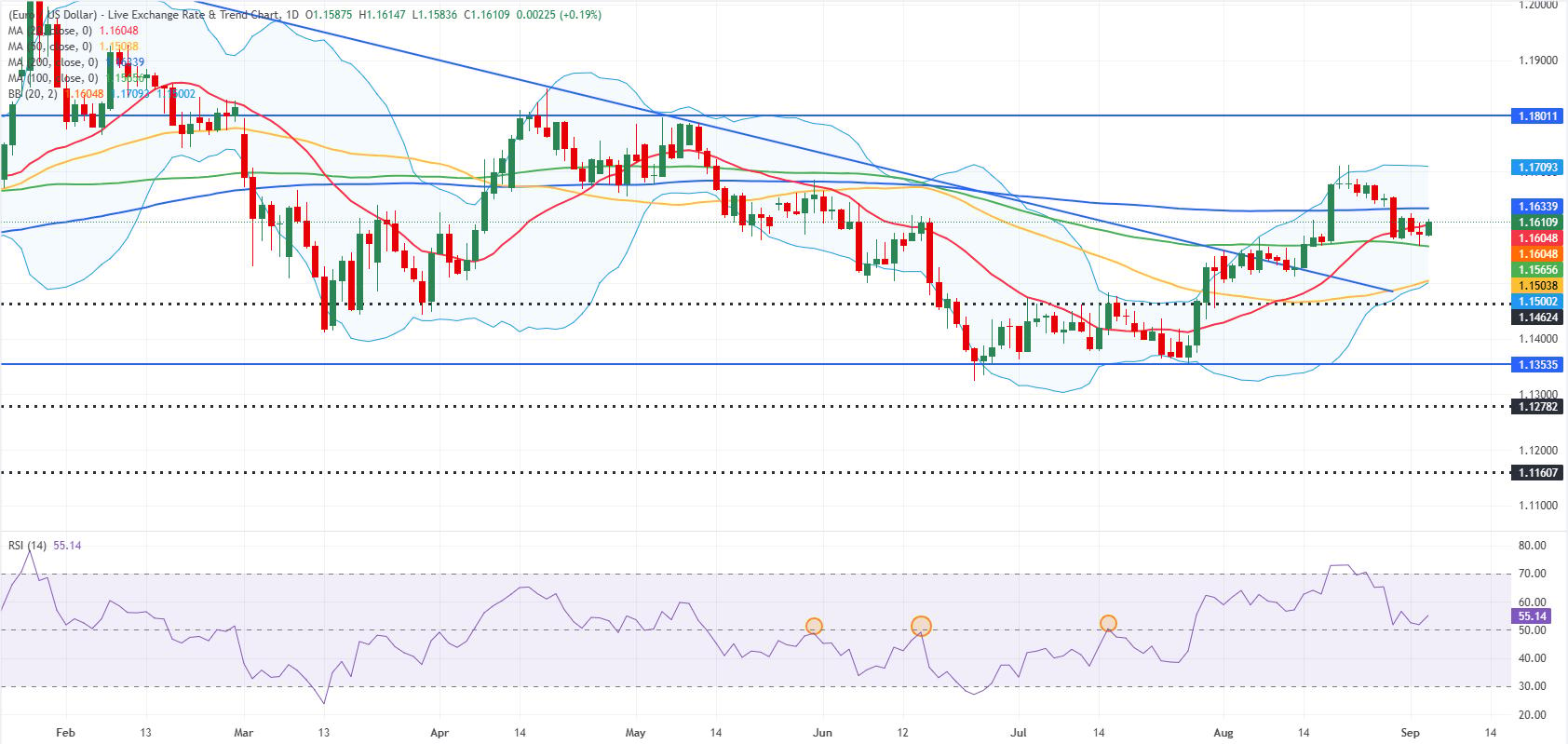
Eren Sengezer, European Session Lead Analyst at FXStreet, offers a brief technical outlook for EUR/USD:
“EUR/USD’s near-term technical outlook points to a slightly bullish stance but doesn’t highlight a buildup in momentum. The pair fluctuates near the middle line of the Bollinger Band and the Relative Strength Index (RSI) stays mostly flat slightly above 50 on the daily chart.”
“On the upside, the 200-day Simple Moving Average (SMA) aligns as a key resistance level at 1.1635 ahead of 1.1710 (upper line of the Bollinger Band) and 1.1800 (static level). Looking south, support levels could be spotted at 1.1560 (100-day SMA), 1.1500 (static level, 50-day SMA) and 1.1350 (static level).”
Employment FAQs
Labor market conditions are a key element to assess the health of an economy and thus a key driver for currency valuation. High employment, or low unemployment, has positive implications for consumer spending and thus economic growth, boosting the value of the local currency. Moreover, a very tight labor market – a situation in which there is a shortage of workers to fill open positions – can also have implications on inflation levels and thus monetary policy as low labor supply and high demand leads to higher wages.
The pace at which salaries are growing in an economy is key for policymakers. High wage growth means that households have more money to spend, usually leading to price increases in consumer goods. In contrast to more volatile sources of inflation such as energy prices, wage growth is seen as a key component of underlying and persisting inflation as salary increases are unlikely to be undone. Central banks around the world pay close attention to wage growth data when deciding on monetary policy.
The weight that each central bank assigns to labor market conditions depends on its objectives. Some central banks explicitly have mandates related to the labor market beyond controlling inflation levels. The US Federal Reserve (Fed), for example, has the dual mandate of promoting maximum employment and stable prices. Meanwhile, the European Central Bank’s (ECB) sole mandate is to keep inflation under control. Still, and despite whatever mandates they have, labor market conditions are an important factor for policymakers given its significance as a gauge of the health of the economy and their direct relationship to inflation.
Recommended Articles


