


Dow Jones Industrial Average knocks lower as tariffs come into effect
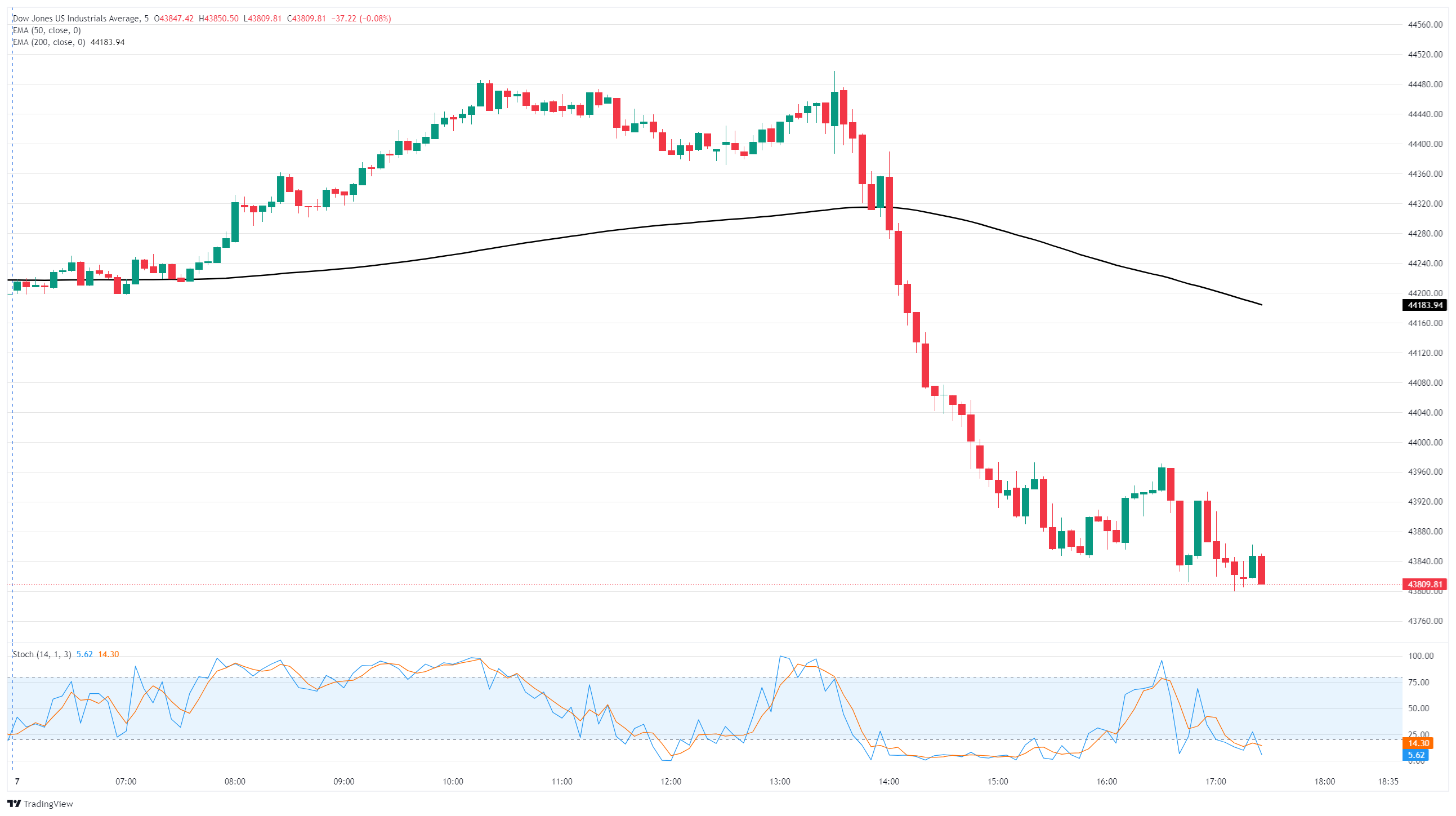
- The Dow Jones fell around 400 points on Thursday, buckling as tariffs weigh on key companies.
- Despite targeted declines in critical stocks, markets are generally brushing off Trump’s tariffs.
- Reciprocal tariffs, which were initially announced in early April, appear to have finally come into effect.
The Dow Jones Industrial Average (DJIA) softened on Thursday, slipping back below 44,000 as freshly minted tariffs weigh on growth prospects for key companies listed on the major blue-chip index. United States (US) President Donald Trump appears to have finally muscled his “reciprocal” tariff bundle over the finish line, with steep import taxes imposed on virtually all goods imported into the US.
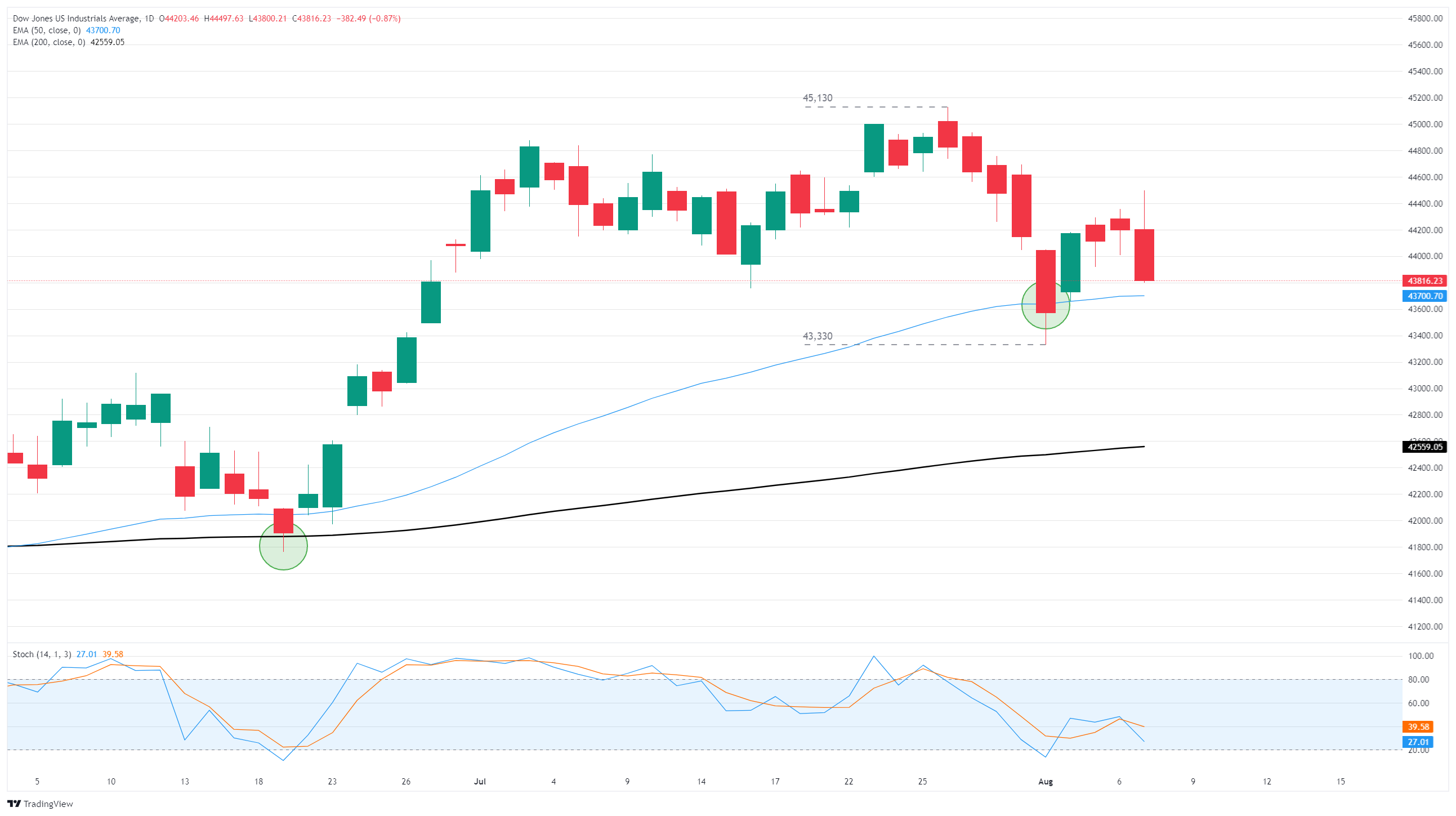
The Dow Jones is headed back into bearish momentum with the index testing down 3% from record highs above 44,130 posted just last week. The Dow is set for another challenge of the 50-day Exponential Moving Average (EMA) near 43,600 after catching a technical bounce from the key moving average last Friday, with intraday flows flubbing a topside push for the 44,500 level.
Tariffs kick off, but losses remain contained in key stocks
Global markets are largely shrugging off President Trump’s package of reciprocal tariffs that went into effect Thursday morning, with the majority of market participants expecting that another deferment will be found. Despite an overall upbeat investor outlook for day one of global tariffs, risk factors from steep import taxes are piling up on Caterpillar (CAT), which fell 3% after the company warned that tariffs will continue to eat the company alive. Caterpillar’s Q2 operating profit tumbled 18% compared to the same quarter in the previous year, matching similar declines in the industrial sector, and highlighting that comparatively limited tariffs up to this point are already having large impacts in key industries.
US weekly Initial Jobless Claims ticked up to 226K, accelerating over the forecast increase to 221K. Nonfarm Productivity also rose more than expected in the second quarter, climbing 2.4% QoQ compared to the expected 1.9% upswing. Coming up on Friday, University of Michigan (UoM) Consumer Inflation Expectations will round out the week’s data docket.
Read more stock news: Apple stock continues advance after Wednesday's $100 billion announcement
Dow Jones 5-minute chart
Dow Jones daily chart
Dow Jones FAQs
The Dow Jones Industrial Average, one of the oldest stock market indices in the world, is compiled of the 30 most traded stocks in the US. The index is price-weighted rather than weighted by capitalization. It is calculated by summing the prices of the constituent stocks and dividing them by a factor, currently 0.152. The index was founded by Charles Dow, who also founded the Wall Street Journal. In later years it has been criticized for not being broadly representative enough because it only tracks 30 conglomerates, unlike broader indices such as the S&P 500.
Many different factors drive the Dow Jones Industrial Average (DJIA). The aggregate performance of the component companies revealed in quarterly company earnings reports is the main one. US and global macroeconomic data also contributes as it impacts on investor sentiment. The level of interest rates, set by the Federal Reserve (Fed), also influences the DJIA as it affects the cost of credit, on which many corporations are heavily reliant. Therefore, inflation can be a major driver as well as other metrics which impact the Fed decisions.
Dow Theory is a method for identifying the primary trend of the stock market developed by Charles Dow. A key step is to compare the direction of the Dow Jones Industrial Average (DJIA) and the Dow Jones Transportation Average (DJTA) and only follow trends where both are moving in the same direction. Volume is a confirmatory criteria. The theory uses elements of peak and trough analysis. Dow’s theory posits three trend phases: accumulation, when smart money starts buying or selling; public participation, when the wider public joins in; and distribution, when the smart money exits.
There are a number of ways to trade the DJIA. One is to use ETFs which allow investors to trade the DJIA as a single security, rather than having to buy shares in all 30 constituent companies. A leading example is the SPDR Dow Jones Industrial Average ETF (DIA). DJIA futures contracts enable traders to speculate on the future value of the index and Options provide the right, but not the obligation, to buy or sell the index at a predetermined price in the future. Mutual funds enable investors to buy a share of a diversified portfolio of DJIA stocks thus providing exposure to the overall index.
Recommended Articles


