


Raoul Pal: Bitcoin Could Hit $450,000 In Liquidity-Driven Supercycle
At Sui Basecamp, macro investor and Real Vision co-founder Raoul Pal delivered a characteristically sweeping address that framed the current crypto market environment as the beginning of what he called a “liquidity-driven supercycle” — with Bitcoin potentially reaching $450,000 before the end of it. Drawing from over three decades of macroeconomic research, Pal outlined his thesis through the lens of what he terms the “Everything Code,” a framework that centers on global liquidity, debt cycles, and currency debasement as the core forces shaping asset prices across all markets.
Why $450,000 Bitcoin Is Possible?
“Bitcoin’s year-on-year rate of change is driven by financial conditions with a three-month lag,” said Pal, pointing to the remarkably consistent correlation between total global liquidity and the price action of major assets. “The correlation between Bitcoin and global liquidity is 90%, and with the Nasdaq, it’s 95%. It’s hard to refute that this is not what is happening.” According to Pal, this correlation is not incidental — it is structurally tied to how the modern macro system operates, especially in a post-2008 world characterized by chronic debt overhang and systematic liquidity injections.
Pal emphasized that most people misunderstand the true driver of crypto cycles. “Everyone talks about the halving, but this is about the debt refi cycle. Every four years, global debt rolls over, and central banks are forced to pump liquidity to avoid systemic collapse.” He added that the average maturity of global debt is four years, concentrated in the three- to five-year sector, which naturally produces cyclical liquidity waves that coincide with market booms in crypto.
The mechanism, Pal argued, is a global financial shell game: “Scarce assets keep going up in price — real estate, equities, art, gold. Young people can’t afford them. What’s actually happening is a global taxation of 8% a year you don’t understand. Add in another 3% global inflation, and you’re looking at 11% debasement.” In this context, Bitcoin — with its fixed supply and decentralized nature — becomes, in Pal’s view, a rational escape valve for capital.
Notably, Pal referred to Bitcoin as the single best-performing asset in all of financial history, citing a 27.5 million percent return since 2012 and an average annualized return of 130%, despite massive drawdowns. “Nothing has ever come close,” he said, before comparing its performance to that of Ethereum (113%) and Solana (142%), with the caveat that Solana’s data covers a shorter timeframe.
While some of his statements may appear hyperbolic, Pal backed them with a detailed macro analysis and time-tested indicators. He invoked his use of Demark indicators — a technical analysis tool — which flagged significant market turning points in prior cycles, and are now suggesting a breakout continuation for Bitcoin.
According to his models, should the ISM (Institute for Supply Management) Manufacturing Index reach a level of 57, Bitcoin could be fairly priced at $450,000. “Is it exact? No. But all the people who are saying it’s going to $150K or $250K are probably scarred from the last cycle,” Pal argued, stressing the importance of forward-looking data.
He also dismissed current bearish sentiment as misguided and backward-looking: “People are creating narratives for today to explain liquidity conditions from three months ago,” he said, criticizing popular economic commentary on platforms like X. To Pal, the market has already priced in recent economic weakness — including fears surrounding tariffs, the slowing economy, and geopolitical tensions — and is beginning to pivot toward the next liquidity expansion phase. “Bitcoin’s already priced it down to 47.4 on the business cycle indicator,” he said, referencing data that had only just come out the day before. “But financial conditions lead by nine months, and they’re turning.”
When Will BTC Peak?
Pal’s broader view is that we are now entering “the banana zone,” his term for the high-velocity portion of the crypto cycle where prices move sharply upward. “Every cycle looks the same. Breakout, retest, banana zone. We’ve had banana one, the corrective zone, banana two. What’s next is banana three.” He believes the current setup is unusually strong due to a confluence of factors: synchronized global liquidity expansion, a weakening dollar, central banks beginning to ease, and retail plus institutional underexposure to risk assets.
As he concluded his speech, Pal reinforced his thesis with urgency but caution: “We’ve got the central banks debasing currency, giving us a gigantic tailwind. They don’t want the system to break. Every time something happens, they inject more liquidity. They’re giving you free money. And to take that money, you need the volatility.” He warned against overtrading, using leverage, or panicking during inevitable corrections. “Don’t f*** this up,” he said, referencing his own past mistakes during the 2017 bull run. “Hold on to your tokens. Be careful. Don’t get FOMO. Follow the liquidity.”
Pal expects this cycle to extend potentially into Q1 or Q2 of 2026, especially if political dynamics around a possible Trump re-election push the liquidity cycle even further. Whether Bitcoin ultimately reaches $450,000 remains to be seen, but Pal’s thesis is clear: the macro tailwinds are aligned, the data supports it, and this may be — as he puts it — “the greatest macro opportunity of all time.”
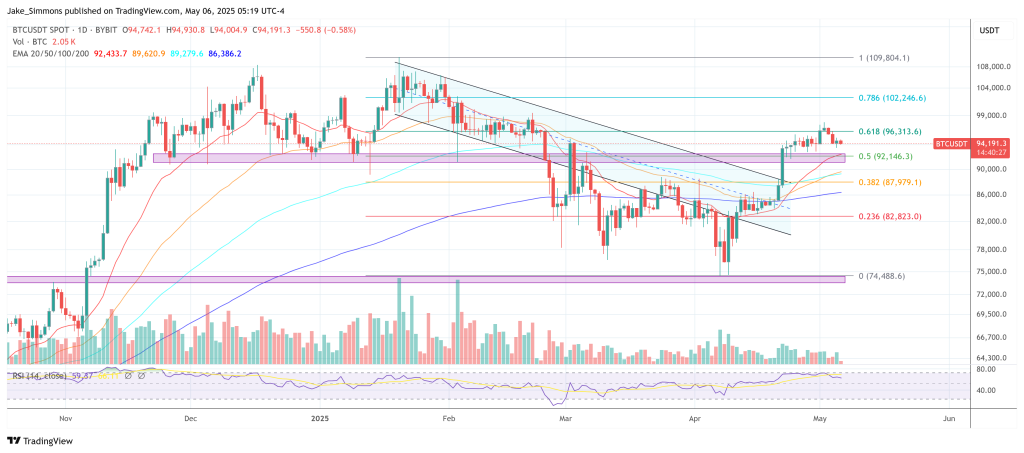
At press time, BTC traded at $94,191.
Recommended Articles


