

Bitcoin $100,000 Rejection Triggers Sell-Off – Key Support In Sight

Source Newsbtc

Bitcoin attempt to sustain momentum above the highly anticipated $100,000 mark has faced stiff resistance, leading to a sharp pullback. Its rejection at this psychological level has fueled bearish pressure, pushing BTC into a corrective phase as sellers take control. Now, all attention turns to key support zones that could determine whether Bitcoin stabilizes or extends its decline.

BTC might see a strong rebound if buyers step in at critical support levels, reigniting bullish momentum. However, a failure to hold above these zones may open the door for further downside, potentially testing lower price levels. As uncertainty looms, Bitcoin’s next move will be pivotal in shaping its short-term trend. 

Bearish Pressure Mounts As Bitcoin Struggles To Hold Gains

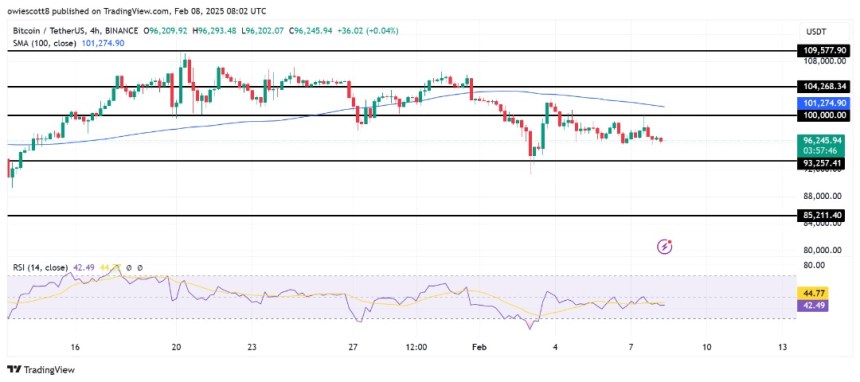
Bitcoin is currently experiencing strong bearish pressure, approaching the $93,257 level while trading below the 100-day Simple Moving Average (SMA). This downward move reflects weakening momentum as sellers continue to dominate price action. Its inability to break above the $100,000 mark and reclaim the 100-day SMA suggests that BTC may remain vulnerable to further declines unless buyers step in at key support levels.

The downward movement suggests a shift in market sentiment, with declining bullish strength and increased volatility. If Bitcoin fails to stabilize near $93,257, it could open the door for more downtrend, testing lower support levels. However, a strong defense by buyers at this range would signal a reversal attempt, offering a chance for Bitcoin to reclaim lost ground and regain its uptrend.
Bitcoin

Furthermore, Bitcoin’s Relative Strength Index (RSI) is also gaining bearish traction declining from the neutral territory toward the oversold zone. This shift suggests weakening buying pressure, allowing sellers to dictate price action. A continued drop in the RSI could reinforce the downward trend, signaling the potential for further declines if bearish sentiment persists.

Nonetheless, if the RSI approaches oversold conditions, it may indicate that Bitcoin is nearing a point of exhaustion, where buyers could step in to trigger a short-term rebound. The next few trading sessions will be crucial in determining whether Bitcoin finds support or extends its decline under mounting bearish pressure.

What’s Next For Bitcoin? Critical Levels To Watch

Bitcoin’s recent rejection at $100,000 has put key support levels in the spotlight as bearish pressure intensifies. The $93,257 level now serves as a crucial test—holding above it is likely to signal a possible bounce, while a breakdown may accelerate losses toward lower support zones.

Should the price drop below the crucial $93,257 support level, bearish momentum could accelerate, increasing the likelihood of a deeper correction. Such a breakdown may trigger further selling pressure, pushing Bitcoin toward the next key support zone at $85,211. 

However, if Bitcoin holds above the $93,257 support level, it could trigger a rebound toward the $100,000 mark. A breakout above this key resistance bolsters upside movement, paving the way for gains.

Bitcoin
Disclaimer: For information purposes only. Past performance is not indicative of future results.
placeholder
Bitcoin CME gaps at $35,000, $27,000 and $21,000, which one gets filled first?Prioritize filling the $27,000 gap and even try higher.
Author  FXStreet
Aug 22, 2023
Prioritize filling the $27,000 gap and even try higher.
placeholder
Bitcoin briefly loses 2025 gains as crypto plunges over the weekend.Bitcoin experienced a sharp decline this weekend, briefly erasing its 2025 gains and dipping below its year-opening value of $93,507. The cryptocurrency fell to a low of $93,029 on Sunday, representing a 25% drop from its all-time high in October. Although it has rebounded slightly to around $94,209, the pressures on the market remain significant. The downturn occurred despite the reopening of the U.S. government on Thursday, which many had hoped would provide essential support for crypto markets. This year initially appeared promising for cryptocurrencies, particularly after the inauguration of President Donald Trump, who has established the most pro-crypto administration thus far. However, ongoing political tensions—including Trump's tariff strategies and the recent government shutdown, lasting a historic 43 days—have contributed to several rapid price pullbacks for Bitcoin throughout the year. Market dynamics are also being influenced by Bitcoin whales—investors holding large amounts of Bitcoin—who have been offloading portions of their assets, consequently stalling price rallies even as positive regulatory developments emerge. Despite these sell-offs, analysts from Glassnode argue that this behavior aligns with typical patterns seen among long-term investors during the concluding stages of bull markets, suggesting it is not indicative of a mass exodus. Notably, Bitcoin is not alone in its struggles, as Ethereum and Solana have also recorded declines of 7.95% and 28.3%, respectively, since the start of the year, while numerous altcoins have faced even steeper losses. Looking ahead, questions linger regarding the viability of the four-year cycle thesis, particularly given the increasing institutional support and regulatory frameworks now in place in the crypto landscape. Matt Hougan, chief investment officer at Bitwise, remains optimistic, suggesting a potential Bitcoin resurgence in 2026 driven by the “debasement trade” thesis and a broader trend toward increased adoption of stablecoins, tokenization, and decentralized finance. Hougan emphasized the soundness of the underlying fundamentals, pointing to a positive outlook for the sector in the longer term.
Author  Mitrade
Nov 17, 2025
Bitcoin experienced a sharp decline this weekend, briefly erasing its 2025 gains and dipping below its year-opening value of $93,507. The cryptocurrency fell to a low of $93,029 on Sunday, representing a 25% drop from its all-time high in October. Although it has rebounded slightly to around $94,209, the pressures on the market remain significant. The downturn occurred despite the reopening of the U.S. government on Thursday, which many had hoped would provide essential support for crypto markets. This year initially appeared promising for cryptocurrencies, particularly after the inauguration of President Donald Trump, who has established the most pro-crypto administration thus far. However, ongoing political tensions—including Trump's tariff strategies and the recent government shutdown, lasting a historic 43 days—have contributed to several rapid price pullbacks for Bitcoin throughout the year. Market dynamics are also being influenced by Bitcoin whales—investors holding large amounts of Bitcoin—who have been offloading portions of their assets, consequently stalling price rallies even as positive regulatory developments emerge. Despite these sell-offs, analysts from Glassnode argue that this behavior aligns with typical patterns seen among long-term investors during the concluding stages of bull markets, suggesting it is not indicative of a mass exodus. Notably, Bitcoin is not alone in its struggles, as Ethereum and Solana have also recorded declines of 7.95% and 28.3%, respectively, since the start of the year, while numerous altcoins have faced even steeper losses. Looking ahead, questions linger regarding the viability of the four-year cycle thesis, particularly given the increasing institutional support and regulatory frameworks now in place in the crypto landscape. Matt Hougan, chief investment officer at Bitwise, remains optimistic, suggesting a potential Bitcoin resurgence in 2026 driven by the “debasement trade” thesis and a broader trend toward increased adoption of stablecoins, tokenization, and decentralized finance. Hougan emphasized the soundness of the underlying fundamentals, pointing to a positive outlook for the sector in the longer term.
placeholder
ECB Policy Outlook for 2026: What It Could Mean for the Euro’s Next MoveWith the ECB likely holding rates steady at 2.15% and the Fed potentially extending cuts into 2026, EUR/USD may test 1.20 if Eurozone growth proves resilient, but weaker growth and an ECB pivot could pull the pair back toward 1.13 and potentially 1.10.
Author  Mitrade
Dec 26, 2025
With the ECB likely holding rates steady at 2.15% and the Fed potentially extending cuts into 2026, EUR/USD may test 1.20 if Eurozone growth proves resilient, but weaker growth and an ECB pivot could pull the pair back toward 1.13 and potentially 1.10.
placeholder
Gold Price Forecast: XAU/USD opens lower around $4,450 on fears of widening Iran conflictsGold price (XAU/USD) opens over 1% lower to near $4,445.00 on Monday, as oil prices have rallied further on fears of further widening of conflicts in the Middle East. WTI Oil price is up almost 3% above $102.50 in the opening trade, increasing fears of higher inflation expectations globally.
Author  FXStreet
Mar 30, Mon
Gold price (XAU/USD) opens over 1% lower to near $4,445.00 on Monday, as oil prices have rallied further on fears of further widening of conflicts in the Middle East. WTI Oil price is up almost 3% above $102.50 in the opening trade, increasing fears of higher inflation expectations globally.
placeholder
Silver Price Forecast: XAG/USD falls to near $72.00 amid fading safe-haven demandSilver price (XAG/USD) continues to lose ground after registering tiny losses in the previous day, trading around $72.90 during the Asian hours on Thursday. The safe-haven demand for the precious metal fades amid rising optimism over Middle East peace.
Author  FXStreet
Apr 02, Thu
Silver price (XAG/USD) continues to lose ground after registering tiny losses in the previous day, trading around $72.90 during the Asian hours on Thursday. The safe-haven demand for the precious metal fades amid rising optimism over Middle East peace.
goTop
quote