

2024’s top performing layer 1 networks: CoinGecko report

Source Cryptopolitan

Blockchain analytics and crypto price tracking platform Coingecko has released an insight into the performance of Layer 1 (L1) tokens. According to the analysis, L1 tokens have soared by over 7,000% since January, driven by “renewed enthusiasm” in the crypto market post-US elections. 

The report highlights how 2024 saw meteoric rises, sharp declines, and mixed performances for newly launched coins. Crypto investors have witnessed the surge of several tokens, with digital assets like Peanut the Squirrel (PNUT) experiencing price rises of over 5000%. 

Financial analysts believe the cryptocurrency’s recent market bull run was spurred by Donald Trump’s presidential election victory, who vowed to embrace and bolster the use of crypto when he takes office.

Coingecko’s market analysis shows L1 tokens also followed the price rise trend, highlighting how the demand for L1 blockchains surged as platforms for decentralized applications (dApps) and smart contracts grew in popularity among developers.

Layer 1 Mantra, AIOZ, SUI among top-performing coins

According to Coingecko’s research, Mantra (OM) led the L1 token price surge with a staggering 7,035.2% year-to-date (YTD) surge. OM’s success is largely attributed to its partnership with UAE-based Zand Digital Bank, aimed at enabling tokenized real-world assets (RWAs) under Dubai’s Virtual Asset Regulatory Authority (VARA) framework. 

At the time of writing, Mantra is trading at $3.8, which represents a 4% increase in the last 24 hours, and a 15,830% rise from its YTD value.
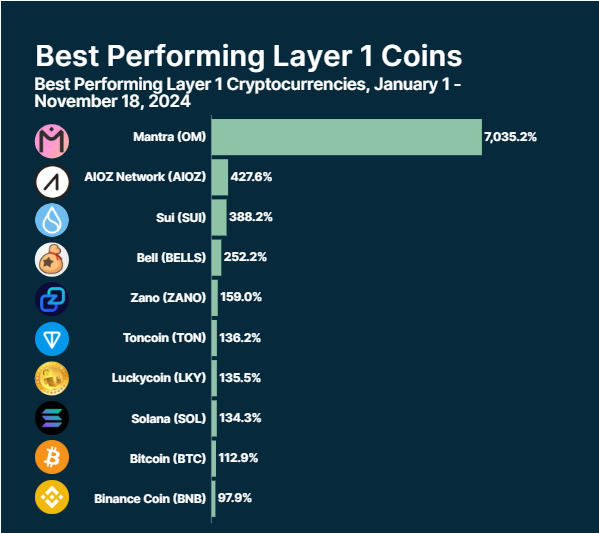
Source: CoinGecko report

AIOZ Network (AIOZ) wasn’t far behind, posting a 427.6% YTD gain thanks to the growing adoption of its decentralized content delivery network. Sui (SUI) secured its spot in the top three with a 388.2% increase. Bellscoin (BELLS), Zano (ZANO), and Toncoin (TON) were also listed in the report among the top performers, respectively.

The year’s biggest declines

On the flip side, Coingecko revealed that several Layer 1 coins faced crushing losses. Entangle (NGL) plummeted by 95.3%, a steep drop attributed to its overvalued launch in March. Kujira (KUJI) and Trias Lab (TRIAS) followed with declines of 86.7% and 83.4%, respectively.

Similar to what the non-fungible token market experienced in 2024, newly launched L1 tokens saw a downward price trend. Coins like Aleo (ALEO) plummeted from their YTD prices by 58.1%, while Saga (SAGA) went down by 69.9%. 

However, Kaia (KAIA) was a rare bright spot, recording a modest 5.2% gain since its October debut. 

Analysts from CryptoQuant emphasized the fierce rivalry within the Layer-1 blockchain sector, noting that many newly launched Layer-1 projects in 2024 faced substantial setbacks. Established Layer-1 protocols continue to leverage their entrenched market positions, but the rapid growth of Layer-2 solutions is raising the bar, making it harder for emerging protocols to carve out a foothold.

Moderate gains for market giants

While mid- and small-cap Layer 1s gave the biggest talking points of the year, larger market-cap coins still delivered respectable returns. Bitcoin (BTC) gained 128.8% YTD, outpacing traditional market indices like the S&P 500, which rose 24.8%. 

Ethereum (ETH), despite its modest 64.6% increase, continued to face challenges from Layer 2s and newer blockchains. According to Coingecko data, ETH is currently changing hands at $3,700, representing a price increase of just over 3% in 24 hours and over 50% in the last month. 

Solana (SOL) bounced back strongly from its FTX-related slump, posting a 278.3% YTD rise, while Binance Coin (BNB) gained 235% within the same period.

A Step-By-Step System To Launching Your Web3 Career and Landing High-Paying Crypto Jobs in 90 Days.

Disclaimer: For information purposes only. Past performance is not indicative of future results.
placeholder
October hike odds climb toward 60% as Goldman and BofA both flip — what Warsh's "dose of accommodation" really changedRate futures now price roughly 55% to 62% for a 25bp hike at the October 27-28 FOMC, up from about 30% before Chair Warsh's post-meeting framing that the Fed is merely "removing some accommodation." Goldman Sachs has added an October hike to its forecast and Bank of America now sees moves in both October and December. Here is the repricing, the language behind it, and the two data points that decide it.
Author  Irene Q.
Sep 23, Wed
Rate futures now price roughly 55% to 62% for a 25bp hike at the October 27-28 FOMC, up from about 30% before Chair Warsh's post-meeting framing that the Fed is merely "removing some accommodation." Goldman Sachs has added an October hike to its forecast and Bank of America now sees moves in both October and December. Here is the repricing, the language behind it, and the two data points that decide it.
placeholder
Four jobs reports in five days: what JOLTS, ADP, claims and the September payrolls mean for the October Fed decisionThe US labour market faces its densest data week of the month. JOLTS job openings land Tuesday (7.2 million expected), ADP on Wednesday (70,000 expected), initial claims on Thursday and the September non-farm payrolls on Friday (100,000 expected, down from 162,000). Markets price a 64%-70% chance of another quarter-point Fed hike on October 28. The dollar index sits at 100.77 and the S&P 500 at 7,729.8.
Author  Mitrade
Sep 28, Mon
The US labour market faces its densest data week of the month. JOLTS job openings land Tuesday (7.2 million expected), ADP on Wednesday (70,000 expected), initial claims on Thursday and the September non-farm payrolls on Friday (100,000 expected, down from 162,000). Markets price a 64%-70% chance of another quarter-point Fed hike on October 28. The dollar index sits at 100.77 and the S&P 500 at 7,729.8.
placeholder
RBA set to hike interest rate to 4.60% in September as inflation remains elevatedThe Reserve Bank of Australia (RBA) is widely expected to raise the Official Cash Rate (OCR) by 25 basis points (bps) to 4.60% from 4.35% on Tuesday, after keeping rates unchanged at its previous two meetings
Author  FXStreet
Yesterday 01: 40
The Reserve Bank of Australia (RBA) is widely expected to raise the Official Cash Rate (OCR) by 25 basis points (bps) to 4.60% from 4.35% on Tuesday, after keeping rates unchanged at its previous two meetings
placeholder
Nvidia's $150 billion buyback landed — and the AI sector fell anyway. That's the signal worth tradingNvidia closed up 1.68% at $228.86 on 28 September after announcing a $150 billion share repurchase authorisation, the largest single corporate buyback on record, while the rest of the AI complex sold off: AMD -3.6%, Micron -2.6%, Meta -4.8% and the Philadelphia Semiconductor Index -1.61%. The divergence is not noise. Capital is rotating toward cash-flow certainty, not abandoning the AI theme. With Micron reporting after the close on 30 September, here is what the split means.
Author  Irene Q.
21 hours ago
Nvidia closed up 1.68% at $228.86 on 28 September after announcing a $150 billion share repurchase authorisation, the largest single corporate buyback on record, while the rest of the AI complex sold off: AMD -3.6%, Micron -2.6%, Meta -4.8% and the Philadelphia Semiconductor Index -1.61%. The divergence is not noise. Capital is rotating toward cash-flow certainty, not abandoning the AI theme. With Micron reporting after the close on 30 September, here is what the split means.
placeholder
The 30-year Treasury just hit a 22-year high — and the bond market is not pricing the Fed, it is pricing the deficitThe 30-year Treasury yield closed at 5.56% on 28 September, the highest since June 2004, while the 10-year reached 5.24% and the 20-year 5.60%. The curve has steepened roughly 30bp in eight sessions even as October hike odds sit at 70.3%. That gap is the story: the long end is repricing fiscal and inflation risk, not policy. With PCE on Wednesday and payrolls on Friday, here is what the long end is really saying.
Author  Irene Q.
20 hours ago
The 30-year Treasury yield closed at 5.56% on 28 September, the highest since June 2004, while the 10-year reached 5.24% and the 20-year 5.60%. The curve has steepened roughly 30bp in eight sessions even as October hike odds sit at 70.3%. That gap is the story: the long end is repricing fiscal and inflation risk, not policy. With PCE on Wednesday and payrolls on Friday, here is what the long end is really saying.
goTop
quote