

El Salvador accepts offers for debt repurchase totaling $940 Million

Source Cryptopolitan

Under President Nayib Bukele’s leadership, El Salvador has made good on financial liberty. On October 4, the El Salvadoran government offered to repurchase its sovereign bonds that are due between 2027 and 2052 at slightly above-market prices and close to par values.

Now, El Salvador has made good on that word. According to a tweet on X from Nayib Bukele, “We’ve just accepted offers for debt repurchase totaling U.S. $940,441,670.83.” 

As part of the official announcement at the start of October, the project is a broader program for El Salvador to manage its external public debt proactively and promote certain conservation and sustainability efforts in El Salvador. 

In the future, El Salvador could repurchase or redeem the Notes not tendered or purchased in the invitation or repurchase or redeem other of its public debt.

According to reports, the principal amount for each holder’s validly tendered Notes accepted for purchase is calculated by multiplying the tendered amount by the approximate proration factor provided by El Salvador and then rounding the result down to the nearest U.S.$1,000. 
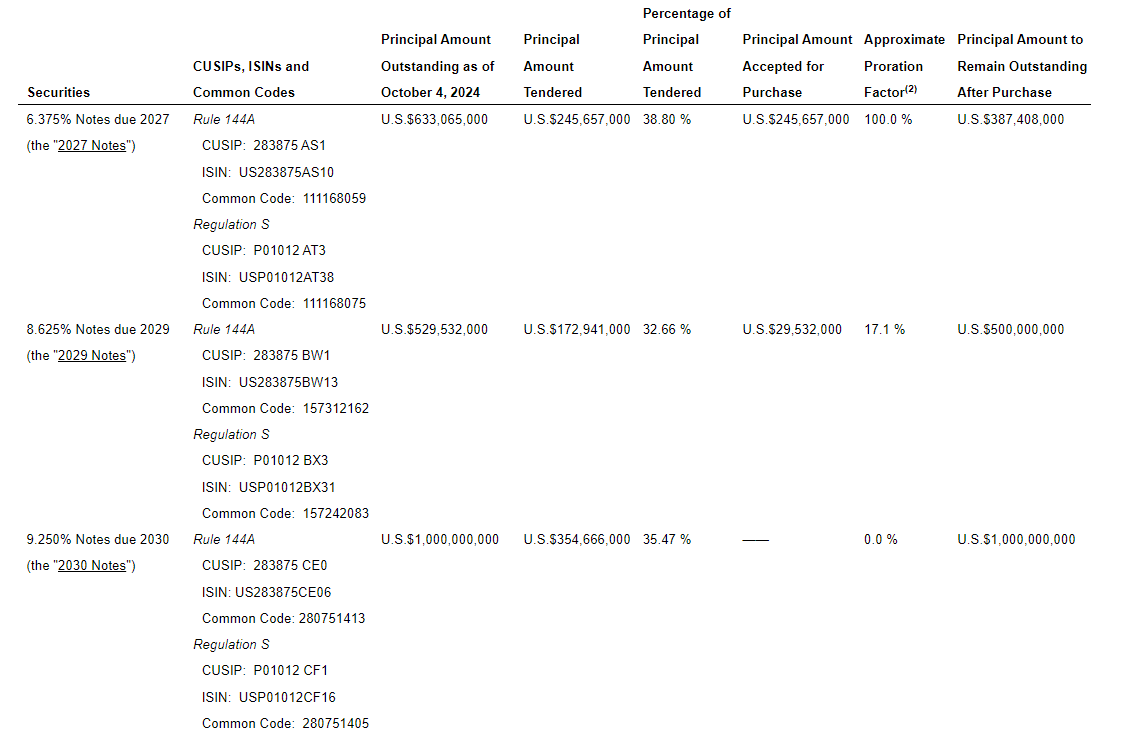
El Salvador accepted tenders of Notes subject to proration, provided that such proration does not lead to (i) the relevant holder transferring Notes to the Republic in a principal amount below U.S.$5,000 for the 2027 and 2029 Notes, below U.S.$10,000 for the 2034 and 2035 Notes, or below U.S.$150,000 for the 2030 Notes, Interest Only Notes, 2041 Notes, 2050 Notes, and 2052 Notes, as applicable.

Also, (ii) the return of Notes in a principal amount less than the applicable minimum denomination to the relevant holder. If proration results in a return of less than the applicable minimum denomination to the holders, the Republic is set to either accept or reject the entire tendered amount.

Bitcoin’s role in El Salvador’s pursuit of financial liberty

According to projections, El Salvador’s national debt is expected to climb by 9.1 billion US dollars between 2024 and 2029 (+30.5 percent). After the tenth straight year of growth, the national debt is expected to reach 38.93 billion US dollars, marking a new peak in 2029.

As defined by the International Monetary Fund, the general government gross debt consists of all liabilities that require payment or payments of interest and/or principal by the debtor to the creditor at a date or dates in the future.

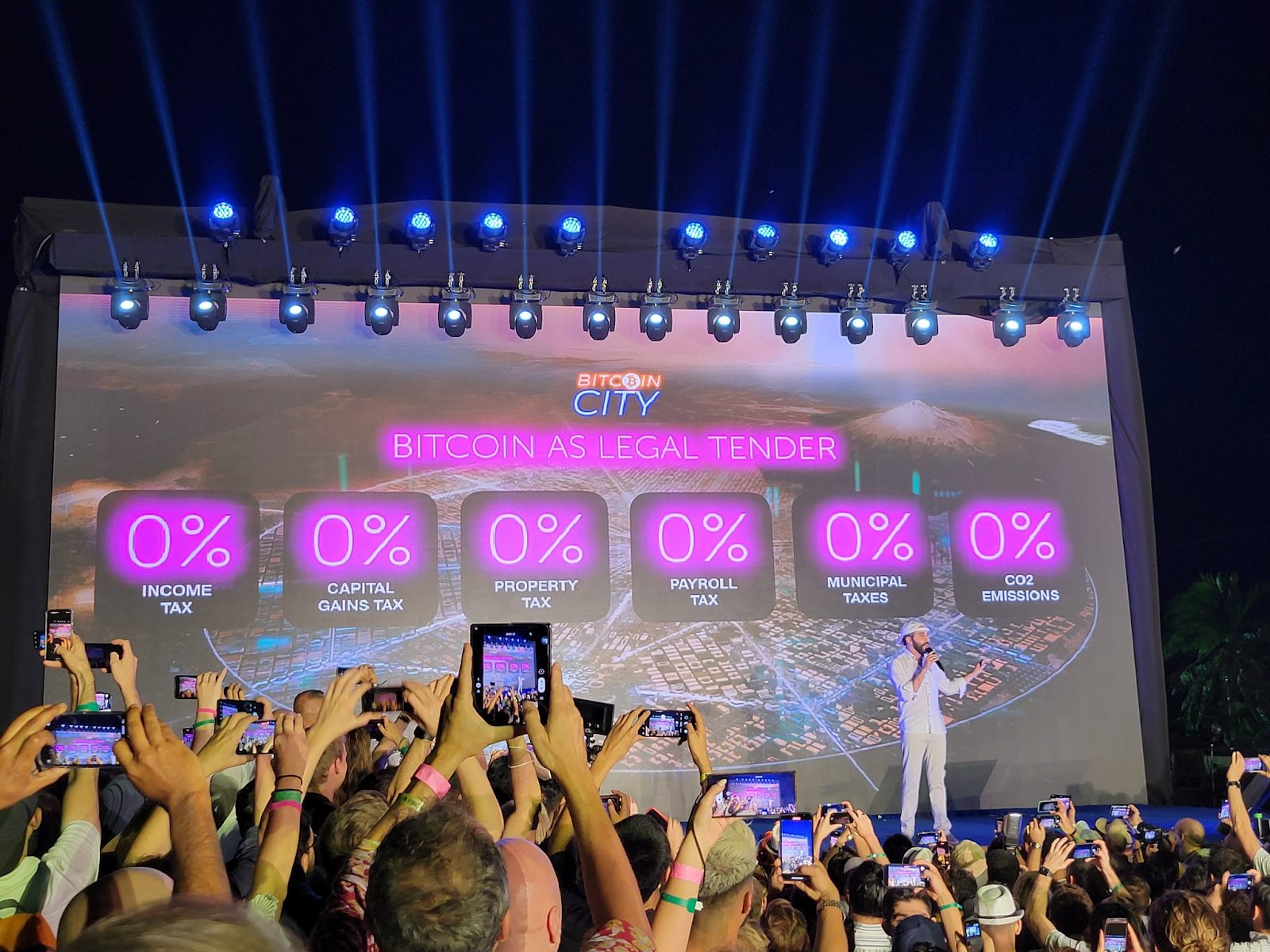
During 2024 El Salvador’s Independence Day, Nayib Bukele said that the nation would no longer rely on loans to maintain national operations. The above initiative follows the nation’s plan of self-sustenance and escaping the IMF’s financial hooks. 
Source: X

El Salvador’s debt stands at $11 trillion. Market analysts believe this will help structure a new wave of investments in the LATAM country. 

In addition, the debt repurchase could positively impact Bitcoin’s price by reinforcing the country’s ability to support its Bitcoin investments and positioning itself as a stronger advocate for the crypto coin.

In May, the nation announced it owns 5,748.76 BTC worth over $361 million at current prices. In 2021, El Salvador became the first country to adopt BTC as legal tender, alongside the U.S. dollar, which it had adopted two decades earlier.

The Bitcoin move earned Nayib’s government harsh criticism for its embrace of the volatile digital asset, including from the International Monetary Fund (IMF).

Disclaimer: For information purposes only. Past performance is not indicative of future results.
placeholder
Gold Price Analysis Today | Forex Gold Analysis | XAU/USD Analysis - November 11, 2026Get the latest gold price analysis, forex gold insights, and XAU/USD analysis for November 11, 2026. Read on for the details.
Author  Mitrade
Nov 11, Wed
Get the latest gold price analysis, forex gold insights, and XAU/USD analysis for November 11, 2026. Read on for the details.
placeholder
Bitcoin lost its 200-day average — but the exit started three sessions before the CPIBitcoin fell 2.5% to about $73,400 on 11 November, an 11-week low, breaking its 200-day moving average near $73,100. The 24-hour liquidation tally reached $632 to $705 million, roughly 82% of it longs. But spot ETF outflows began three sessions earlier and USDT's market cap has shrunk $6.6 billion in 60 days — the leveraged length left before the inflation print did. A double top at 81,890 and 81,080 leaves a measured target of 69,366.
Author  Suzie
Nov 11, Wed
Bitcoin fell 2.5% to about $73,400 on 11 November, an 11-week low, breaking its 200-day moving average near $73,100. The 24-hour liquidation tally reached $632 to $705 million, roughly 82% of it longs. But spot ETF outflows began three sessions earlier and USDT's market cap has shrunk $6.6 billion in 60 days — the leveraged length left before the inflation print did. A double top at 81,890 and 81,080 leaves a measured target of 69,366.
placeholder
Nvidia slid 7.7% after hours while AMD and Broadcom rose — the AI trade changed hands, it didn't breakNvidia closed Wednesday at 173.73, up 2.87%, then fell as much as 8.1% to 159.44 after reports that its board was preparing for a possible leadership change. The same session, the Philadelphia Semiconductor Index rose 5.7% with all 30 components higher, CoreWeave jumped 24.7% on 168% revenue growth, and Micron added 11.9%. If AI demand were being repriced, AMD and Broadcom would not be bid. This is a governance discount on one name, and 204.54 — the 200-day average — is the level that settles it.
Author  Irene Q.
Nov 12, Thu
Nvidia closed Wednesday at 173.73, up 2.87%, then fell as much as 8.1% to 159.44 after reports that its board was preparing for a possible leadership change. The same session, the Philadelphia Semiconductor Index rose 5.7% with all 30 components higher, CoreWeave jumped 24.7% on 168% revenue growth, and Micron added 11.9%. If AI demand were being repriced, AMD and Broadcom would not be bid. This is a governance discount on one name, and 204.54 — the 200-day average — is the level that settles it.
placeholder
Gold hit a one-year low while central banks bought 321 tonnes — the sellers were never the ones you thinkSpot gold closed at 3,876 on Thursday, down 2.8% and its lowest close in more than a year, with an intraday low near 3,852. The dollar is at a 19-month high of 103.21 and the 10-year yield is at 5.10%, so the price move is easy to explain. What is harder to explain is who sold: central banks bought 321 tonnes in Q3, the PBoC added for a 24th straight month, ETF holdings are near a record 4,256 tonnes, and roughly 95% of the futures selling came from non-reportable and sovereign-type accounts rather than hedge funds. This piece separates the two books that have to balance.
Author  Irene Q.
Yesterday 02: 40
Spot gold closed at 3,876 on Thursday, down 2.8% and its lowest close in more than a year, with an intraday low near 3,852. The dollar is at a 19-month high of 103.21 and the 10-year yield is at 5.10%, so the price move is easy to explain. What is harder to explain is who sold: central banks bought 321 tonnes in Q3, the PBoC added for a 24th straight month, ETF holdings are near a record 4,256 tonnes, and roughly 95% of the futures selling came from non-reportable and sovereign-type accounts rather than hedge funds. This piece separates the two books that have to balance.
placeholder
Brent rose 3.3% and US crude stocks built 4.66 million barrels in the same weekBrent January settled at 95.82, up 3.3%, and WTI at 88.74, up 2.55%, after the US signalled it would not pursue a deal with Iran and attacks on Gulf shipping continued. In the same week, EIA data showed US crude inventories rising 4.657 million barrels against expectations of a 1.1 million draw, with gasoline up another 1.799 million. OPEC output also rebounded 1.96 million barrels a day to 27.16 million in October, led by Saudi Arabia at 10.56 million. This piece separates the geopolitical premium from the physical balance and lays out where each side of the trade is anchored.
Author  Irene Q.
Yesterday 03: 06
Brent January settled at 95.82, up 3.3%, and WTI at 88.74, up 2.55%, after the US signalled it would not pursue a deal with Iran and attacks on Gulf shipping continued. In the same week, EIA data showed US crude inventories rising 4.657 million barrels against expectations of a 1.1 million draw, with gasoline up another 1.799 million. OPEC output also rebounded 1.96 million barrels a day to 27.16 million in October, led by Saudi Arabia at 10.56 million. This piece separates the geopolitical premium from the physical balance and lays out where each side of the trade is anchored.
goTop
quote