

Massive Bitcoin Rally Predicted For Next 6 Months After Fed Rate Cut

Source Newsbtc

As the crypto community awaits the Federal Reserve’s (Fed) rate cut announcement on September 18, the stakes are high for Bitcoin (BTC) and the broader financial landscape. This upcoming decision marks the first central bank rate cut since the Fed slashed its key rate to near zero in March 2020 amid the COVID-19 pandemic. 

Will A 50bps Cut Spark A Bitcoin Bull Run?

According to CME Group’s FedWatch tool, markets are currently pricing in a 59% chance of a half-percentage-point rate cut and a 41% chance of a quarter-point cut. There’s an overwhelming expectation that by the end of 2024, the Fed could implement up to 100 basis points in cuts, with nearly 60% odds of 125 basis points. 

This suggests that investors anticipate at least one or two substantial rate cuts in the three remaining Fed meetings of the year, starting with this week’s announcement.

The potential effects of a 50 basis point cut remain hotly debated within the crypto industry. Market expert Crypto Rover argues that such a cut could reignite a bull run for Bitcoin, stating that the conditions could lead to “super bullish” prospects. 

Similarly, analyst Lark Davis recalls how Bitcoin previously surged following past rate cuts, predicting that if history repeats, the next 6-12 months could see significant price increases for the largest cryptocurrency on the market.

Optimism Vs Historical Caution In Crypto Market

In addition to optimism and bullish expectations, other analysts express caution. EmperorBTC predicts an initial market pump following the rate cut, driven by cheaper borrowing costs. 

However, the analyst warns of profit-taking by short-term holders leading to a subsequent market dump, suggesting a “sell the news” scenario that could leave many investors disillusioned before the market stabilizes and resumes growth.

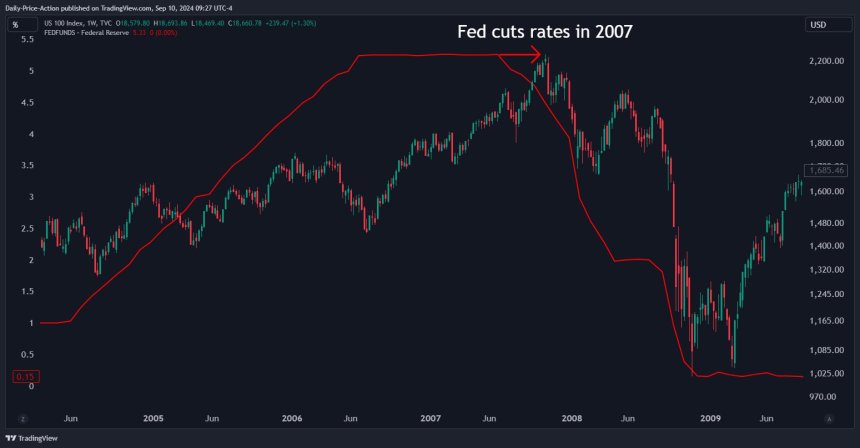
On the other hand, technical analyst Justin Bennett offers a more cautionary historical perspective. He points to the market’s performance during the Fed’s rate cuts in 2007, when the Nasdaq 100 Index retraced significantly after the initial cuts, suggesting that the same pattern could emerge in 2023. 
Bitcoin

Bennett’s analysis suggests that current market conditions may mirror previous downturns, calling into question the optimistic projections shared by some for the broader digital asset market.

In a similar vein, NewsBTC reported on Monday the analysis of crypto strategist Doctor Profit, in which he highlights a divided sentiment in the market regarding the rate cut, with equal chances of a 0.25% or 0.50% reduction. 

However, the analyst is leaning towards the larger cut, arguing that failure to take decisive action could lead to turmoil reminiscent of “Blood Monday” on August 5, when Bitcoin experienced a sharp decline to $48,900.

Bitcoin

Despite the divided sentiment in the market, Bitcoin has jumped from the $57,000 mark traded on Monday to a current price of $61,000, recording a surge of nearly 6% in a matter of hours in anticipation of tomorrow’s announcements.

Featured image from DALL-E, chart from TradingView.com 

Disclaimer: For information purposes only. Past performance is not indicative of future results.
placeholder
The Fed will sit still on October 28 — but 100 of 100 economists now expect a December hikeA Reuters poll run October 16-20 found 94 of 100 economists expecting the Fed to hold at 3.75-4.00% on October 28 — and all 100 expecting a hike in December, against less than half a month earlier. The market is close to the same price, with CME FedWatch at roughly 17% for October and 82.8% for December. With the Fed in blackout since October 17, here are the five dates that decide the rest of the year, what each one is priced for, and the two directions each can take.
Author  Irene Q.
Oct 22, Thu
A Reuters poll run October 16-20 found 94 of 100 economists expecting the Fed to hold at 3.75-4.00% on October 28 — and all 100 expecting a hike in December, against less than half a month earlier. The market is close to the same price, with CME FedWatch at roughly 17% for October and 82.8% for December. With the Fed in blackout since October 17, here are the five dates that decide the rest of the year, what each one is priced for, and the two directions each can take.
placeholder
Big Tech's $800 billion AI bill faces its first real test — free cash flow is the judgeAlphabet and Microsoft report after the close on October 28, Amazon on October 29, with hyperscaler AI capex running near $800 billion a year. Meta's negative free cash flow and 9.40% drop on October 22 was the warning; this week's prints decide whether cloud growth and backlog can pay for the buildout. Here are the consensus numbers, the free-cash-flow table and the two-sided test.
Author  Irene Q.
Oct 26, Mon
Alphabet and Microsoft report after the close on October 28, Amazon on October 29, with hyperscaler AI capex running near $800 billion a year. Meta's negative free cash flow and 9.40% drop on October 22 was the warning; this week's prints decide whether cloud growth and backlog can pay for the buildout. Here are the consensus numbers, the free-cash-flow table and the two-sided test.
placeholder
Anthropic files for a $2 trillion IPO — the $80.7 billion loss is the decoy, the $450 billion compute bill is the riskAnthropic publicly filed its S-1 on October 26, revealing $16.29 billion of first-half revenue (+1,304% year over year) and a $80.7 billion net loss — of which $72.4 billion is a non-cash convertible-note charge. The real number is the $450 billion of signed, mostly non-cancelable compute commitments. Here is what the filing says, why NVDA, ARM and MU are the tradeable read-through, and the conditions that decide whether the AI trade passes its first public valuation test.
Author  Irene Q.
Oct 27, Tue
Anthropic publicly filed its S-1 on October 26, revealing $16.29 billion of first-half revenue (+1,304% year over year) and a $80.7 billion net loss — of which $72.4 billion is a non-cash convertible-note charge. The real number is the $450 billion of signed, mostly non-cancelable compute commitments. Here is what the filing says, why NVDA, ARM and MU are the tradeable read-through, and the conditions that decide whether the AI trade passes its first public valuation test.
placeholder
Fed October Rate Decision Preview: Rate Hike Pause Has Become Consensus, How Will US Stocks, Dollar, and Gold React?The Federal Reserve will announce its October interest rate decision at 14:00 Eastern Time on October 28, and Fed Chair Warsh will hold a press conference at 14:30. Markets currently wide
Author  TradingKey
Oct 27, Tue
The Federal Reserve will announce its October interest rate decision at 14:00 Eastern Time on October 28, and Fed Chair Warsh will hold a press conference at 14:30. Markets currently wide
placeholder
Brent's $115 front month sits $4.6 above January — the $14 spread to WTI is the supply-risk premiumDecember Brent trades at $115.29 while January is $110.71, a $4.58 backwardation. The December Brent-WTI spread is $14.2, versus a $3-5 normal. That gap, not the headline, is where the Middle East supply risk is priced. Here is what the curve says, why the December contract's expiry on October 30 will mechanically cut the headline by $4.6, and the 108.81 neckline that decides the next move.
Author  Irene Q.
20 hours ago
December Brent trades at $115.29 while January is $110.71, a $4.58 backwardation. The December Brent-WTI spread is $14.2, versus a $3-5 normal. That gap, not the headline, is where the Middle East supply risk is priced. Here is what the curve says, why the December contract's expiry on October 30 will mechanically cut the headline by $4.6, and the 108.81 neckline that decides the next move.
goTop
quote