


OpenAI pushes cost-per-task pricing as it expands into chip design and finance
OpenAI is expanding its advanced models into chip design, life sciences, and finance, arguing that a model with a higher upfront cost can pay off by performing a task with fewer tries.
Reuters reported on September 9 that CFO Sarah Friar made this argument at Goldman Sachs’ Communacopia + Technology Conference in San Francisco on September 7.
For businesses trying to decide between high-end and low-cost models, this alters the debate. Instead of asking which model has the lowest token price, OpenAI would like customers to consider which model offers the cheapest completed task.
Chip design as a wedge, not an EDA replacement
OpenAI is not attempting to supplant electronic design automation systems that engineers are currently employing to develop chips. Its solutions, in fact, assist in enhancing those processes by helping the engineers analyze problems, evaluate approaches, and speed up certain jobs.
According to Friar, the demand for AI developed for specific tasks is growing. As has been reported by Reuters, OpenAI is also testing a business model where pricing depends on how effective the AI is for the given company rather than on consumption.
This aligns with the post made by Friar on July 17 that suggested the importance of “Useful Intelligence per Dollar” over token price. While a cheaper model could require several retries and reviews as well as human intervention, an expensive model may prove to be a more cost-effective option as it gets to the result quicker.
Jalapeño as the in-house proof point
The clearest demonstration of OpenAI’s ingenuity is Jalapeño, their very first custom inference chip. The company stated in a post on August 25 that its AI technology facilitated Jalapeño’s transition from the stage of conception to tapeout within only nine months.
Thanks to AI, the cycles of design, measurement, and verification were shortened. AI was also used to improve the performance of the arithmetic circuits and program the finished chip.
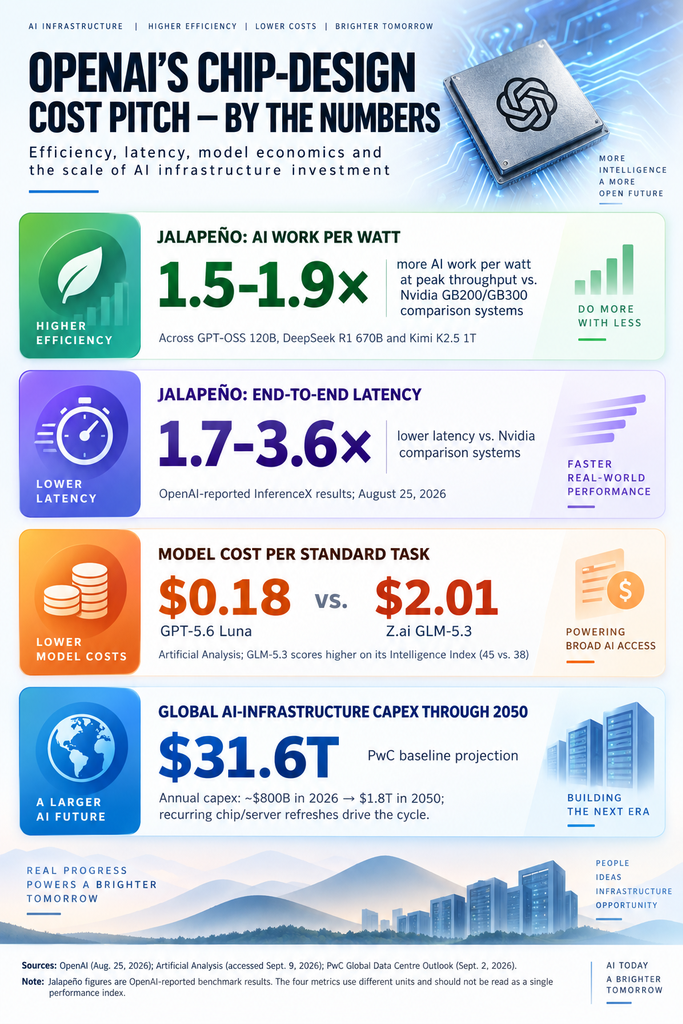
OpenAI claimed that the performance of the Jalapeño chip was 1.5-1.9 times higher when it came to AI work per watt in comparison to Nvidia’s GB200 and GB300 equivalent devices used for performing the calculations by GPT-OSS 120B, DeepSeek R1, and Kimi K2.5.
According to the information provided by Cryptopolitan on August 25, the Broadcom-designed chip is meant strictly for OpenAI’s purposes and not for selling at the market. These statistics are therefore only OpenAI’s numbers. SemiAnalysis observed the InferenceX runs but did not independently reproduce the full test suite.
The cost-per-task argument, checked against outside data
Friar stated that OpenAI’s decision to slash the cost of their lower-tier product Luna has contributed to an almost tenfold growth in its use, as well as increased the number of Codex’s users to 25 million, according to Reuters.
Independent testing provides some evidence for the pricing declaration. Artificial Analysis compares the pricing of GPT-5.6 Luna with Z.ai’s GLM-5.3 and establishes the price of Luna at around $0.18 versus GLM-5.3 at $2.01 for a standard task.
However, this is not exactly a one-sided comparison. GLM-5.3 scored 45 on the Intelligence Index of Artificial Analysis, which gives Luna a score of just 38. Thus, OpenAI has an advantage in pricing per standard task but is not necessarily the best-performing AI.
A field OpenAI is entering late
AI-assisted chip design is already well established. Synopsys says its generative-AI copilot can cut information-retrieval time by 40% and reduce time-to-solution by 10 to 20 times.
Cadence said on June 1 that its autonomous ChipStack AI engineer can reduce some RTL validation cycles from five weeks to less than a day. Google’s AlphaChip has also been used in advanced chips across Alphabet.
OpenAI’s real differentiator, then, is not the claim that AI can help design chips. It is the argument that its proprietary models can do so at a lower cost per successful outcome.
Why the stakes keep climbing
The market behind that argument is enormous. PwC said on September 2 that global AI-infrastructure capital expenditure could reach $31.6 trillion through 2050, with annual spending rising from about $800 billion in 2026 to $1.8 trillion in 2050. Recurring chip and server upgrades are expected to drive much of that spending.
The OECD’s July 10 report on AI markets adds the counterpoint: quality-adjusted AI model prices fell nearly 80% between January 2024 and April 2026, even as compute, chips and other critical inputs remained highly concentrated.
OpenAI is betting that tighter integration across models, software and silicon will turn that concentration into an efficiency advantage. If it succeeds, cost per completed task could matter more than token price—and become another force pushing AI toward full-stack players.
If you're reading this, you’re already ahead. Stay there with our newsletter.
Recommended Articles


