


Lawsuit says Tether locked $42.4 million in USDT months before any warrant existed
Two Thai businessmen are suing Tether in federal court over about $42.4 million of frozen USDT.
The stablecoin issuer froze the tokens last October on nothing more than a verbal request from a US agent, and a seizure warrant obtained almost four months later cannot cure an unlawful freeze, the complaint says.
The blacklist hit ten Ethereum addresses
The lawsuit was filed in the U.S. District Court for the Southern District of New York on August 31. It lists Nutthawat Rukthammachalern and Natthawat Kasamvilas as plaintiffs and four Tether entities as defendants.
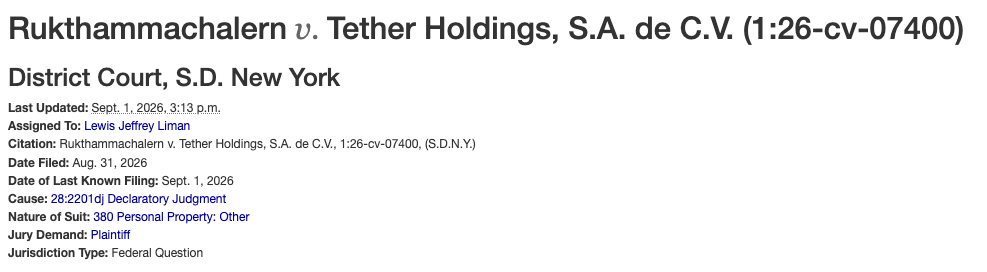
The filing says the tokens were held in ten Ethereum addresses. Nine belong to Rukthammachalern and one to Kasamvilas.
Tether blacklisted those addresses on October 30, 2025, the complaint says. A Homeland Security Investigations agent had unofficially asked for the blacklisting, without a warrant, court order, or notice to the account holders.
A federal magistrate judge in North Carolina did not sign a seizure warrant until February 19, 2026. The complaint stated that the warrant laid out a plan for Tether to burn the frozen USDT, mint an equal amount of new tokens, and transmit them to a government-controlled wallet.
“Tether froze our clients’ funds following an informal government request with no warrant, no court order, no legal process directed to Tether and no notice,” Mark Beckett, counsel for the two men, said.
He added that “a warrant followed nearly four months later.”
Tether, he said, “has no contractual relationship with our clients, is not a custodian of our clients’ USDT, and has no legal right or basis to blacklist our clients’ accounts.”
The lawsuit depicts Tether as a private company acting on its own, separate from any possible government claim. The plaintiffs seek a ruling that the freeze is unlawful, an order forbidding the destruction of the tokens before any final forfeiture ruling, and damages.
They are also seeking the income, the complaint says, that Tether garnered while the funds were frozen.
Reserves keep earning Treasury yield while the accounts sit locked
The complaint says that when Tether mints the stablecoin, it takes in dollars and purchases interest-bearing instruments, mostly US Treasury securities held in New York. These holdings are the reserves.
The plaintiffs contend that freezing a customer’s USDT costs Tether nothing, while it continues to accumulate yield on the corresponding reserves. That hands the company a financial inducement to freeze tokens and burn them.
Tether markets USDT as stable, fully backed, and freely transferable but fails to mention it can block or destroy any holder’s tokens on any blockchain at will, the plaintiffs say.
“The new lawsuit against Tether is a baseless attempt to interfere with Tether’s important work with global law enforcement, including the Department of Justice, to prevent the unlawful use of USDT,” the company said in a statement. The USDT smart contract has the ability to blacklist, which means Tether can flag addresses on blockchains such as Ethereum.
Tether works with over 340 law enforcement organizations across 65 nations, Cryptopolitan reported in April. The company said that cooperation had helped freeze more than $4.4 billion in assets tied to suspected illicit activity.
Don’t just read crypto news. Understand it. Subscribe to our newsletter. It's free.
Recommended Articles


