


Gold rises as speculation of Yen intervention weighs on the US Dollar
- Gold rises as a softer US Dollar offsets firm Treasury yields.
- Yen intervention speculation pressures the Greenback despite resilient yields.
- Iran strike threats keep Oil around $90, sustaining inflation risks.
Gold (XAU/USD) price rises over 1% on Wednesday as the Greenback softens amid speculation of an intervention to bolster the Japanese Yen (JPY), while US Treasury yields hold firm after weak US jobs data. At the time of writing, the XAU/USD pair trades at $4,373.
The Japanese Yen strengthened across the board, raising speculation that Japanese authorities may have intervened in the FX market or conducted a rate check. However, no official confirmation of either action was made.
XAU/USD climbs as softer Dollar offsets firm yields and Iran risks
The yellow metal remains bid as the US 10-year Treasury yield stays near Tuesday’s closing price of 4.79%. The US Dollar Index (DXY), which measures the performance of the American currency against six other currencies, is at 99.59, down 0.06%.
Recently, US President Donald Trump said that the US is “prepared to do another attack on Iran,” adding that the campaign “won’t continue for too long.“ Following the remarks, Oil prices resumed their uptrend, with West Texas Intermediate (WTI) up 0.10% at $90.86.
Despite this, US yields barely blinked as higher energy prices implied higher interest rates needed to tackle stubbornly sticky inflation in the US.
The Federal Reserve’s (Fed) Beige Book was just released; in it, the US central bank stated that economic activity increased modestly since early July, while overall employment rose slightly. Regarding inflation, prices rose in eight districts.
US data showed that private-sector hiring in August was weaker than expected, at 38K, compared with the forecast of 47K and down from 46K in July, according to the ADP Employment Change National report.
New York Fed President John Williams said that US bond yields aren’t driven by inflation expectations but rather reflect a solid economy. Williams stated that inflation is not out of control and that current monetary policy is in the right place to achieve price stability toward the Fed’s 2% goal.
Ahead, the US economic docket will feature the release of jobs data, the ISM Services PMI for August, followed by the Nonfarm Payrolls report on Friday.
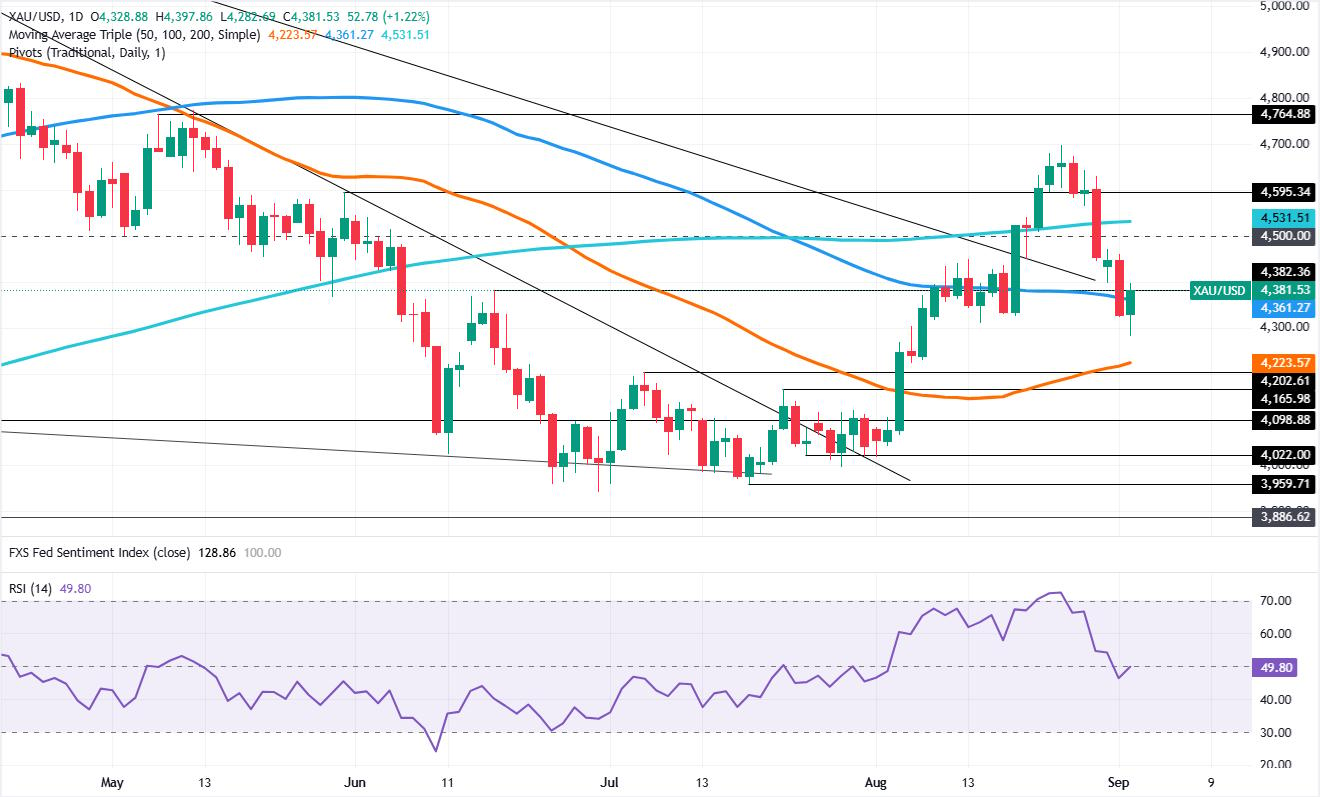
XAU/USD technical outlook: Gold reclaims 100-day SMA, eyes on $4,400
Gold price reclaimed $4,300, clearing the 100-day Simple Moving Average (SMA) at $4,361 at the time of writing. Despite this, which could open the door to further gains, short-term momentum remains bearish.
The Relative Strength Index (RSI) is below its 50-neutral level, indicating that sellers are in control, meaning that bullion’s path of least resistance is downwards.
For a bearish continuation, XAU/USD first support is $4,300. Once cleared, a move towards the 50-day SMA at $4,223 is on the cards. On further weakness, the $4,200 emerges as the next area of interest.
On the upside, if XAU/USD rallies past $4,400, this paves the way to challenge the $4,450 ahead of the $4,500 mark. A decisive breakout exposes the 200-day SMA at $4,531 ahead of $4,600.
Gold FAQs
Gold has played a key role in human’s history as it has been widely used as a store of value and medium of exchange. Currently, apart from its shine and usage for jewelry, the precious metal is widely seen as a safe-haven asset, meaning that it is considered a good investment during turbulent times. Gold is also widely seen as a hedge against inflation and against depreciating currencies as it doesn’t rely on any specific issuer or government.
Central banks are the biggest Gold holders. In their aim to support their currencies in turbulent times, central banks tend to diversify their reserves and buy Gold to improve the perceived strength of the economy and the currency. High Gold reserves can be a source of trust for a country’s solvency. Central banks added 1,136 tonnes of Gold worth around $70 billion to their reserves in 2022, according to data from the World Gold Council. This is the highest yearly purchase since records began. Central banks from emerging economies such as China, India and Turkey are quickly increasing their Gold reserves.
Gold has an inverse correlation with the US Dollar and US Treasuries, which are both major reserve and safe-haven assets. When the Dollar depreciates, Gold tends to rise, enabling investors and central banks to diversify their assets in turbulent times. Gold is also inversely correlated with risk assets. A rally in the stock market tends to weaken Gold price, while sell-offs in riskier markets tend to favor the precious metal.
The price can move due to a wide range of factors. Geopolitical instability or fears of a deep recession can quickly make Gold price escalate due to its safe-haven status. As a yield-less asset, Gold tends to rise with lower interest rates, while higher cost of money usually weighs down on the yellow metal. Still, most moves depend on how the US Dollar (USD) behaves as the asset is priced in dollars (XAU/USD). A strong Dollar tends to keep the price of Gold controlled, whereas a weaker Dollar is likely to push Gold prices up.
Recommended Articles


