


Banks move stablecoin plans forward as BIS questions their role
Despite the opinion expressed by the head of the Bank for International Settlements (BIS) that stablecoins do not qualify as money on a large scale, the largest banks in the world are shifting financial settlement and regular transactions to publicly accessible blockchains.
Addressing the Jackson Hole Economic Symposium on August 28, BIS general manager Pablo Hernández de Cos said that a framework based on tokenized deposits “looks more promising” than stablecoins. The officials at BIS have emphasized that tokenized deposits should be the backbone of modern systems of digital payments as banks transfer their activities to blockchains.
For banks, the dilemma is simple: should they adopt blockchain now, or wait for regulators to approve a more technologically advanced version of this innovative solution?
Where de Cos says stablecoins break down
De Cos centered his argument on three properties he says money must have: singleness, interoperability, and financial integrity.
In relation to the topic of singleness, he provided a simple example. If one person owns Tether’s USDT tokens and would like to transfer money to a recipient who only accepts USDC tokens from Circle, that person would first have to sell the USDT and purchase USDC. However, as the price of the coins can fluctuate in the market, the final value of the transfer may not equal one US dollar. The system does not guarantee that the two stablecoins are exchangeable in one-to-one transactions.
Interoperability leads to another issue. The majority of fiat-pegged stablecoins function on fragmented public, permissionless blockchains and scaling layers. Even asking for the same stablecoin issued on various blockchains to shift from one chain to another warrants having to perform complicated—and sometimes costly—procedures.
As opposed to that, the settlement process of tokenized deposits includes the use of central bank accounts, as stated by De Cos, which keeps par redemption and finality of such kind of deposits intact.
The integrity problem the BIS keeps returning to
Financial integrity is the third issue. According to De Cos, information has shown that most stablecoins are now in self-custodied wallets and that more and more transfers are being done between wallets on the blockchain without any platform conducting know-your-customer checks. This is very different from traditional finance, where bank deposits, the least anonymous form of money, prevail.
In its Annual Economic Report on June 23, the BIS presented a similar viewpoint. The section about stablecoins reached a point where it declared that designs of the existing stablecoins “fall short on foundational properties of money and threaten financial integrity.”
Furthermore, the study expressed concerns about the concept of “stablecoin dollarization” in emerging economies, where the need for foreign stablecoins can have an impact on capital transfers and reduce their monetary sovereignty.
What the payment data actually shows
The scale debate is supported by sizeable numbers.
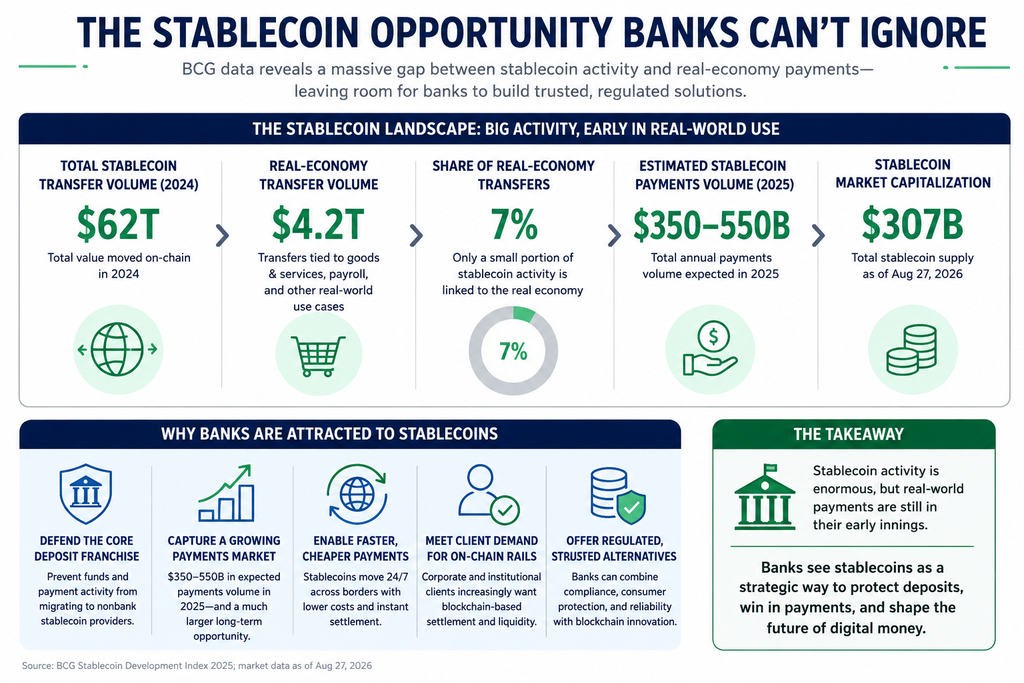
According to a white paper published in January 2026, the Boston Consulting Group (BCG) and the blockchain data company Allium estimated that public blockchains conducted transactions of over $62 trillion worth of stablecoins over the course of one year. However, only about $4.2 trillion of this (approximately 7% of the total amount) was payments that were made in the real economy.
BCG estimated that the observable bilateral payments for goods and services in 2025 is at $350 billion to $550 billion, which they referred to as the minimum. In addition, the paper noted that the market capitalization of stablecoins rose to $307 billion in December 2025.
Why banks are moving anyway
Those warnings have not stopped banks from moving on-chain.
Forkast reported on August 28 that a consortium of more than 12 global banks—including Bank of America, Wells Fargo, Santander, Citi, Goldman Sachs, and UBS—is preparing to issue its own stablecoin on public blockchains rather than leave the market to Tether and Circle.
The GENIUS Act, implemented on July 18, 2025, was a piece of legislation that allowed banks to obtain federal-level access through subsidiaries approved by the OCC, though it prohibited issuers from paying any interest to holders.
Bank of America CEO Brian Moynihan has warned that as much as $6 trillion in deposits could leave banks if stablecoin issuers were allowed to offer yield.
“If they make that legal, we’ll go into that business.”
Smaller lenders are moving too. Cryptopolitan previously reported that 39 state bankers’ associations formed the BankChain Alliance, targeting a 2027 launch. The initiative is designed to give community banks a shared route into tokenized deposits and stablecoins without depending on crypto-native platforms.
Are banks moving from exploration toward a joint stablecoin?
Today’s Seoul Economic Daily coverage says the major bank group is considering a dollar-pegged token initially, with expansion to G7 currencies. It also highlights the strategic reason: banks fear stablecoins could pull deposits away from traditional banks.
| Feature | Stablecoins | Tokenized deposits |
|---|---|---|
| What is it? | Digital tokens designed to maintain a stable value against a reference asset, usually the U.S. dollar | Digital representations of ordinary commercial-bank deposits on a programmable ledger |
| Issuer | Typically, a private stablecoin issuer | Commercial bank |
| Holder’s claim | Claim on the stablecoin issuer/reserve structure | Direct claim on the issuing bank |
| Backing | Usually, reserves such as cash, central-bank reserves, Treasuries or other permitted assets | The bank’s deposit liability is ultimately part of the banking system |
| Redeemability | Designed to redeem at $1, but secondary-market prices can deviate from par | Redeemable at par as a bank deposit/claim |
| Settlement | Transfers between token holders on blockchain networks | Payment debits one bank balance and credits another, with interbank settlement ultimately using central-bank money |
| Blockchain | Often public/permissionless networks | Typically, permissioned or controlled banking platforms, although hybrid designs are possible |
| Interoperability | Can be fragmented across issuers and blockchains | Can achieve greater fungibility when connected through tokenized central-bank reserves |
| AML/KYC | Can involve pseudonymous wallets and self-custody | Account-based and within supervised banking infrastructure |
| Bank deposits | Can potentially pull funds away from banks | Keeps deposits within the banking system |
| Main advantage | Global reach, programmability and 24/7 transferability | Programmability while preserving the existing bank/central-bank monetary structure |
| BIS’s preferred role | Specialized uses rather than the core of everyday payments | Bulk of day-to-day payments and wholesale settlement |
| Current examples | USDT, USDC and other fiat-backed tokens | JPMorgan’s deposit-token model and other bank tokenization projects |
Central banks want tokenized deposits and central-bank money at the center of the on-chain economy, while commercial banks are increasingly deciding they also need stablecoins. JPMorgan’s own position, in particular, is still that it has no current plans to issue a stablecoin.
If you're reading this, you’re already ahead. Stay there with our newsletter.
Recommended Articles


