


Is This The Ethereum Endgame? Investors Pull $3 Billion From Exchanges
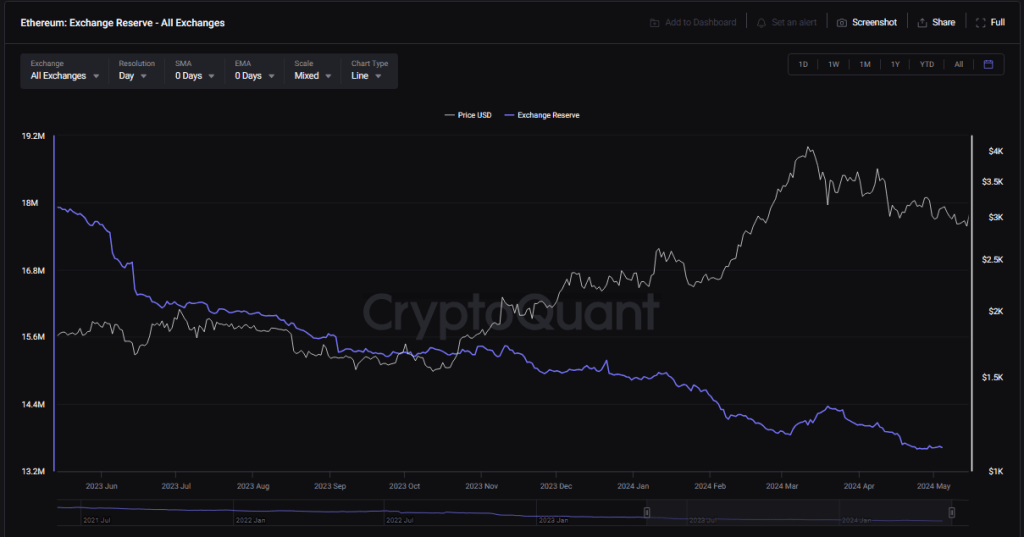
The winds of change are blowing through the Ethereum ecosystem. Since the long-awaited approval of spot Ether ETFs in the US on May 23rd, a quiet exodus of Ether has been underway. A massive amount of the world’s second-largest cryptocurrency, or around $3 billion, has vanished from centralized exchanges, marking the lowest level of Ether reserves in years. This flight of the digital asset has analysts buzzing with the possibility of a supply squeeze, potentially propelling Ether to new heights.
Exodus To Self-Custody: A Bullish Signal?
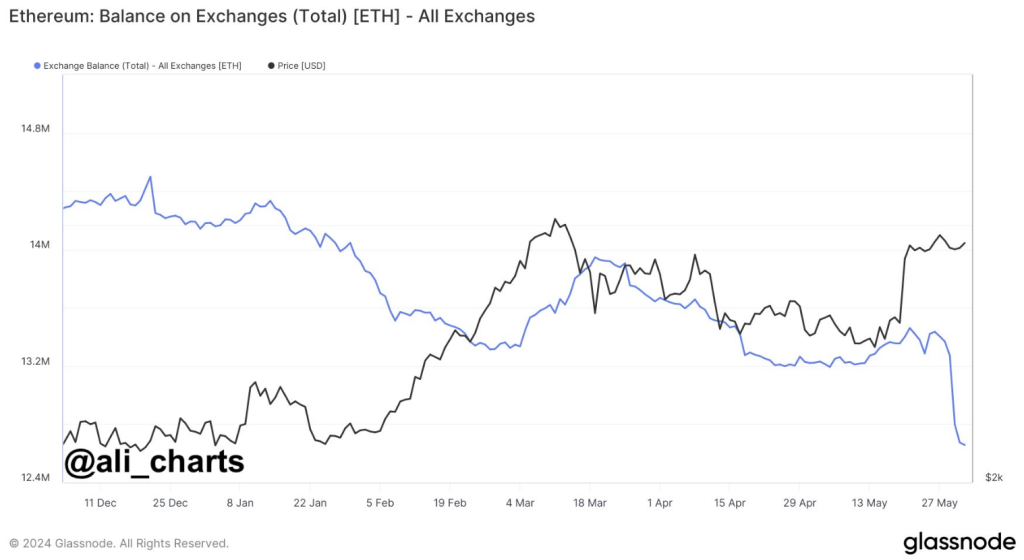
Crypto analyst Ali Martinez reported on X in a recent post that since the US legalized spot Ethereum ETF products, nearly 777,000 ETH, or almost $3 billion, have been removed from cryptocurrency exchanges. Even if the Ether ETF products haven’t formally begun trading on exchanges yet, the continuation of this trend could have a significant impact on how ETH prices behave over time.
Since the @SECGov approved spot #Ethereum ETFs, approximately 777,000 $ETH — valued at about $3 billion — have been withdrawn from #crypto exchanges! pic.twitter.com/EzQVC0cw27
— Ali (@ali_charts) June 2, 2024
Traditionally, high reserves on exchanges have indicated a selling-heavy market, with investors readily offloading their holdings. The current situation, however, paints a different picture. Analysts suggest this mass exodus signifies a shift in investor sentiment. Many are moving their Ether to personal wallets, a move known as self-custody, indicating a long-term bullish outlook.
The low exchange reserves suggest investors are treating Ether not just as a trading asset, but as a potential store of value, says Michael Nadeau, a DeFi report crypto analyst. This shift in mindset, coupled with the potential for increased demand from ETFs, could create a perfect storm for a price surge.
The Ethereum network itself may also be contributing to the supply squeeze. Unlike Bitcoin miners who face constant operational costs, Ethereum validators, responsible for securing the network under the Proof-of-Stake model, don’t have the same financial pressure to sell their holdings. This lack of “structural sell pressure,” as Nadeau terms it, further restricts the readily available supply of Ether.
Ethereum ETF Launch: A Double-Edged Sword?
The upcoming launch of Ether ETFs in late June adds another layer of intrigue. The success of spot Bitcoin ETFs in January, which saw a significant price increase for Bitcoin, serves as a potential roadmap for Ether. Analysts predict a similar demand surge, pushing the price of Ether towards, or even beyond, its all-time high of $4,871 set in November 2021.
However, a potential roadblock exists in the form of Grayscale’s Ethereum Trust (ETHE), a massive investment vehicle currently holding a staggering $11 billion worth of Ether. If Grayscale decides to follow suit with its Bitcoin Trust (GBTC), which experienced over $6 billion in outflows after the launch of spot Bitcoin ETFs, it could dampen the price increase.
Buckle Up For A Bumpy Ride?While the future remains uncertain, the current market conditions present a fascinating scenario for Ether. The combination of a shrinking supply and the potential influx of demand from ETFs paints a picture of a potential bull run. However, the wildcard of Grayscale’s actions and the broader market sentiment inject a dose of caution.
Featured image from Current Affairs-Adda247, chart from TradingView
Recommended Articles


