


Bitcoin Price Forecast: Geopolitical tensions, ETF outflows keep BTC under pressure
- Bitcoin trades around $62,600 on Tuesday after losses of over 2% in the previous day amid fresh escalation in the US-Iran conflict.
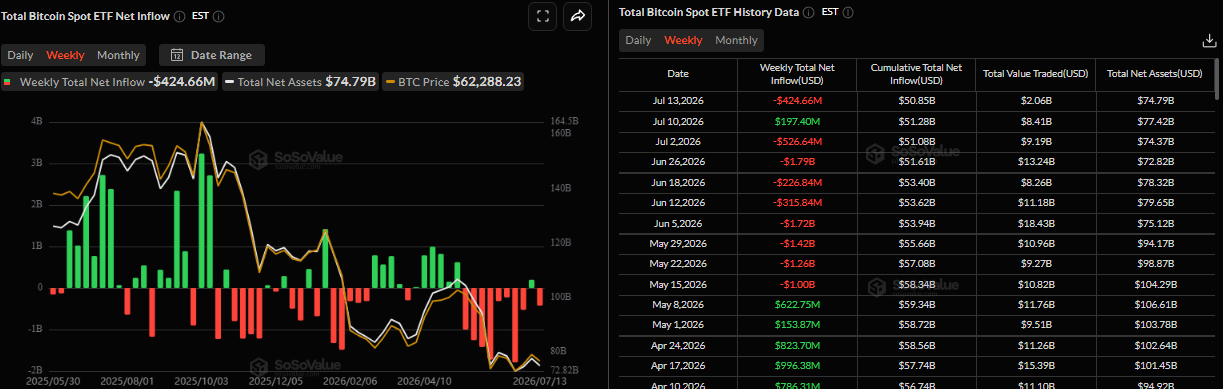
- US-listed spot ETFs recorded an outflow of $425 million on Monday, reversing last week’s modest inflows.
- Market participants await the US CPI report and Fed Chair Warsh’s testimony, which could provide fresh clues on the Fed’s interest rate outlook.
Bitcoin (BTC) remains under pressure, trading at $62,600 on Tuesday after slipping over 2% in the previous day. The bearish bias is further fueled by renewed geopolitical tensions between the US and Iran, which have dampened risk appetite. Institutional demand signals cautious signs as spot Exchange Traded Funds (ETFs) recorded outflows of over $425 million on Monday.
Meanwhile, traders are now turning their attention to the US Consumer Price Index (CPI) report and Federal Reserve (Fed) Chair Kevin Warsh’s testimony on Tuesday for fresh clues on the Fed’s interest rate outlook, which could provide directional bias to the Crypto King.
Markets await Fed interest rate outlook
Traders await the US CPI report, which will be published on Tuesday and is expected to show a fall in the headline number amid a significant decline in gasoline prices during June. Meanwhile, the focus will be on the core CPI figures, which serve as a primary gauge of the underlying inflation trend.
Moreover, Federal Reserve (Fed) Chair Kevin Warsh’s inaugural semi-annual monetary policy testimony before the House Financial Services Committee could influence interest rate expectations. The rate outlook, in turn, will play a key role in shaping near-term US Dollar (USD) price dynamics and provide meaningful impetus to risk-sensitive assets such as Bitcoin.
Global markets continue the week on a risk-off footing as renewed tensions between the US and Iran dampened investor sentiment. The US military launched a third straight night of strikes against Iran on Monday after US President Donald Trump reimposed a naval blockade of Iranian ports. In response, Iran’s Islamic Revolutionary Guard Corps (IRGC) targeted US facilities in the region, while Iranian cruise missiles hit two UAE tankers in the strait.
The closure of the Strait of Hormuz and rising geopolitical uncertainty pushed West Texas Intermediate (WTI) Crude Oil prices above $80 per barrel, while risky assets such as Bitcoin slipped below $62,000 on Monday and remain under pressure, trading around $62,600 on Tuesday.
“June CPI will now provide the primary test, with headline inflation expected to moderate to 3.9 percent and core inflation to 2.9 percent. Gradual disinflation and a Federal Reserve on hold would remain supportive of Bitcoin and other hard assets, but renewed energy disruption around the Strait of Hormuz or persistent core inflation could revive the risk of tighter monetary policy,” said Bitfinex analyst.
Institutional demand reverses
Institutional demand for Bitcoin began the week on a negative note. SoSoValue data showed that the spot Bitcoin ETFs recorded an outflow of $424.66 million on Monday, reversing last week’s modest net inflows of $197.40 million. If this outflow trend continues and intensifies this week, BTC could see further correction.
Could the Clarity Act be a catalyst for the week?
The US House of Representatives will hold a field hearing on the Digital Asset Market Clarity (CLARITY) Act on Friday as lawmakers continue advancing crypto market-structure legislation.
Donald Trump posted on his Truth Social on Monday, “In honor of Senator Lindsey Graham, a big supporter, the U.S. Senate should pass the Clarity Act.”
He described the legislation as essential to preserving US leadership in digital assets and artificial intelligence (AI) amid growing competition from China.
“China, and many other countries, would like to take complete and total control of this major financial ‘happening,’ as well as AI, where we are now leading, but where they are fighting hard. Don’t let China win on either subject!!!,” Trump added.
The bill was passed by the House on July 17, 2025, with a 294–134 bipartisan vote and cleared the Senate Banking Committee in mid-May 2026, but has not yet passed the full Senate.
As explained in the previous report, the Clarity Act will serve as a bridge to help crypto become a mature industry, supporting the implementation of the GENIUS Act while addressing oversight overlap between the US Securities and Exchange Commission (SEC) and the Commodity Futures Trading Commission (CFTC).
Under the Clarity Act, the CFTC has been given authority over the spot market, expanding its oversight beyond crypto derivatives. Market participants see this move as a win for the industry, as the CFTC is said to take a more principle-based approach than the SEC’s disclosure-based framework.
Friday’s hearing marks an important event in efforts to align the House and Senate versions of the CLARITY Act ahead of the August 7 congressional recess, a critical window for the bill’s progress this year.
Bitcoin Price Forecast: BTC remains under the hood
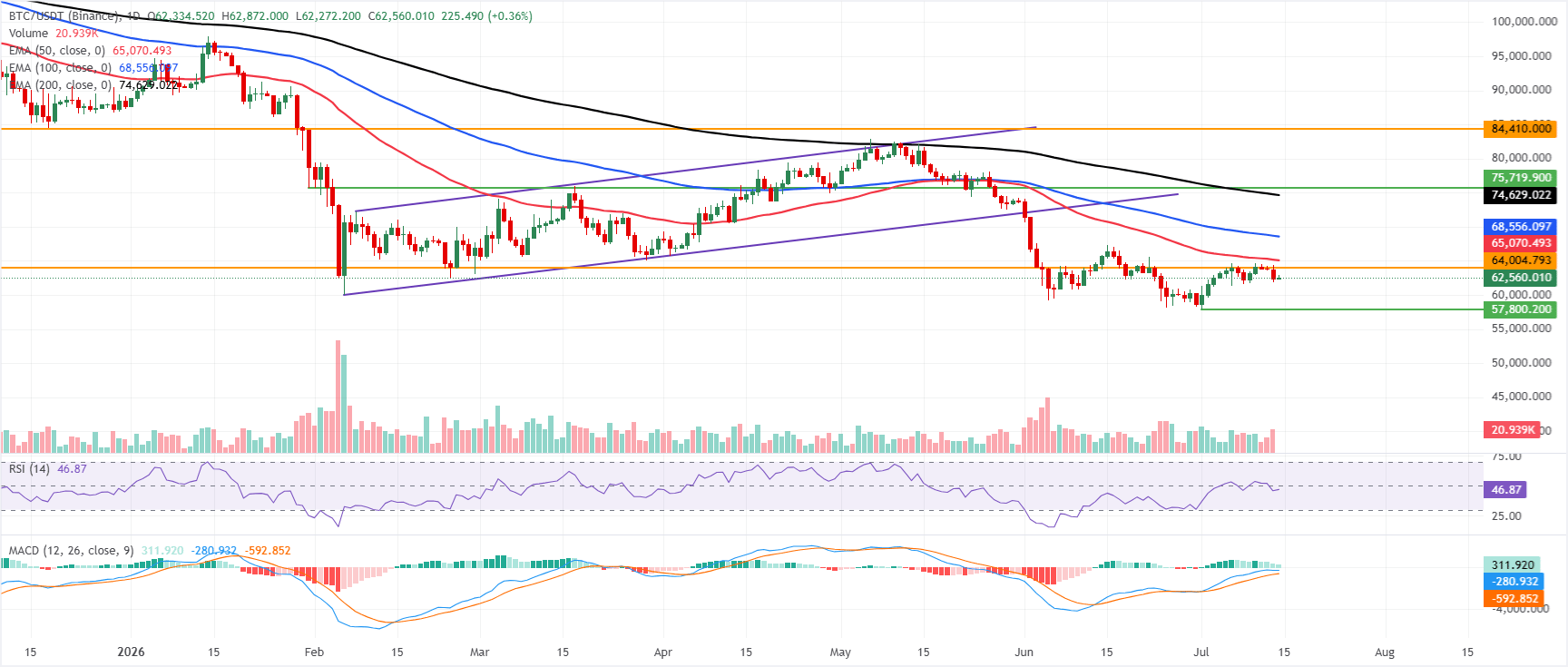
Bitcoin price trades at $62,560 on Tuesday after falling over 2% in the previous day. BTC is maintaining a bearish near-term bias as it remains below the 50-day, 100-day, and 200-day Exponential Moving Averages (EMAs) at $65,070, $68,556, and $74,629, respectively.
The cluster of overhead levels reinforces a capped tone. At the same time, the Relative Strength Index (RSI) at 46 on the daily chart stays below the neutral 50 line, hinting at subdued upside momentum even as the Moving Average Convergence Divergence (MACD) holds in positive territory, suggesting only moderate recovery pressure.
On the topside, initial resistance is seen at the horizontal barrier around $64,004, followed by the 50-day EMA at $65,070 and then the 100-day EMA at $68,556, all of which need to be reclaimed to ease the current downside bias.
On the downside, the lack of clearly defined nearby support levels in this setup leaves the pair vulnerable to renewed selling should momentum fade, with traders likely to look to the $60,000 key psychological level on the chart for potential demand zones.
(The technical analysis of this story was written with the help of an AI tool. Know more.)
Crypto ETF FAQs
An Exchange-Traded Fund (ETF) is an investment vehicle or an index that tracks the price of an underlying asset. ETFs can not only track a single asset, but a group of assets and sectors. For example, a Bitcoin ETF tracks Bitcoin’s price. ETF is a tool used by investors to gain exposure to a certain asset.
Yes. The first Bitcoin futures ETF in the US was approved by the US Securities & Exchange Commission in October 2021. A total of seven Bitcoin futures ETFs have been approved, with more than 20 still waiting for the regulator’s permission. The SEC says that the cryptocurrency industry is new and subject to manipulation, which is why it has been delaying crypto-related futures ETFs for the last few years.
Yes. The SEC approved in January 2024 the listing and trading of several Bitcoin spot Exchange-Traded Funds, opening the door to institutional capital and mainstream investors to trade the main crypto currency. The decision was hailed by the industry as a game changer.
The main advantage of crypto ETFs is the possibility of gaining exposure to a cryptocurrency without ownership, reducing the risk and cost of holding the asset. Other pros are a lower learning curve and higher security for investors since ETFs take charge of securing the underlying asset holdings. As for the main drawbacks, the main one is that as an investor you can’t have direct ownership of the asset, or, as they say in crypto, “not your keys, not your coins.” Other disadvantages are higher costs associated with holding crypto since ETFs charge fees for active management. Finally, even though investing in ETFs reduces the risk of holding an asset, price swings in the underlying cryptocurrency are likely to be reflected in the investment vehicle too.
Recommended Articles


