

Ethereum Co-Founder Predicts Supply Crunch From ETFs, This Is The Price Target

Source Newsbtc

Joseph Lubin, co-founder of Ethereum and CEO of blockchain technology firm Consensys, has expressed that the potential approval of spot Ethereum ETFs by the US Securities and Exchange Commission (SEC) could lead to significant supply constraints for Ether. This development is anticipated to be a “watershed” moment for Ethereum.

In an exclusive interview with DL News, Lubin predicted that the approval of spot Ethereum ETFs will unlock substantial institutional demand. Given that many institutions have begun their crypto investments with spot Bitcoin ETFs, Ethereum is naturally the next substantial asset for diversification.

“There’s going to be a pretty large amount of natural, pent-up pressure to purchase Ether” through these ETFs, Lubin commented. However, he also noted that the situation for Ethereum differs significantly from that of Bitcoin because of the underlying supply dynamics.

A major factor distinguishing Ethereum from Bitcoin in the context of ETF creation is the availability of the assets. On-chain data indicates that more than 27% of all Ether is staked across various protocols on the Ethereum network. These funds are locked in contracts and are contributing to the network’s security and operations, thus they are not readily available for market trading.

“Much of the Ether is put to work in the core protocol, DeFi systems, or in DAOs,” Lubin explained. This structural difference means that there is less Ether available for ETF providers to purchase and allocate to new ETF shares.

In August 2021, the Ethereum network’s EIP 1559 introduced a burning mechanism where a portion of the Ether used for transaction fees is permanently removed from circulation. This deflationary mechanism is designed to balance Ether supply growth and potentially increase its scarcity over time.

As network activity increases—potentially spurred further by new institutional interest in Ethereum through ETFs—this burn mechanism will gradually reduce the available supply, adding another layer to the potential supply crunch. “This could be a pretty profound watershed moment”, Lubin said.

Ethereum Price Targets And Doubts

The market impact of an approved Ethereum spot ETF could be significant. Crypto analyst Miles Deutscher projected a possible scenario where Ethereum could see a price surge similar to that experienced by Bitcoin following its own ETF approval.

According to Deutscher’s analysis, “BTC rallied 75% in 63 days after the spot ETF was approved. If ETH follows the same trend (if approved), this would take it to $6,446 by July 23.”

However, opinions among analysts vary. Vetle Lunde from K33 Research pointed out the challenges in replicating Bitcoin’s success, noting that the futures-based Ethereum ETFs have only captured a small fraction of the assets compared to their Bitcoin counterparts prior to spot ETF approval. “Fut-based ETH ETFs have seen cumulative net inflows of $126m since launch ~ roughly equivalent to the inflow to BITX over the past 3 days. Fut-based ETH ETFs aggregated AUM is only 7.4% of the AUM fut-based BTC ETFs had before the spot approval,” he remarked.

Meanwhile, crypto analyst Vijay Boyapati raised concerns about the structural differences in ETFs, specifically the inability of ETF structures to incorporate staking. “It should be noted that the ETH ETFs, if approved, will be a much worse proxy for the underlying asset than BTC ETFs because the SEC is still extremely unlikely to allow the ETF applicants to stake,” he said.

This could result in the ETFs not fully reflecting the underlying value growth of Ethereum price, as also highlighted by Alex Thorn, Head of Research at crypto-focused financial services firm Galaxy commented: “Lack of staking in ETH ETPs would be material for returns. If u bought $10k ETH on Merge day in Sep ‘22 and held until today without staking it, you underperformed by 8% over that period vs someone who bought and staked to collect issuance, tips, and MEV.”

At press time, ETH traded at $3,759.
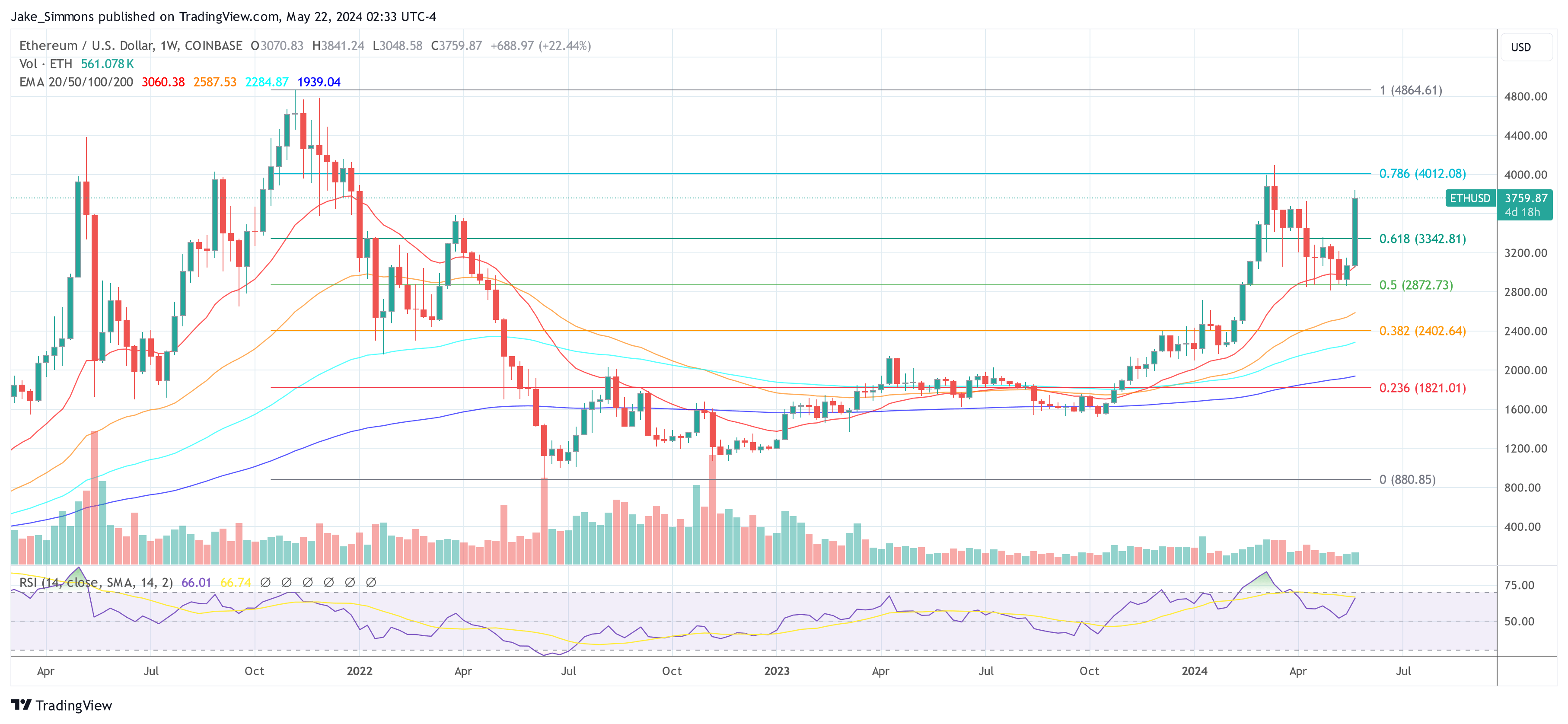
Ethereum price
Disclaimer: For information purposes only. Past performance is not indicative of future results.
placeholder
Bitcoin CME gaps at $35,000, $27,000 and $21,000, which one gets filled first?Prioritize filling the $27,000 gap and even try higher.
Author  FXStreet
Aug 22, 2023
Prioritize filling the $27,000 gap and even try higher.
placeholder
Pinduoduo Earnings Incoming: Morgan Stanley Sees Long-Term Profit Potential​Insights – On November 21, Chinese e-commerce giant Pinduoduo (PDD) will release its Q3 2024 earnings.
Author  Mitrade
Nov 20, 2024
​Insights – On November 21, Chinese e-commerce giant Pinduoduo (PDD) will release its Q3 2024 earnings.
placeholder
Elon Musk’s xAI and Neuralink Launch New Funding Rounds​Billionaire Elon Musk recently raised funds for his two high-profile tech companies, xAI and Neuralink.
Author  Insights
Jun 03, 2025
​Billionaire Elon Musk recently raised funds for his two high-profile tech companies, xAI and Neuralink.
placeholder
Bitcoin briefly loses 2025 gains as crypto plunges over the weekend.Bitcoin experienced a sharp decline this weekend, briefly erasing its 2025 gains and dipping below its year-opening value of $93,507. The cryptocurrency fell to a low of $93,029 on Sunday, representing a 25% drop from its all-time high in October. Although it has rebounded slightly to around $94,209, the pressures on the market remain significant. The downturn occurred despite the reopening of the U.S. government on Thursday, which many had hoped would provide essential support for crypto markets. This year initially appeared promising for cryptocurrencies, particularly after the inauguration of President Donald Trump, who has established the most pro-crypto administration thus far. However, ongoing political tensions—including Trump's tariff strategies and the recent government shutdown, lasting a historic 43 days—have contributed to several rapid price pullbacks for Bitcoin throughout the year. Market dynamics are also being influenced by Bitcoin whales—investors holding large amounts of Bitcoin—who have been offloading portions of their assets, consequently stalling price rallies even as positive regulatory developments emerge. Despite these sell-offs, analysts from Glassnode argue that this behavior aligns with typical patterns seen among long-term investors during the concluding stages of bull markets, suggesting it is not indicative of a mass exodus. Notably, Bitcoin is not alone in its struggles, as Ethereum and Solana have also recorded declines of 7.95% and 28.3%, respectively, since the start of the year, while numerous altcoins have faced even steeper losses. Looking ahead, questions linger regarding the viability of the four-year cycle thesis, particularly given the increasing institutional support and regulatory frameworks now in place in the crypto landscape. Matt Hougan, chief investment officer at Bitwise, remains optimistic, suggesting a potential Bitcoin resurgence in 2026 driven by the “debasement trade” thesis and a broader trend toward increased adoption of stablecoins, tokenization, and decentralized finance. Hougan emphasized the soundness of the underlying fundamentals, pointing to a positive outlook for the sector in the longer term.
Author  Mitrade
Nov 17, 2025
Bitcoin experienced a sharp decline this weekend, briefly erasing its 2025 gains and dipping below its year-opening value of $93,507. The cryptocurrency fell to a low of $93,029 on Sunday, representing a 25% drop from its all-time high in October. Although it has rebounded slightly to around $94,209, the pressures on the market remain significant. The downturn occurred despite the reopening of the U.S. government on Thursday, which many had hoped would provide essential support for crypto markets. This year initially appeared promising for cryptocurrencies, particularly after the inauguration of President Donald Trump, who has established the most pro-crypto administration thus far. However, ongoing political tensions—including Trump's tariff strategies and the recent government shutdown, lasting a historic 43 days—have contributed to several rapid price pullbacks for Bitcoin throughout the year. Market dynamics are also being influenced by Bitcoin whales—investors holding large amounts of Bitcoin—who have been offloading portions of their assets, consequently stalling price rallies even as positive regulatory developments emerge. Despite these sell-offs, analysts from Glassnode argue that this behavior aligns with typical patterns seen among long-term investors during the concluding stages of bull markets, suggesting it is not indicative of a mass exodus. Notably, Bitcoin is not alone in its struggles, as Ethereum and Solana have also recorded declines of 7.95% and 28.3%, respectively, since the start of the year, while numerous altcoins have faced even steeper losses. Looking ahead, questions linger regarding the viability of the four-year cycle thesis, particularly given the increasing institutional support and regulatory frameworks now in place in the crypto landscape. Matt Hougan, chief investment officer at Bitwise, remains optimistic, suggesting a potential Bitcoin resurgence in 2026 driven by the “debasement trade” thesis and a broader trend toward increased adoption of stablecoins, tokenization, and decentralized finance. Hougan emphasized the soundness of the underlying fundamentals, pointing to a positive outlook for the sector in the longer term.
placeholder
WTI holds steady above $92.00 as Strait of Hormuz remains closed; bulls seem hesitant West Texas Intermediate (WTI) – the benchmark US Crude Oil price – trades with a mild positive bias during the Asian session on Friday, though it lacks bullish conviction amid hopes of Iran ceasefire stabilizing.
Author  FXStreet
Apr 10, Fri
West Texas Intermediate (WTI) – the benchmark US Crude Oil price – trades with a mild positive bias during the Asian session on Friday, though it lacks bullish conviction amid hopes of Iran ceasefire stabilizing.
goTop
quote