


Exchanges Scramble to Contain Retail Speculation As Metals Become China’s Hottest Trade
Industrial metals have suddenly become one of the most crowded trades in China, with futures volumes in aluminum, copper, nickel, and tin surging as retail traders pile into the market.
The spike in activity has pushed exchanges and regulators to intervene repeatedly, raising concerns that a wave of speculation—rather than fundamentals—is driving prices and volatility.
Retail Traders Drive Explosive Growth in Metals Volumes
Recent market data shows trading activity in key base metals accelerating at an exceptional pace. Combined futures volumes in aluminium, copper, nickel, and tin on the Shanghai Futures Exchange surged sharply month-over-month, reaching levels far above the recent average.
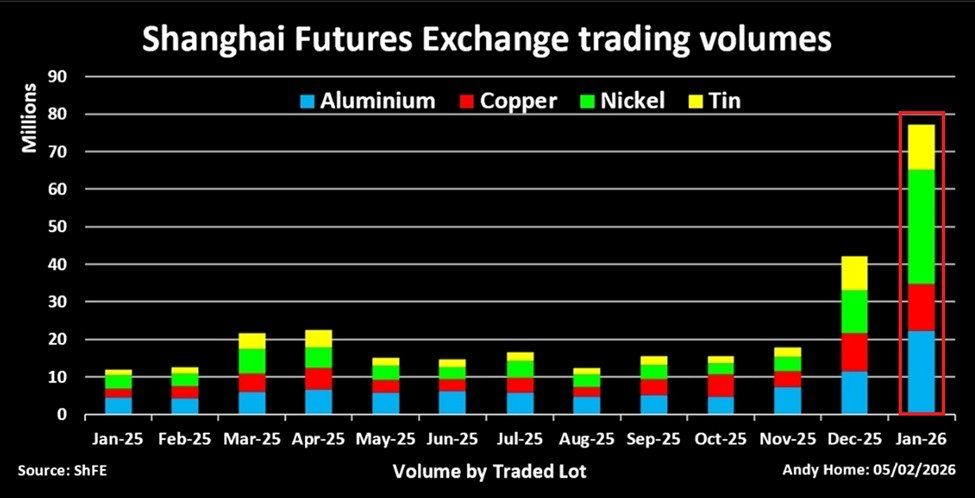 Shanghai Futures Exchange trading volumes from January 2025 to January 2026, showing 78 million lots traded in January 2026 with nickel dominating at 30 million lots. Source: The Kobeissi Letter
Nickel contracts led the rally, with trading volumes jumping several-fold in a single month. Tin markets also saw extraordinary activity, with daily trading volumes at times exceeding levels that dwarf typical physical consumption benchmarks.
The turnout points to derivatives speculation, not industrial demand, dominating flows, with retail participation being a key catalyst.
Metals trading has become a trending topic across Chinese social media platforms and WeChat trading groups.
“…short-term momentum strategies and leverage are increasingly popular among individual investors,” the Kobeissi Letter indicated.
This pattern mirrors earlier speculative episodes seen in equities, crypto, and commodities, where retail enthusiasm quickly amplified price swings.
Exchanges Move to Cool a Fast-Moving Metals Market
The rally’s speed has forced exchanges to step in. Both Shanghai and regional futures markets have repeatedly raised margin requirements and tightened trading rules in recent weeks.
“As a result, the Shanghai and Guangzhou Futures Exchanges have raised margins and tightened trading rules 38 times over the last 2 months to try to contain the speculation. The metals rush is far from over,” Markets Today reported.
This unusual but frequent set of interventions may signal mounting concern about excessive leverage. Historically, such measures have been used to slow speculative inflows and stabilize markets when price movements become detached from underlying supply-and-demand fundamentals.
However, repeated tightening also shows:
- How quickly trading volumes have expanded
- How difficult it may be to contain momentum once retail participation reaches critical mass.
Periods of rapid speculative growth often precede sharp corrections, particularly in highly leveraged derivatives markets.
Precious Metals Add to the Volatility Narrative
At the same time, the broader metals complex is sending mixed signals. Silver, in particular, has experienced one of the strongest rallies in its history, climbing sharply over the past year before entering a more volatile consolidation phase.
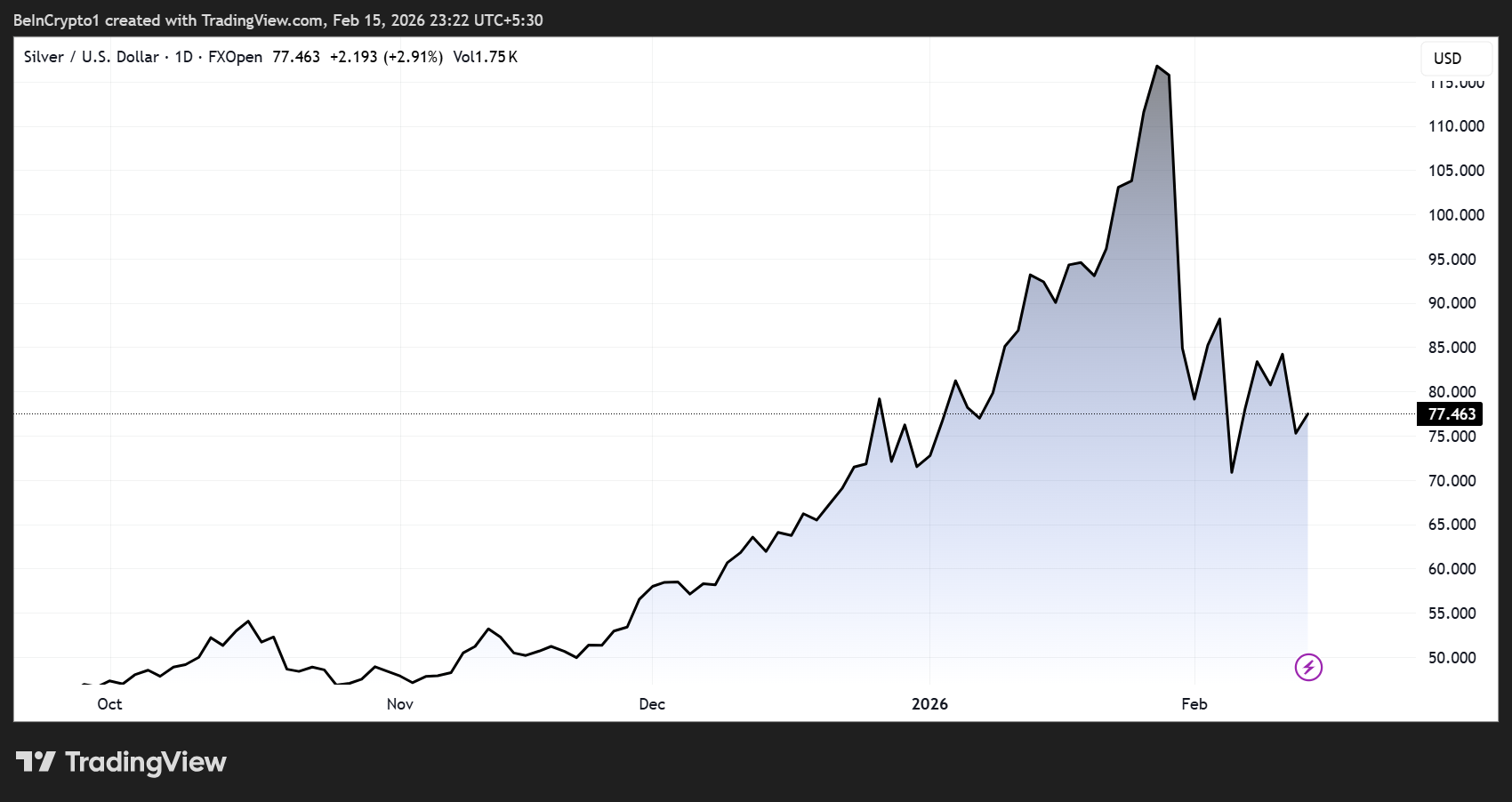 Silver (XAG) Price Performance. Source: TradingView
Against this backdrop, some strategists argue that silver and other metals have become stretched relative to broader commodity indices. In previous cycles, such conditions sometimes preceded cooling price action.
Others counter that structural supply constraints and strong industrial demand, especially from energy transition technologies, could continue to support elevated prices over the longer term.
The divergence in views reflects a market struggling to distinguish between structural trends and speculative excess.
Macro Forces Lurking Behind the Rally
Beyond retail speculation, the metals surge comes amid broader macroeconomic shifts. China has been steadily reducing its holdings of US Treasuries while increasing gold reserves.
This reinforces the perception that global capital is increasingly seeking diversification away from TradFi assets.
The People’s Bank of China has reported consecutive months of gold accumulation, a trend mirrored by several other central banks in recent years.
While these macro trends do not directly explain the retail-driven surge in industrial metals trading, they contribute to a wider narrative that investors at multiple levels—from individuals to sovereign institutions—are reassessing risk, liquidity, and the role of hard assets in portfolios.
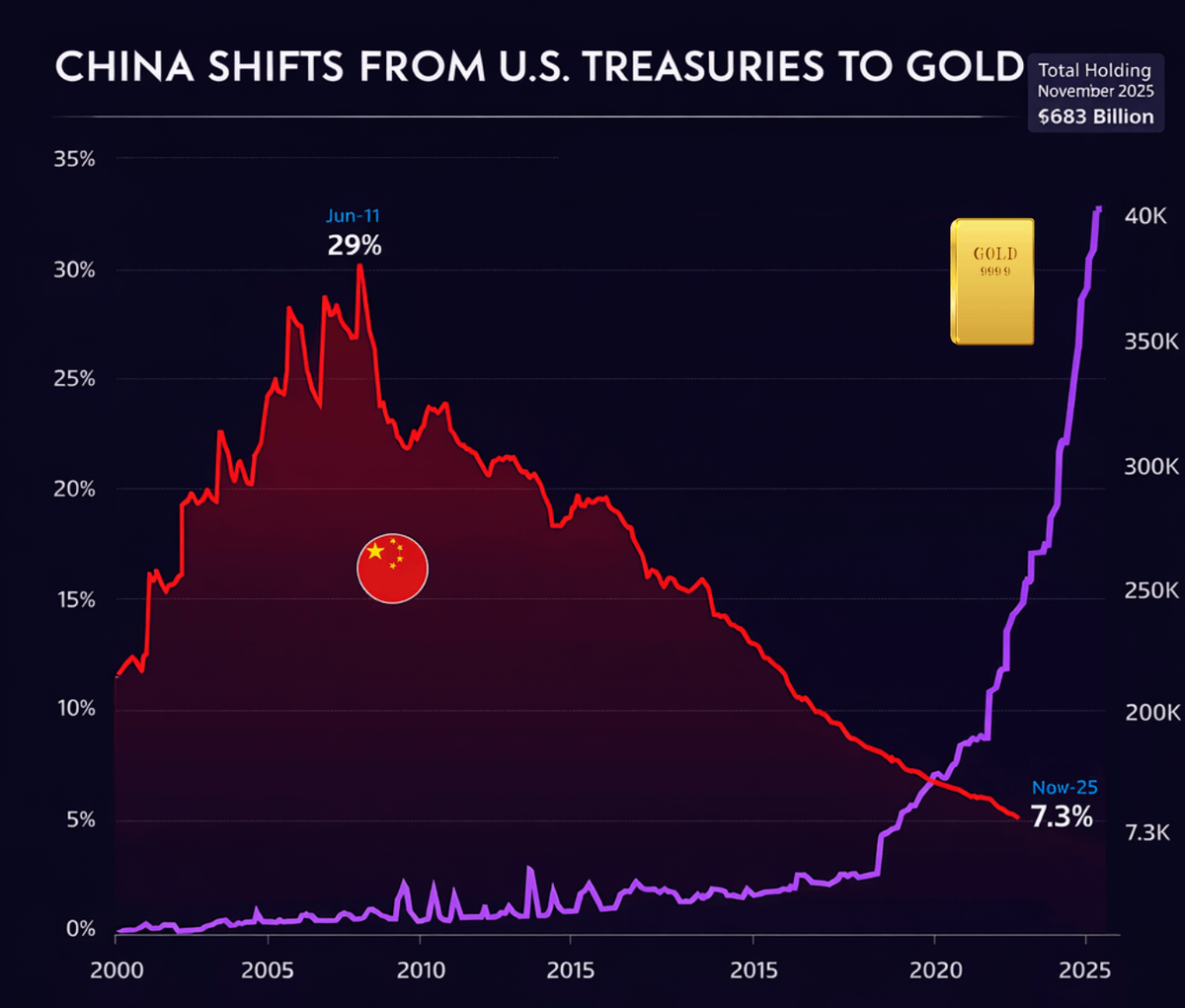 Chart illustrating China’s declining U.S. Treasury holdings from 29% in June 2011 to 7.3% now, alongside a sharp increase in gold reserves to $370 billion. Source: DefiWimar
The combination of retail speculation, tightening exchange controls, and mixed macro signals suggests volatility is likely to remain elevated in the months ahead.
Recommended Articles


