

IMF Says Brazil’s System Is Working—So Why Is Crypto Booming Without a Crisis?
Brazil is testing one of crypto’s oldest assumptions: that digital assets only thrive when traditional financial systems fail.
With its benchmark Selic rate sitting at 15%, one of the highest among major economies, Brazil’s central bank has maintained an aggressively tight monetary stance. Yet according to new IMF research, the country’s financial system is not cracking under pressure. Instead, credit markets remain resilient, and crypto adoption is accelerating anyway.
Why Brazil’s Crypto Adoption Defies Traditional Macro Logic
Only days after releasing its Q2 2025 COFER data, the International Monetary Fund (IMF) has shared another report, this time dissecting Brazil’s macroeconomic outlook.
In the post, the IMF said that Brazil’s recent credit expansion “was not a policy failure,” arguing that monetary transmission remains effective despite elevated interest rates.
“IMF research shows that the recent credit expansion in Brazil, amid a basic interest rate of 15%, was not a policy failure. Fintechs and rising incomes are reshaping access to finance. Meanwhile, monetary policy keeps doing its job,” wrote the IMF in a post.
Bank lending rose 11.5% in 2024, while corporate bond issuance surged 30%. These outcomes would typically dampen the appetite for alternative financial assets. By conventional macro logic, this should be a hostile environment for crypto.
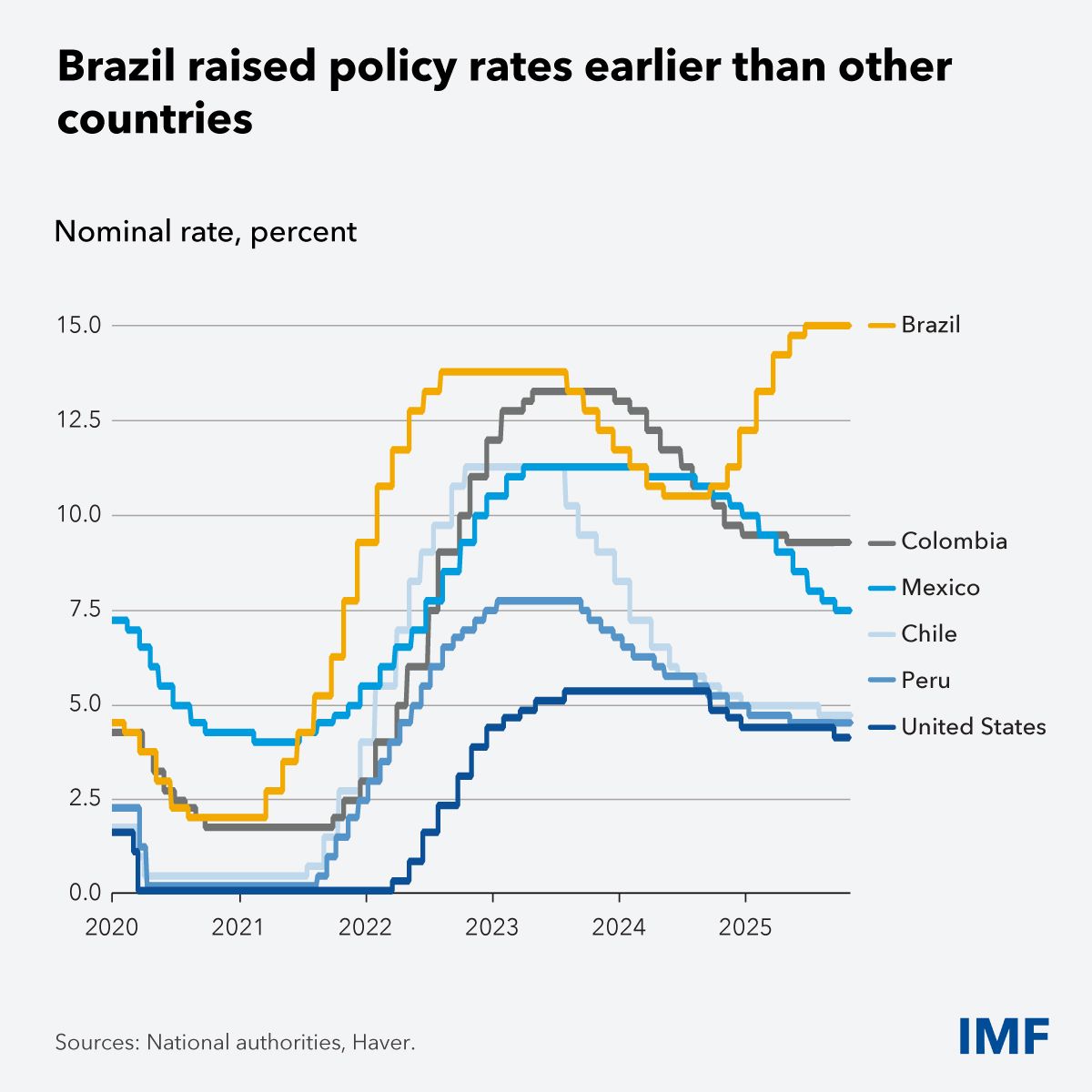 Brazil raised policy rates earlier and more aggressively than peer countries, reaching 15% in 2024-2025 (Source: IMF)
Instead, Brazil’s crypto activity jumped 43% year-over-year (YoY) in 2025, exposing a growing disconnect between legacy macro narratives and on-the-ground adoption trends.
A System That Works and Still Goes On-Chain
The IMF’s latest Article IV consultation emphasizes that Brazil’s central bank has done “exactly what it was supposed to do.”
- Policy tightening has filtered through to lending rates,
- Credit growth has begun to slow, and
- Inflation expectations, while still elevated, are being actively managed.
Strong income growth, low unemployment, and rapid fintech expansion helped sustain credit demand even in the face of high interest rates.
Digital banks and fintech lenders now account for roughly a quarter (25%) of Brazil’s credit card market, dramatically expanding financial access without undermining policy effectiveness.
Yet crypto adoption is rising in parallel, not as a protest against the system, but increasingly as an extension of it.
Citing Mercado Bitcoin, the largest digital-asset platform in Latin America, industry analysts indicate that younger investors are driving Brazil’s crypto surge.
Adoption among users aged 24 and under increased by 56% YoY, driven by stablecoins and tokenized fixed-income products, not by speculative altcoins.
Digital fixed-income products distributed approximately $325 million in returns in 2025, offering yields that directly compete with Brazil’s high-rate carry trade.
Overall crypto transaction volumes rose 43%, while lower-risk crypto products grew 108%, signaling a shift from speculation toward structured investing.
Middle-income users are allocating a significant share of their portfolios to stablecoins, while lower-income investors continue to favor Bitcoin for its higher returns.
Bitcoin remains the most widely traded asset, followed by Ethereum and Solana, with approximately 18% of investors diversifying across multiple cryptocurrency assets.
This behavior challenges the notion that crypto adoption is solely a response to inflation, currency collapse, or policy failure.
Legacy Finance Starts to Bend
Traditional institutions are responding. Itaú Unibanco, Latin America’s largest private bank, has recommended a 1% to 3% portfolio allocation to Bitcoin, framing it as a diversification tool and partial hedge rather than a speculative bet.
The bank cited Bitcoin’s low correlation with traditional assets and its role as a globally traded, decentralized store of value. This endorsement aligns with similar guidance from major U.S. asset managers.
Together with Mercado Bitcoin’s expansion into tokenized income and equity products, including issuance on the Stellar network, the lines between traditional finance and blockchain infrastructure are becoming increasingly blurred.
Brazil’s experience undermines the notion that crypto only thrives in broken systems. Instead, it suggests a new phase of adoption driven by utility, yield access, and portfolio diversification, even when monetary policy is working as intended.
The next fault line may not be inflation or interest rates, but questions of privacy, transparency, and control. As crypto becomes embedded within regulated financial rails, debates are shifting away from macro failure toward who governs the infrastructure itself.
Brazil’s crypto boom is not a crisis trade. It’s a convergence trade, and that may be the more disruptive development of all.
Recommended Articles


