
Banks Could Start Holding XRP Due To This Simple Change

Source Newsbtc

Banks have mostly stayed on the sidelines when it comes to holding XRP directly, even as interest in digital assets continues to increase. That hesitation has not been due to a lack of utility or demand but to strict regulatory capital rules that made holding XRP economically impractical for regulated institutions.

However, a small adjustment in how XRP is treated under global banking rules could remove that barrier and change how banks interact with the cryptocurrency.

Why Banks Can’t Hold XRP

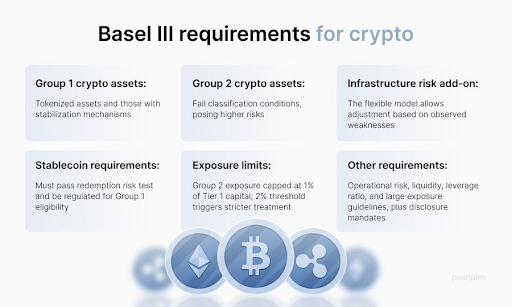
The main obstacle preventing banks from holding XRP has been its treatment under the global banking framework known as Basel III. Basel III is an international regulatory framework developed after the 2008 financial crisis that introduces higher quality and quantity of capital requirements in the international banking sector. 

Right now, XRP currently falls into the Type 2 crypto exposure under Basel III, which is set up with rules for assets that pose higher risks. Under these rules, most cryptocurrencies, including XRP, fall into a high-risk category that carries a punitive capital requirement. Banks are required to apply a 1,250% risk weight to such assets, implying they must set aside far more capital than the value of the XRP itself.

This means that under the Basel III framework, for every $1 of XRP exposure, a bank must hold $12.50 in capital. This dynamic was recently explained by a crypto commentator with the name Stern Drew on the social media platform X. 

In a post on X, Drew explained that this capital inefficiency alone accounts for years of institutional hesitation. The issue has not been demand nor technology, but the regulatory capital treatment that made holding XRP irrational from a balance sheet perspective.
XRP banks

The Regulatory Inflection Point

The conversation around XRP’s regulatory status is becoming increasingly important to its long-term outlook. Interestingly, Drew’s analysis goes further by pointing to what he describes as an inflection point that markets may be overlooking. Now that legal and regulatory clarity surrounding cryptocurrencies is improving, XRP could be reclassified into a lower-risk category under Basel III.

The endgame is that XRP is on a clear path to becoming a Tier-1 digital asset for global institutions, which is mostly for tokenized traditional assets and stablecoins with strong mechanisms.  If that reclassification occurs, the economics will change immediately. XRP would become acceptable for direct balance sheet exposure, allowing banks to custody, deploy, and settle using the asset without the need of excessive capital. 

This is not a discussion about short-term price movements but about capital mechanics that determine whether large pools of institutional money can participate in holding XRP at all. In this case, liquidity provisioning of XRP by banks would change from off-balance-sheet usage to direct institutional ownership.

XRP price chart from Tradingview.com
Disclaimer: For information purposes only. Past performance is not indicative of future results.
placeholder
ECB Policy Outlook for 2026: What It Could Mean for the Euro’s Next MoveWith the ECB likely holding rates steady at 2.15% and the Fed potentially extending cuts into 2026, EUR/USD may test 1.20 if Eurozone growth proves resilient, but weaker growth and an ECB pivot could pull the pair back toward 1.13 and potentially 1.10.
Author  Mitrade
8 hours ago
With the ECB likely holding rates steady at 2.15% and the Fed potentially extending cuts into 2026, EUR/USD may test 1.20 if Eurozone growth proves resilient, but weaker growth and an ECB pivot could pull the pair back toward 1.13 and potentially 1.10.
placeholder
Dogecoin Is Repeating Its 2020 Accumulation Cycle, Analyst SaysCrypto analyst Cryptollica (@Cryptollica on X) is arguing that Dogecoin’s weekly chart is doing that familiar thing again: carving out a rounded base, bleeding off volatility, resetting momentum
Author  NewsBTC
8 hours ago
Crypto analyst Cryptollica (@Cryptollica on X) is arguing that Dogecoin’s weekly chart is doing that familiar thing again: carving out a rounded base, bleeding off volatility, resetting momentum
placeholder
TradingKey 2025 Markets Recap & Outlook | Gold Records Its Best Performance in Half a Century, Wall Street Predicts $5,000 Breach in 2026TradingKey - Amid increasing global economic uncertainty, gold is experiencing its best year since 1979, recording its largest gain in 46 years.As of December 26, the price of gold futures (New York g
Author  TradingKey
8 hours ago
TradingKey - Amid increasing global economic uncertainty, gold is experiencing its best year since 1979, recording its largest gain in 46 years.As of December 26, the price of gold futures (New York g
placeholder
Top 10 crypto predictions for 2026: Institutional demand and big banks could lift BitcoinCrypto’s 2026 outlook hinges on whether institutional demand returns—via ETFs, banks and digital-asset treasury buyers—with BTC facing a wide range between support near $80,600 and a potential $140,259 upside target, while stablecoins, AI tokens, Solana growth and regulation remain key themes.
Author  Mitrade
8 hours ago
Crypto’s 2026 outlook hinges on whether institutional demand returns—via ETFs, banks and digital-asset treasury buyers—with BTC facing a wide range between support near $80,600 and a potential $140,259 upside target, while stablecoins, AI tokens, Solana growth and regulation remain key themes.
placeholder
TradingKey 2025 Markets Recap & Outlook | Global Central Banks 2025 Recap and 2026 Outlook: Navigating Post-Easing Recovery and Diverging PathsIn 2025, major central banks globally generally maintained an accommodative stance, but the pace of policy adjustment slowed significantly. As inflation gradually came under control and e
Author  TradingKey
Yesterday 10: 31
In 2025, major central banks globally generally maintained an accommodative stance, but the pace of policy adjustment slowed significantly. As inflation gradually came under control and e
goTop
quote