


Gold price advances while US Dollar consolidates ahead of FOMC minutes
- Gold price generates more gains as Fed policymakers are confident that inflation is broadly declining.
- The FOMC minutes for January policy will be a detailed explanation behind the Fed's steady interest rate decision.
- Investors see the preliminary S&P Global Manufacturing PMI for February at 50.5.
Gold price (XAU/USD) extends its bullish streak for the fourth straight trading session on Tuesday. The outlook for the precious metal has strengthened as commentary from Federal Reserve (Fed) policymakers that inflation is broadly moving in the right direction has faded the impact of stubborn Consumer Price Index (CPI) and Producer Price Index (PPI) data for January.
The confidence of Fed policymakers that inflation is declining over the long term has trimmed the opportunity cost of holding non-yielding assets such as Gold. Meanwhile, investors await the Federal Reserve Open Market Committee (FOMC) minutes for the first monetary policy meeting of 2024. The FOMC minutes will provide cues about the timing of three rate-cuts, as forecasted by the Fed.
On the economic data front, preliminary S&P Global PMI data for February will guide the forward action in the Gold price and the US Dollar, which will be published on Thursday. The US Manufacturing PMI is expected to exceed the 50.0 threshold for the second straight month at 50.5. An upbeat factory data would have a negative impact on the Gold price.
Daily Digest Market Movers: Gold price extends its upside while US Dollar remains sideways
- Gold price continues to generate gains but struggles to extend the upside above four-day high around $2,023.
- The upside in the precious metal seems restricted amid persistent fears of higher for longer interest rates by the Federal Reserve due to stubborn inflation data.
- The United States core inflation data is almost double than the required rate of 2%, easing hopes of rate cuts by the Fed before June.
- The CME FedWatch tool shows that traders are confident about interest rates remaining unchanged in the range of 5.25%-5.50% till the May monetary policy meeting. For the June meeting, chances for a 25 basis points (bps) rate-cut stand at 53%.
- While investors have lowered their bets for rate cuts significantly after stubborn consumer and producer price inflation data for January, Fed policymakers see the one-time high inflation as insignificant.
- Fed policymakers believe that the longer-run inflation trend is declining and overly focusing on a one-time blip could be a tremendous mistake.
- The US Dollar Index, which measures the value of Greenback against six major currencies, is confined in a tight range around 104.20 as investors await the FOMC minutes for January policy meeting, which will be released on Wednesday.
- The FOMC minutes will provide a detailed explanation behind the maintenance of interest rates at their current level for the fourth time in a row.
- In the monetary policy statement, Fed Chair Jerome Powell said a continuation of good data is required to reduce borrowing rates. Good data means easing price pressures.
- Meanwhile, 10-year US Treasury yields which reflect expectations for Fed policy are slightly up to near 4.30%.
Technical Analysis: Gold price aims to stabilize above $2,020
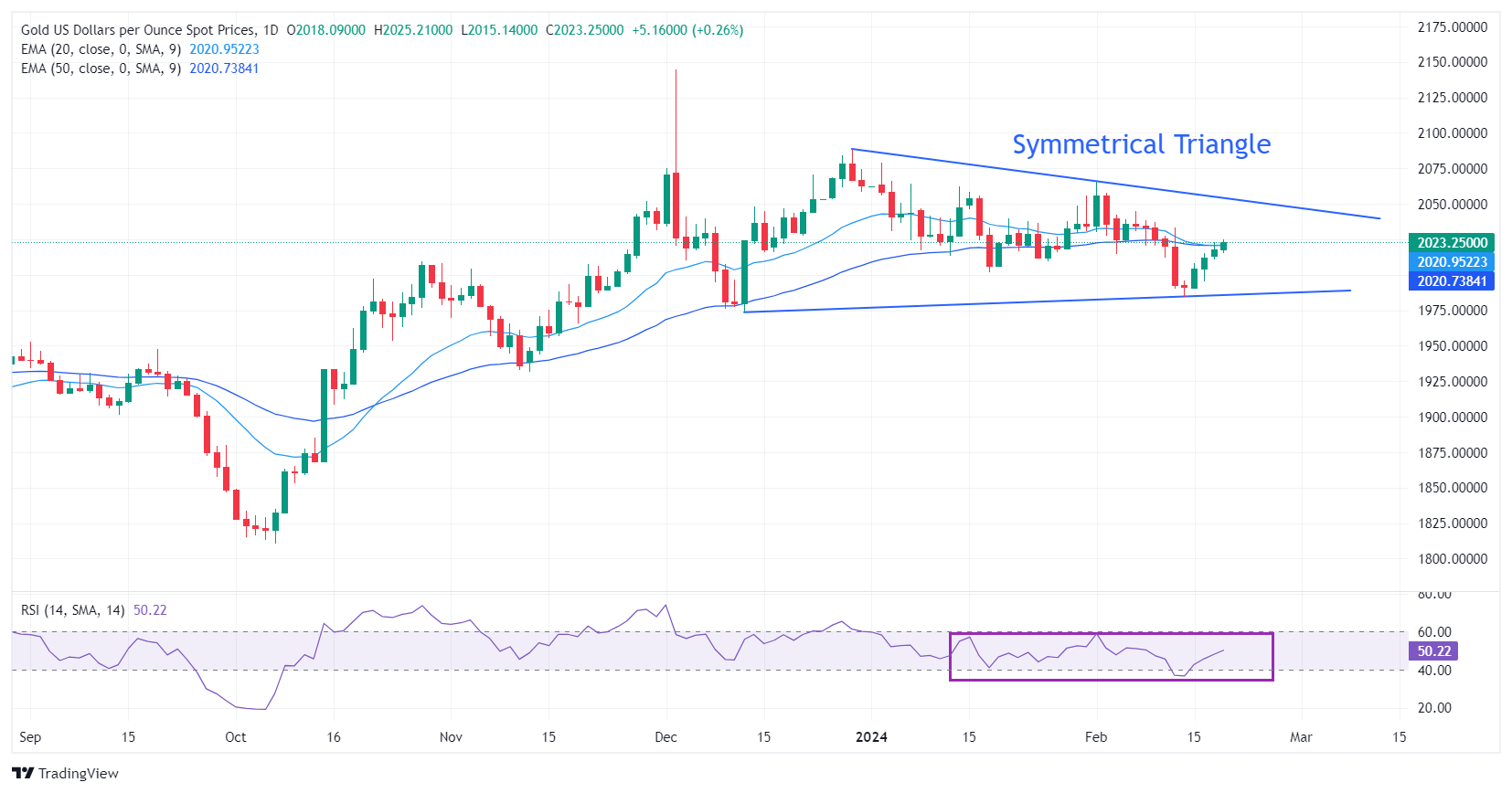
Gold price continues its winning spell for the fourth straight trading session. The precious metal attempts to deliver a decisive break above the 20 and 50-day Exponential Moving Averages (EMAs), which trade around $2,020.
The primary trend in the Gold price indicates indecisiveness among market participants due to a Symmetrical Triangle formation on a daily time frame. The upward and downward-sloping borders of the aforementioned chart pattern are plotted from December 13 low at $1,973 and December 28 high at $2,088, respectively.
The triangle could breakout in either direction, however, the odds marginally favor a move in the direction of the trend prior to the formation of the triangle – in this case up. A decisive break above or below the triangle boundary lines would indicate a breakout was underway.
The 14-period Relative Strength Index (RSI) has returned to the 40.00-60.00 range quickly after testing territory below 40.00, indicating a strong bullish reversal.
Gold FAQs
Why do people invest in Gold?
Gold has played a key role in human’s history as it has been widely used as a store of value and medium of exchange. Currently, apart from its shine and usage for jewelry, the precious metal is widely seen as a safe-haven asset, meaning that it is considered a good investment during turbulent times. Gold is also widely seen as a hedge against inflation and against depreciating currencies as it doesn’t rely on any specific issuer or government.
Who buys the most Gold?
Central banks are the biggest Gold holders. In their aim to support their currencies in turbulent times, central banks tend to diversify their reserves and buy Gold to improve the perceived strength of the economy and the currency. High Gold reserves can be a source of trust for a country’s solvency. Central banks added 1,136 tonnes of Gold worth around $70 billion to their reserves in 2022, according to data from the World Gold Council. This is the highest yearly purchase since records began. Central banks from emerging economies such as China, India and Turkey are quickly increasing their Gold reserves.
How is Gold correlated with other assets?
Gold has an inverse correlation with the US Dollar and US Treasuries, which are both major reserve and safe-haven assets. When the Dollar depreciates, Gold tends to rise, enabling investors and central banks to diversify their assets in turbulent times. Gold is also inversely correlated with risk assets. A rally in the stock market tends to weaken Gold price, while sell-offs in riskier markets tend to favor the precious metal.
What does the price of Gold depend on?
The price can move due to a wide range of factors. Geopolitical instability or fears of a deep recession can quickly make Gold price escalate due to its safe-haven status. As a yield-less asset, Gold tends to rise with lower interest rates, while higher cost of money usually weighs down on the yellow metal. Still, most moves depend on how the US Dollar (USD) behaves as the asset is priced in dollars (XAU/USD). A strong Dollar tends to keep the price of Gold controlled, whereas a weaker Dollar is likely to push Gold prices up.
Recommended Articles


