


Gold price surges as Trump signs reciprocal tariffs order
- Gold climbs to near record high amid USD weakness and trade fears
- US Dollar Index drops 0.61%, fueling bullion’s rally.
- Central banks' Gold purchases surge 54% YoY, adding upside pressure.
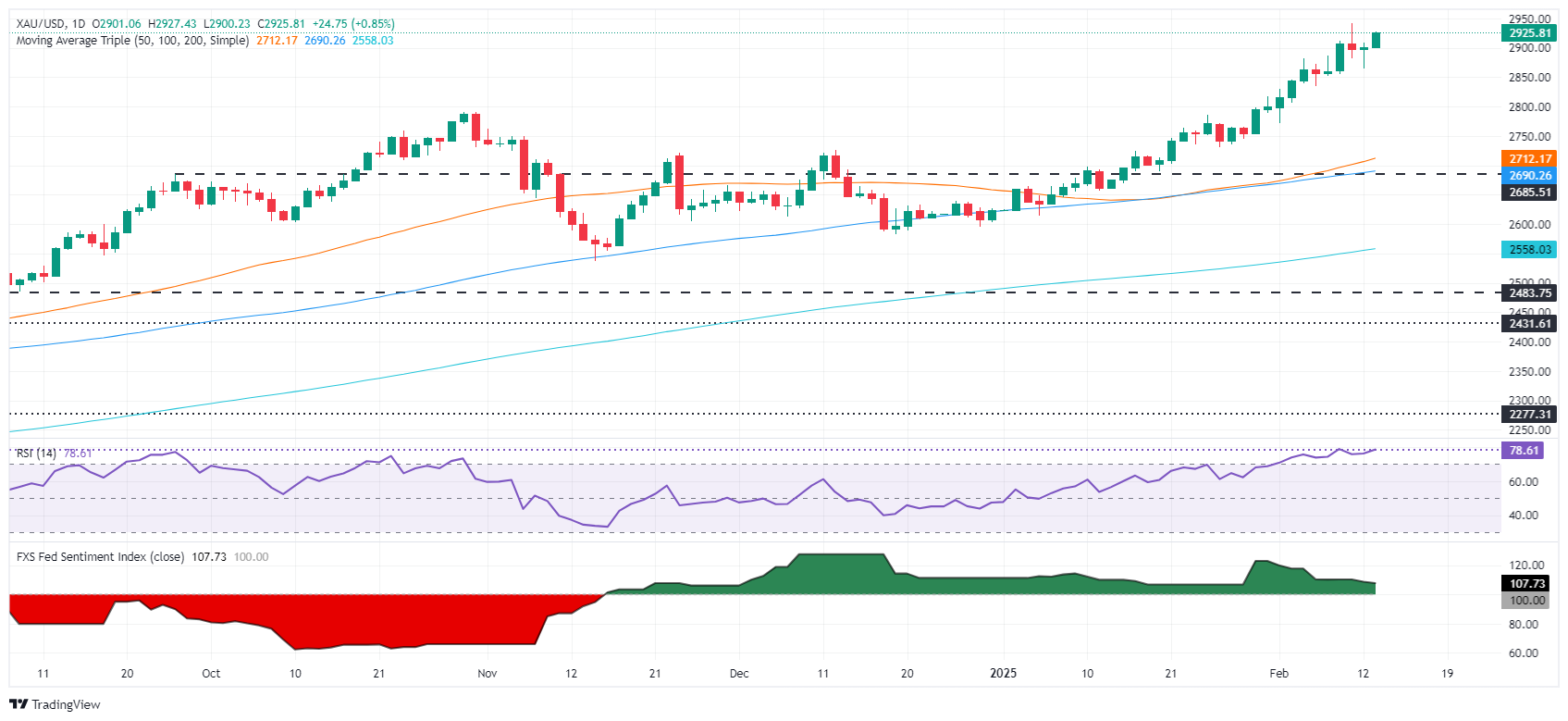
Gold climbed during the North American session on Thursday following the release of the Producer Price Index (PPI), which was mildly higher than expected. United States (US) President Donald Trump's threats of tariffs increased the appeal of the yellow metal, which trades at $2,925 shy of cracking the record high of $2,942 hit on February 11.
At the time of writing, US President Donald Trump had signed the reciprocal tariff order and said: “Whatever they charge us, we will charge them.” He added that there would be no tariffs if products are manufactured or built in the US and added that, alongside steel and aluminum, tariffs on autos are coming soon.
Bullion prices climbed on the news headlines due to the overall Greenback’s weakness across the board. The US Dollar Index (DXY), which measures the performance of the buck against a basket of six currencies, drops 0.61% down to 107.32.
US Treasury bond yields are also plunging, although the latest US inflation report on the producer’s side showed the disinflation process has stalled. The positive note in the US economic docket is that the jobs market is still strong after the number of Americans filling for unemployment benefits dipped last week, revealed the US Department of Labor.
Given the uncertainty surrounding US trade policies and a possible reacceleration of inflation, XAU/USD could test higher prices in the short term. In addition, as revealed on February 11, increased demand from central banks could exert upward pressure on Bullion prices.
The World Gold Council (WGC) revealed that central banks purchased over 1,000 tons of gold for the third consecutive year in 2024. Following Trump's electoral victory, purchases by central banks surged by more than 54% year-over-year to 333 tons, according to WGC data.
Daily digest market movers: Gold rallies as US Treasury bond yields plummet
- The US 10-year Treasury bond yield tanks ten basis points (bps), and is down at 4.519%.
- US real yields, which correlate inversely to Bullion prices, plunge eight basis points to 2.072%, a tailwind for XAU/USD.
- The January US Producer Price Index (PPI) registered a 0.4% MoM increase, surpassing forecasts of 0.3% and showing a slight decrease from the previous month's 0.5%. Over the past twelve months, the PPI climbed by 3.5%, exceeding expectations and rising from December's 3.3% figure.
- Core PPI, which excludes volatile food and energy prices, rose by 0.3% MoM as anticipated and experienced an increase of 3.6% YoY, higher than the expected 3.3%.
- Furthermore, Initial Jobless Claims for the week ending February 8 dropped to 213K, below the forecast of 215K but improving from the previous week's total of 220K.
- The latest US inflation reports altered the Fed’s stance from easing policy to holding rates unchanged as the disinflation process stalled. Fed Chair Jerome Powell said on Wednesday, "We are close but not there on inflation," and emphasized the need to "keep policy restrictive for now."
- Money market fed funds rate futures are pricing 38.5 basis points of easing by the Federal Reserve in 2025.
XAU/USD technical outlook: Gold price jumps towards the all-time high
Gold price rally is accelerating as of the writing, following Trump’s signing an executive order for reciprocal tariffs. As investors turn nervous, the non-yielding metal continues to climb after clearing the February 12 peak of $2,909.
After turning flat, the Relative Strength Index (RSI) aims higher, indicating that bulls are moving in. With that said, XAU/USD's next key resistance level would be an all-time high at $2,942. A breach of the latter will expose $2,950, followed by the $3,000 milestone for the golden metal.
Conversely, if XAU/USD drops below $2,900, the first support would be the psychological $2,850 mark. Once surpassed, the October 31 cycle high turned support at $2,790 is up next, followed by January 27’s swing low of $2,730.
Gold FAQs
Gold has played a key role in human’s history as it has been widely used as a store of value and medium of exchange. Currently, apart from its shine and usage for jewelry, the precious metal is widely seen as a safe-haven asset, meaning that it is considered a good investment during turbulent times. Gold is also widely seen as a hedge against inflation and against depreciating currencies as it doesn’t rely on any specific issuer or government.
Central banks are the biggest Gold holders. In their aim to support their currencies in turbulent times, central banks tend to diversify their reserves and buy Gold to improve the perceived strength of the economy and the currency. High Gold reserves can be a source of trust for a country’s solvency. Central banks added 1,136 tonnes of Gold worth around $70 billion to their reserves in 2022, according to data from the World Gold Council. This is the highest yearly purchase since records began. Central banks from emerging economies such as China, India and Turkey are quickly increasing their Gold reserves.
Gold has an inverse correlation with the US Dollar and US Treasuries, which are both major reserve and safe-haven assets. When the Dollar depreciates, Gold tends to rise, enabling investors and central banks to diversify their assets in turbulent times. Gold is also inversely correlated with risk assets. A rally in the stock market tends to weaken Gold price, while sell-offs in riskier markets tend to favor the precious metal.
The price can move due to a wide range of factors. Geopolitical instability or fears of a deep recession can quickly make Gold price escalate due to its safe-haven status. As a yield-less asset, Gold tends to rise with lower interest rates, while higher cost of money usually weighs down on the yellow metal. Still, most moves depend on how the US Dollar (USD) behaves as the asset is priced in dollars (XAU/USD). A strong Dollar tends to keep the price of Gold controlled, whereas a weaker Dollar is likely to push Gold prices up.
Recommended Articles


