


Gold trades firm as US-Venezuela tensions keep geopolitical risks elevated
- Gold trades above the $4,400 mark as US-Venezuela tensions fuel safe-haven demand.
- Investors remain focused on geopolitical risks and Fed expectations as key US data looms.
- Technically, XAU/USD holds a bullish bias after finding support near $4,300.
Gold (XAU/USD) trades with a bullish bias at the start of the first full trading week of 2026, as heightened tensions between the United States (US) and Venezuela drive fresh safe-haven demand, lifting prices back above the $4,400 psychological level. At the time of writing, XAU/USD trades around $4,420, up nealry 2% on the day.
Over the weekend, the US launched a major military operation in Venezuela, carrying out air and ground strikes that led to the capture of Venezuelan President Nicolás Maduro and his wife, Cilia Flores. US President Donald Trump said the US would temporarily “run” Venezuela. “We’re going to run the country until such time as we can do a safe, proper and judicious transition,” Trump told reporters.
The sharp escalation between the US and Venezuela, combined with the ongoing Russia-Ukraine conflict, keeps Gold supported close to record highs near $4,549 set on December 26.
Meanwhile, expectations of further monetary policy easing by the Federal Reserve (Fed) add an additional layer of support as investors turn their attention to a busy week of US economic data.
The spotlight later on Monday falls on the ISM Manufacturing Purchasing Managers Index (PMI) for December, followed by the S&P Global Composite and Services PMIs on Tuesday. Markets will also digest the ISM Services PMI and JOLTS Job Openings report on Wednesday, weekly Initial Jobless Claims on Thursday, and the closely watched Nonfarm Payrolls (NFP) report on Friday.
Market movers: Geopolitical uncertainty and Fed guidance remain in focus
- Venezuelan President Nicolás Maduro is being held at a detention center in Brooklyn to face drug- and terrorism-related charges. The move has drawn international criticism. However, the US president defended the action and issued sharp warnings to other countries in the region, saying Cuba looks ready to fall amid its economic troubles and that Mexico must get its act together on cartel violence. He also repeated controversial remarks about the strategic importance of Greenland.
- On the monetary policy front, investors are pricing in two interest rate cuts this year following a cumulative 75 basis points (bps) of easing in 2025. However, the Fed’s latest dot plot from the December FOMC meeting points to only one cut in 2026. Recent data showed the US economy expanded at an annualised pace of 4.3% in Q3, while inflation showed some signs of cooling, with the Consumer Price Index (CPI) rising 2.7% YoY in November, keeping the door open for further policy easing.
- Philadelphia Fed President Anna Paulson said over the weekend that she expects inflation to moderate, the labour market to stabilise and US economic growth to come in around 2% this year. Speaking ahead of the Allied Social Science Associations Annual Meeting, Paulson noted that the job market has been bending but not breaking. She said she views the current level of the funds rate as still a little restrictive, adding that some modest further policy adjustments could be appropriate later in the year.
- According to the CME FedWatch Tool, markets widely expect the Fed to keep interest rates unchanged at the January 27-28 meeting, with only an 18.3% probability of a rate cut. The odds of a cut rise to around 44% for the March meeting.
Technical analysis:
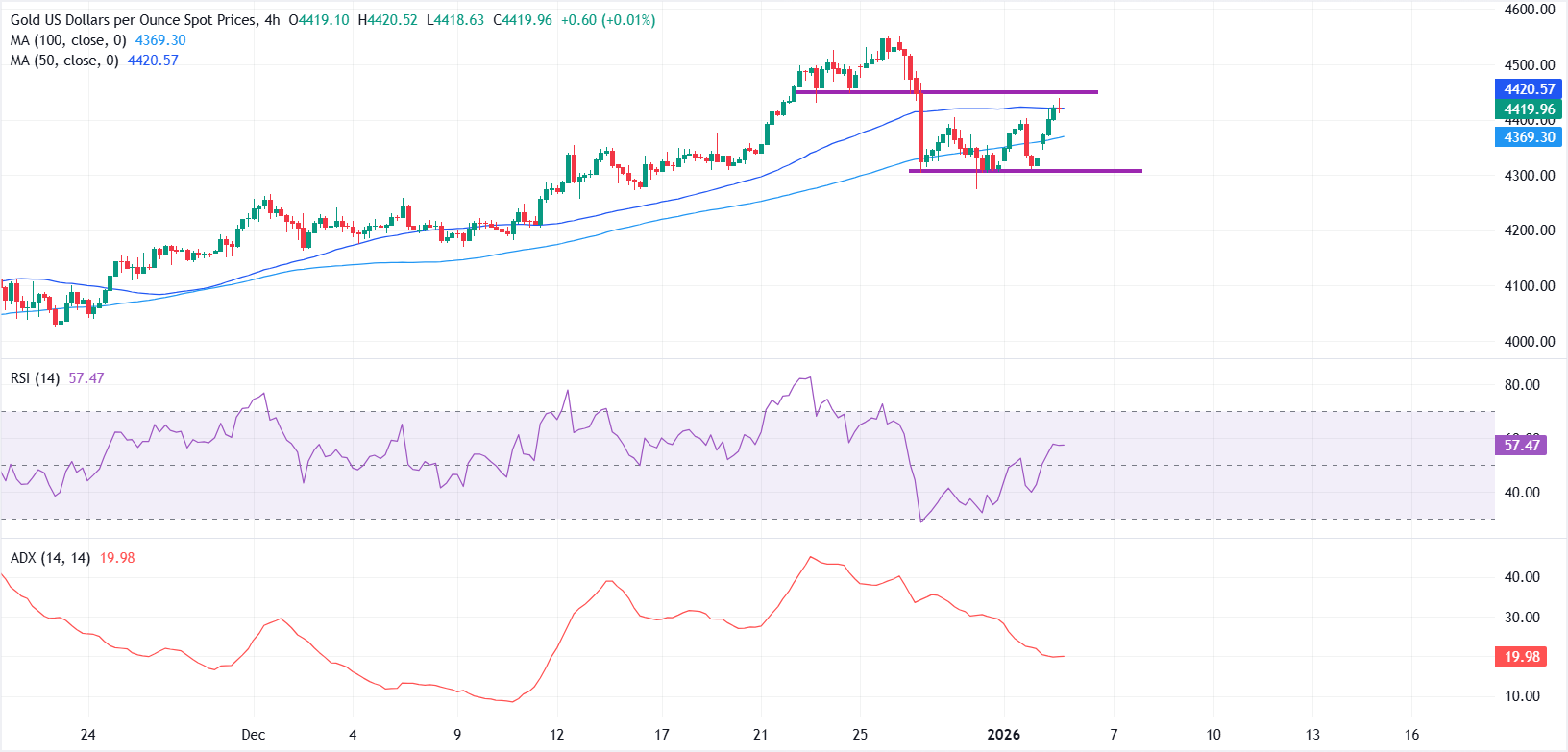
The technical outlook for XAU/USD remains bullish following a brief correction from record highs, with buyers stepping back in near the $4,300 psychological level.
On the 4-hour chart, the Relative Strength Index has turned higher and climbed back above the 50 threshold after briefly dipping toward oversold territory, pointing to improving momentum. However, the Average Directional Index continues to trend lower, indicating a loss of trend strength and suggesting prices may consolidate before the next leg higher.
On the upside, immediate resistance is seen near $4,450. A sustained break above this zone would expose the all-time high around $4,549, with further upside potential beyond that level.
On the downside, a failure to hold above the 50-period Simple Moving Average near $4,420 would shift focus toward the 100-period SMA around $4,367. Stronger support is located near the $4,300 psychological mark, where buyers previously emerged.
Gold FAQs
Gold has played a key role in human’s history as it has been widely used as a store of value and medium of exchange. Currently, apart from its shine and usage for jewelry, the precious metal is widely seen as a safe-haven asset, meaning that it is considered a good investment during turbulent times. Gold is also widely seen as a hedge against inflation and against depreciating currencies as it doesn’t rely on any specific issuer or government.
Central banks are the biggest Gold holders. In their aim to support their currencies in turbulent times, central banks tend to diversify their reserves and buy Gold to improve the perceived strength of the economy and the currency. High Gold reserves can be a source of trust for a country’s solvency. Central banks added 1,136 tonnes of Gold worth around $70 billion to their reserves in 2022, according to data from the World Gold Council. This is the highest yearly purchase since records began. Central banks from emerging economies such as China, India and Turkey are quickly increasing their Gold reserves.
Gold has an inverse correlation with the US Dollar and US Treasuries, which are both major reserve and safe-haven assets. When the Dollar depreciates, Gold tends to rise, enabling investors and central banks to diversify their assets in turbulent times. Gold is also inversely correlated with risk assets. A rally in the stock market tends to weaken Gold price, while sell-offs in riskier markets tend to favor the precious metal.
The price can move due to a wide range of factors. Geopolitical instability or fears of a deep recession can quickly make Gold price escalate due to its safe-haven status. As a yield-less asset, Gold tends to rise with lower interest rates, while higher cost of money usually weighs down on the yellow metal. Still, most moves depend on how the US Dollar (USD) behaves as the asset is priced in dollars (XAU/USD). A strong Dollar tends to keep the price of Gold controlled, whereas a weaker Dollar is likely to push Gold prices up.
Recommended Articles


