

NZD/USD Price Forecast: Plunges below 0.6100 on RBNZ 50 bps rate cut

Source Fxstreet
  • NZD/USD plummets below 0.6100 as the RBNZ reduced its OCR further by 50 bps to 4.75%.
  • The RBNZ was expected to deliver a hefty rate cut amid weak growth prospects.
  • Investors await the FOMC minutes for fresh cues on the interest rate outlook.

The NZD/USD pair faces an intense sell-off and slides below the round-level support of 0.6100 in Wednesday’s North American session. The Kiwi pair plunges as the Reserve Bank of New Zealand (RBNZ) has cut its Official Cash Rate (OCR) by 50 basis points (bps) to 4.75%.

The RBNZ was expected to deliver a larger-than-usual interest rate cut due to softening labor market conditions and subdued growth. Market participants expect the RBNZ to reduce interest rates at a similar pace again in November.

Meanwhile, dismal market sentiment due to Middle East risks has also dampened the appeal of risk-sensitive assets. The US Dollar Index (DXY), which tracks the Greenback’s value against six major currencies, climbs to near 102.70.

The US Dollar strengthens as traders have priced out the scenario of the Federal Reserve (Fed) to reduce interest rates again by 50 bps in November. The Fed started the policy-easing cycle with a sizeable cut of 50 bps in September. Meanwhile, investors await Federal Open Market Committee (FOMC) Minutes for the September meeting, which will be published at 18:00 GMT.

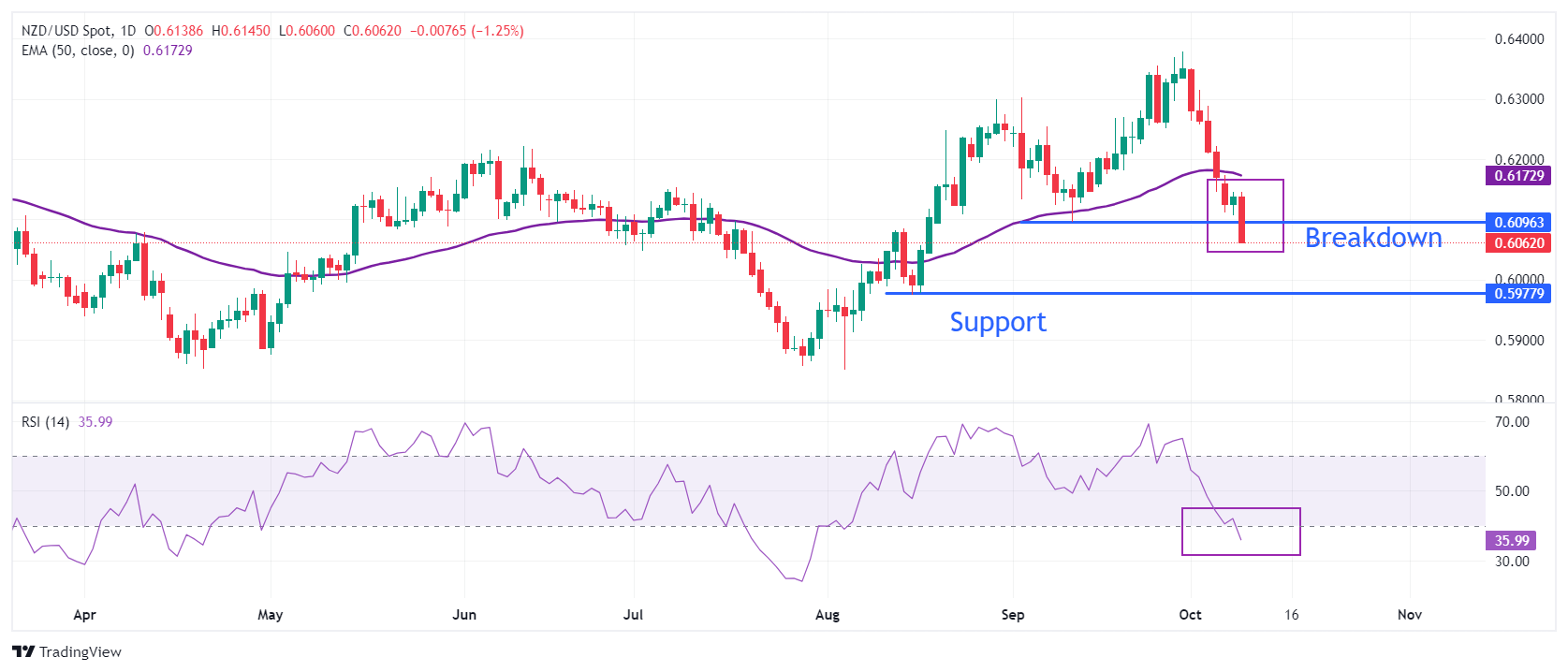
NZD/USD weakens after breaking below the horizontal support plotted from the September 11 low of 0.6100 on a daily timeframe. The overall trend of the Kiwi pair has become bearish as it has formed a lower swing low. The asset is also trading below the 50-day Exponential Moving Average (EMA), which trades around 0.6173.

The 14-day Relative Strength Index (RSI) slides below 40.00, suggesting that a bearish momentum has been triggered.

More downside is highly likely towards the psychological support of 0.6000 and the August 15 low of 0.5974.

On the flip side, a reversal move above the October 8 high of 0.6146 will drive the asset towards the 50-day EMA at 0.6173 and the October 4 high near 0.6220.

NZD/USD daily chart
Economic Indicator

RBNZ Interest Rate Decision

The Reserve Bank of New Zealand (RBNZ) announces its interest rate decision after its seven scheduled annual policy meetings. If the RBNZ is hawkish and sees inflationary pressures rising, it raises the Official Cash Rate (OCR) to bring inflation down. This is positive for the New Zealand Dollar (NZD) since higher interest rates attract more capital inflows. Likewise, if it reaches the view that inflation is too low it lowers the OCR, which tends to weaken NZD.

Read more.

Last release: Wed Oct 09, 2024 01:00

Frequency: Irregular

Actual: 4.75%

Consensus: 4.75%

Previous: 5.25%

Source: Reserve Bank of New Zealand

The Reserve Bank of New Zealand (RBNZ) holds monetary policy meetings seven times a year, announcing their decision on interest rates and the economic assessments that influenced their decision. The central bank offers clues on the economic outlook and future policy path, which are of high relevance for the NZD valuation. Positive economic developments and upbeat outlook could lead the RBNZ to tighten the policy by hiking interest rates, which tends to be NZD bullish. The policy announcements are usually followed by Governor Adrian Orr’s press conference.


Disclaimer: For information purposes only. Past performance is not indicative of future results.
placeholder
Bitcoin To Anchor America Party—’Fiat Is Hopeless,’ Says Elon MuskMusk Pitches Bitcoin As Pillar Of America Party
Author  Bitcoinist
Jul 07, 2025
Musk Pitches Bitcoin As Pillar Of America Party
placeholder
Bitcoin briefly loses 2025 gains as crypto plunges over the weekend.Bitcoin experienced a sharp decline this weekend, briefly erasing its 2025 gains and dipping below its year-opening value of $93,507. The cryptocurrency fell to a low of $93,029 on Sunday, representing a 25% drop from its all-time high in October. Although it has rebounded slightly to around $94,209, the pressures on the market remain significant. The downturn occurred despite the reopening of the U.S. government on Thursday, which many had hoped would provide essential support for crypto markets. This year initially appeared promising for cryptocurrencies, particularly after the inauguration of President Donald Trump, who has established the most pro-crypto administration thus far. However, ongoing political tensions—including Trump's tariff strategies and the recent government shutdown, lasting a historic 43 days—have contributed to several rapid price pullbacks for Bitcoin throughout the year. Market dynamics are also being influenced by Bitcoin whales—investors holding large amounts of Bitcoin—who have been offloading portions of their assets, consequently stalling price rallies even as positive regulatory developments emerge. Despite these sell-offs, analysts from Glassnode argue that this behavior aligns with typical patterns seen among long-term investors during the concluding stages of bull markets, suggesting it is not indicative of a mass exodus. Notably, Bitcoin is not alone in its struggles, as Ethereum and Solana have also recorded declines of 7.95% and 28.3%, respectively, since the start of the year, while numerous altcoins have faced even steeper losses. Looking ahead, questions linger regarding the viability of the four-year cycle thesis, particularly given the increasing institutional support and regulatory frameworks now in place in the crypto landscape. Matt Hougan, chief investment officer at Bitwise, remains optimistic, suggesting a potential Bitcoin resurgence in 2026 driven by the “debasement trade” thesis and a broader trend toward increased adoption of stablecoins, tokenization, and decentralized finance. Hougan emphasized the soundness of the underlying fundamentals, pointing to a positive outlook for the sector in the longer term.
Author  Mitrade
Nov 17, 2025
Bitcoin experienced a sharp decline this weekend, briefly erasing its 2025 gains and dipping below its year-opening value of $93,507. The cryptocurrency fell to a low of $93,029 on Sunday, representing a 25% drop from its all-time high in October. Although it has rebounded slightly to around $94,209, the pressures on the market remain significant. The downturn occurred despite the reopening of the U.S. government on Thursday, which many had hoped would provide essential support for crypto markets. This year initially appeared promising for cryptocurrencies, particularly after the inauguration of President Donald Trump, who has established the most pro-crypto administration thus far. However, ongoing political tensions—including Trump's tariff strategies and the recent government shutdown, lasting a historic 43 days—have contributed to several rapid price pullbacks for Bitcoin throughout the year. Market dynamics are also being influenced by Bitcoin whales—investors holding large amounts of Bitcoin—who have been offloading portions of their assets, consequently stalling price rallies even as positive regulatory developments emerge. Despite these sell-offs, analysts from Glassnode argue that this behavior aligns with typical patterns seen among long-term investors during the concluding stages of bull markets, suggesting it is not indicative of a mass exodus. Notably, Bitcoin is not alone in its struggles, as Ethereum and Solana have also recorded declines of 7.95% and 28.3%, respectively, since the start of the year, while numerous altcoins have faced even steeper losses. Looking ahead, questions linger regarding the viability of the four-year cycle thesis, particularly given the increasing institutional support and regulatory frameworks now in place in the crypto landscape. Matt Hougan, chief investment officer at Bitwise, remains optimistic, suggesting a potential Bitcoin resurgence in 2026 driven by the “debasement trade” thesis and a broader trend toward increased adoption of stablecoins, tokenization, and decentralized finance. Hougan emphasized the soundness of the underlying fundamentals, pointing to a positive outlook for the sector in the longer term.
placeholder
Gold rises on softer US Dollar, traders await Trump's address on Iran warGold price (XAU/USD) extends the rally to near $4,775 during the early Asian session on Thursday. The precious metal surges amid a weakening US Dollar (USD) and cooling geopolitical tensions in the Middle East.
Author  FXStreet
Yesterday 01: 20
Gold price (XAU/USD) extends the rally to near $4,775 during the early Asian session on Thursday. The precious metal surges amid a weakening US Dollar (USD) and cooling geopolitical tensions in the Middle East.
placeholder
Silver Price Forecast: XAG/USD falls to near $72.00 amid fading safe-haven demandSilver price (XAG/USD) continues to lose ground after registering tiny losses in the previous day, trading around $72.90 during the Asian hours on Thursday. The safe-haven demand for the precious metal fades amid rising optimism over Middle East peace.
Author  FXStreet
22 hours ago
Silver price (XAG/USD) continues to lose ground after registering tiny losses in the previous day, trading around $72.90 during the Asian hours on Thursday. The safe-haven demand for the precious metal fades amid rising optimism over Middle East peace.
placeholder
Gold retreats sharply from two-week top/$4,800 as Trump’s Iran comments boost USDGold (XAU/USD) witnessed an intraday turnaround from the $4,800 mark, or a fresh two-week high set earlier this Thursday, and for now, seems to have snapped a four-day winning streak amid resurgent US Dollar (USD) demand.
Author  FXStreet
23 hours ago
Gold (XAU/USD) witnessed an intraday turnaround from the $4,800 mark, or a fresh two-week high set earlier this Thursday, and for now, seems to have snapped a four-day winning streak amid resurgent US Dollar (USD) demand.
Related Instrument
goTop
quote