


Indian Rupee falls further as US-Iran tit-for-tat strikes boost oil prices
- The Indian Rupee declines further against the US Dollar due to surging oil prices.
- A significant fall in the INR has increased the odds of RBI intervention.
- Investors await the US CPI data for fresh cues regarding the interest rate outlook.
The Indian Rupee (INR) extends its decline against the US Dollar (USD) on Wednesday after a sharp correction the previous day. The USD/INR pair jumps marginally above 95.00 as surging energy prices have battered the Indian currency significantly.
In the opening session, the MCX Crude Oil contract expiring on September 21 trades higher by over 2% to near Rs. 8,920.
Currencies from economies, such as India, which rely heavily on oil imports to meet their energy needs, tend to underperform in a high-oil-price environment.
Escalating US-Iran attacks boost oil prices
Rising tit-for-tat attacks between the US and Iran in the past few weeks have prompted fears of prolonged energy supply disruption again.
Earlier in the day, Iran's Islamic Revolutionary Guard Corps (IRGC) launched ballistic missile strikes targeting the Al Azraq air base in Jordan, which shelters US military personnel and aircraft, in response to US Central Command (CENTCOM) consistently bombing Iranian tankers in the Gulf of Oman, Al Jazeera reported.
Meanwhile, the data from Kpler shows that the number of commodity vessels sailing through the Strait of Hormuz totalled seven on September 7, compared with eight on the previous day, Reuters reported. This is a significant decline from an average of 130-140 ships transiting through Hormuz before the Middle East war started.
Falling INR prompts fears of RBI intervention
A significant decline in the Indian currency this week has prompted fears of the Reserve Bank of India’s (RBI) stealth intervention through spot and Non-Deliverable Forward (NDF) markets.
The table below shows the percentage change of Indian Rupee (INR) against listed major currencies today. Indian Rupee was the strongest against the US Dollar.
| USD | EUR | GBP | JPY | CAD | AUD | INR | CHF | |
|---|---|---|---|---|---|---|---|---|
| USD | -0.08% | -0.08% | -0.41% | -0.08% | -0.17% | 0.31% | -0.13% | |
| EUR | 0.08% | 0.00% | -0.34% | -0.01% | -0.11% | 0.47% | -0.04% | |
| GBP | 0.08% | -0.01% | -0.33% | 0.02% | -0.09% | 0.43% | -0.04% | |
| JPY | 0.41% | 0.34% | 0.33% | 0.34% | 0.24% | 0.78% | 0.30% | |
| CAD | 0.08% | 0.01% | -0.02% | -0.34% | -0.10% | 0.45% | -0.04% | |
| AUD | 0.17% | 0.11% | 0.09% | -0.24% | 0.10% | 0.56% | 0.07% | |
| INR | -0.31% | -0.47% | -0.43% | -0.78% | -0.45% | -0.56% | -0.50% | |
| CHF | 0.13% | 0.04% | 0.04% | -0.30% | 0.04% | -0.07% | 0.50% |
The heat map shows percentage changes of major currencies against each other. The base currency is picked from the left column, while the quote currency is picked from the top row. For example, if you pick the Indian Rupee from the left column and move along the horizontal line to the US Dollar, the percentage change displayed in the box will represent INR (base)/USD (quote).
According to a Reuters report, while the Indian central bank was present in the market on Tuesday, traders said the intervention was not enough to prevent the Indian Rupee from weakening.
US Inflation will be key trigger this week
This week, the major trigger for the USD/INR pair will be the US Consumer Price Index (CPI) data for August, which will be released on Friday. The inflation data is expected to have a significant influence on the US interest rate outlook.
According to TD Securities, upcoming inflation data should be “subdued enough to keep the Fed on hold,” though they stress that “the PCE translation will be key.” The bank estimates that, if their forecast is realized, “core PCE would likely be a modest 0.18% m/m, with market-based an even more subdued 0.13%.” They argue that such an outcome “would be a welcome number for the more centrist members of the FOMC like Waller and Williams, and in our view, would be enough to keep the Fed on hold in September.”
USD/INR Technical Analysis
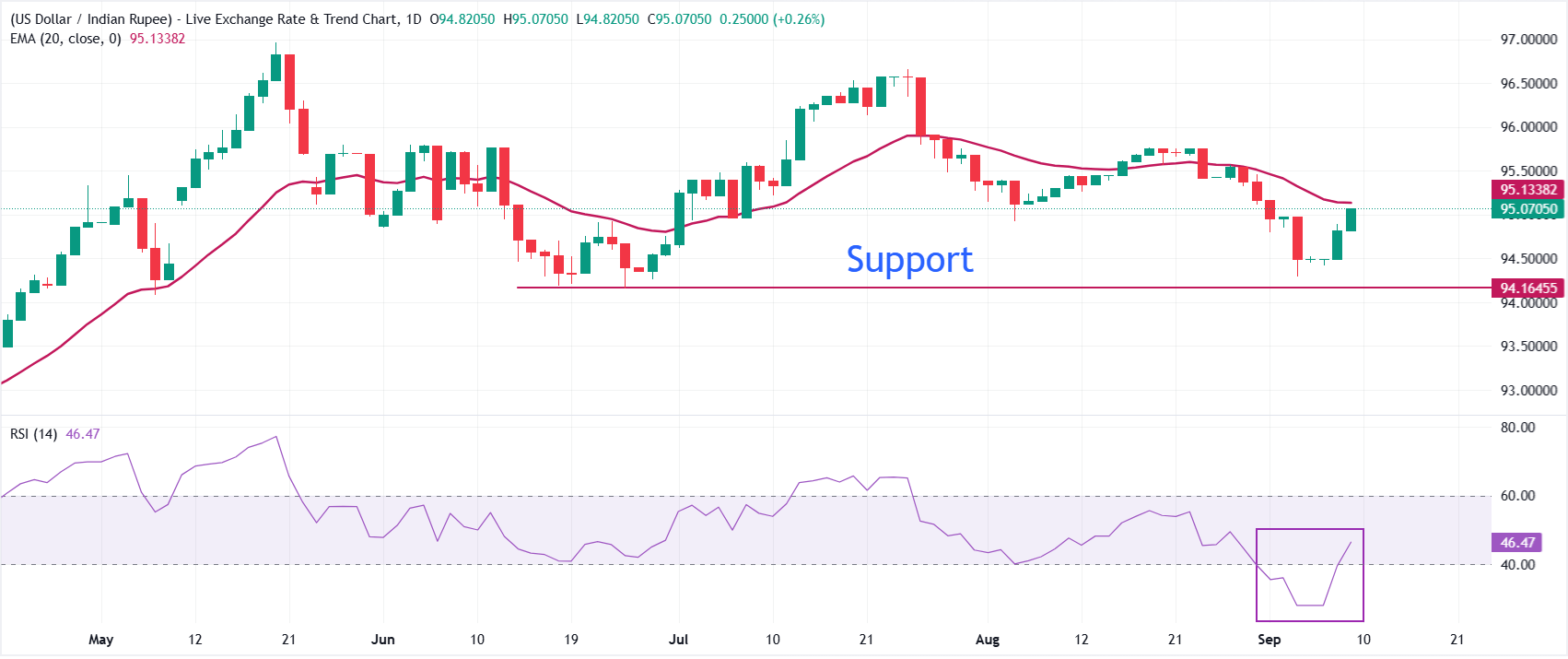
In the daily chart, USD/INR trades at 95.07. The pair has recovered strongly to near the 20-day exponential moving average (EMA) at 95.1338, suggesting strong demand at lower levels.
The Relative Strength Index (14) recovers quickly into the 40.00-60.00 zone after staying below 40.00 for a few trading days, backing the view of strong buying interest at lower levels.
On the topside, initial resistance is located at the 20-day EMA around 95.13; a daily close above this level would be needed to ease immediate selling pressure and open the way for a more sustained rebound toward 95.50. Looking down, the June low at 94.15 will remain the key support area.
(The technical analysis of this story was written with the help of an AI tool. Know more.)
Indian Rupee FAQs
The Indian Rupee (INR) is one of the most sensitive currencies to external factors. The price of Crude Oil (the country is highly dependent on imported Oil), the value of the US Dollar – most trade is conducted in USD – and the level of foreign investment, are all influential. Direct intervention by the Reserve Bank of India (RBI) in FX markets to keep the exchange rate stable, as well as the level of interest rates set by the RBI, are further major influencing factors on the Rupee.
The Reserve Bank of India (RBI) actively intervenes in forex markets to maintain a stable exchange rate, to help facilitate trade. In addition, the RBI tries to maintain the inflation rate at its 4% target by adjusting interest rates. Higher interest rates usually strengthen the Rupee. This is due to the role of the ‘carry trade’ in which investors borrow in countries with lower interest rates so as to place their money in countries’ offering relatively higher interest rates and profit from the difference.
Macroeconomic factors that influence the value of the Rupee include inflation, interest rates, the economic growth rate (GDP), the balance of trade, and inflows from foreign investment. A higher growth rate can lead to more overseas investment, pushing up demand for the Rupee. A less negative balance of trade will eventually lead to a stronger Rupee. Higher interest rates, especially real rates (interest rates less inflation) are also positive for the Rupee. A risk-on environment can lead to greater inflows of Foreign Direct and Indirect Investment (FDI and FII), which also benefit the Rupee.
Higher inflation, particularly, if it is comparatively higher than India’s peers, is generally negative for the currency as it reflects devaluation through oversupply. Inflation also increases the cost of exports, leading to more Rupees being sold to purchase foreign imports, which is Rupee-negative. At the same time, higher inflation usually leads to the Reserve Bank of India (RBI) raising interest rates and this can be positive for the Rupee, due to increased demand from international investors. The opposite effect is true of lower inflation.
Recommended Articles


