

EUR/USD extends decline after mixed German data, focus on US NFP, tariff ruling
- EUR/USD extends losses to one-month lows below 1.1660.
- Mixed German macroeconomic data has increased pressure on the Euro.
- The US NFP and the Supreme Court's ruling on Trump's trade tariffs attract the focus on Friday.
27EUR/USD depreciates further, trading at monthly lows of 1.1640 at the time of writing, on track to a 0.6% depreciation this week. Mixed data from Germany has increased pressure on the Euro (EUR) on Friday, while the US Dollar (USD) appreciates in cautious markets, with all eyes on US Nonfarm Payroll (NFP) figures and the ruling on US President Donald Trump's tariff policies.
The US Supreme Court meets later on Friday to decide the legality of Trump's use of the International Emergency Economic Powers Act form 1977 to issue trade tariffs. In case of a negative ruling, US companies are expected to request the reimbursement of nearly $150 billion for levies already paid on imports.
Before that, the Bureau of Labor Statistics (BLS) will release December's Nonfarm Payrolls report, the first complete payrolls report after the largest US government shutdown in history. The data is expected to show a moderate increase in net jobs, which is unlikely to clarify the US Federal Reserve's (Fed) monetary policy path. Markets will also be attentive to the Unemployment Rate.
In the European session, the focus will be on November's Eurozone Retail Sales report and the speech of the European Central Bank's (ECB) board member, Philip Lane. The impact of these events is likely to be limited, with investors awaiting more relevant developments in the US.
Euro Price Today
The table below shows the percentage change of Euro (EUR) against listed major currencies today. Euro was the strongest against the Japanese Yen.
| USD | EUR | GBP | JPY | CAD | AUD | NZD | CHF | |
|---|---|---|---|---|---|---|---|---|
| USD | 0.04% | 0.09% | 0.30% | 0.07% | 0.12% | 0.23% | 0.05% | |
| EUR | -0.04% | 0.05% | 0.26% | 0.03% | 0.08% | 0.18% | 0.00% | |
| GBP | -0.09% | -0.05% | 0.19% | -0.02% | 0.03% | 0.13% | -0.05% | |
| JPY | -0.30% | -0.26% | -0.19% | -0.21% | -0.17% | -0.07% | -0.25% | |
| CAD | -0.07% | -0.03% | 0.02% | 0.21% | 0.04% | 0.14% | -0.02% | |
| AUD | -0.12% | -0.08% | -0.03% | 0.17% | -0.04% | 0.10% | -0.07% | |
| NZD | -0.23% | -0.18% | -0.13% | 0.07% | -0.14% | -0.10% | -0.17% | |
| CHF | -0.05% | -0.01% | 0.05% | 0.25% | 0.02% | 0.07% | 0.17% |
The heat map shows percentage changes of major currencies against each other. The base currency is picked from the left column, while the quote currency is picked from the top row. For example, if you pick the Euro from the left column and move along the horizontal line to the US Dollar, the percentage change displayed in the box will represent EUR (base)/USD (quote).
Daily Digest Market Movers: Subdued trading ahead of US developments
- FX volatility remains low, with major currencies trading within tight ranges as investors hold their breath ahead of the US Supreme Court's decision on tariffs and the release of December's US employment report.
- Nonfarm Payrolls data is expected to show a 60K increase in net employment in December, after a 64K rise in November.
- Beyond that, the Unemployment Rate is expected to decline to 4.5% from 4.6% in November, and wage growth is expected to have accelerated 0.3% in the month and 3.6% year-on-year from 0.1% and 3.5% respectively in the previous month.
- Later on, January's preliminary Michigan Consumer Sentiment Index report is expected to show some improvement, to 53.5, from December's 52.9 reading.
- Data released on Thursday revealed that weekly Jobless Claims increased to 208K in the last week of 2025, from 200K in the previous week. The numbers, however, were lower than the 210K increase forecasted by the market, and the US Dollar appreciated following the release.
- German data has been mixed on Friday. Industrial Production rose against expectations, but the trade balance narrowed due to a significant decline in exports, which has reactivated concerns about the outlook of the region´s leading economy.
- Later on Friday, the Eurozone's November Retail Sales figures are seen ticking up 0.1% after a flat reading in October. Year-on-year, the regions' retail consumption is seen accelerating to a 1.6% increase from 1.5% in the previous month.
- The ECB Board Member Philip Lane will speak about the economy at a conference in Denmark on Friday, but he is unlikely to say anything new about the ECB's monetary policy plans.
Technical Analysis: EUR/USD's next bearish target is at the 1.1615 area
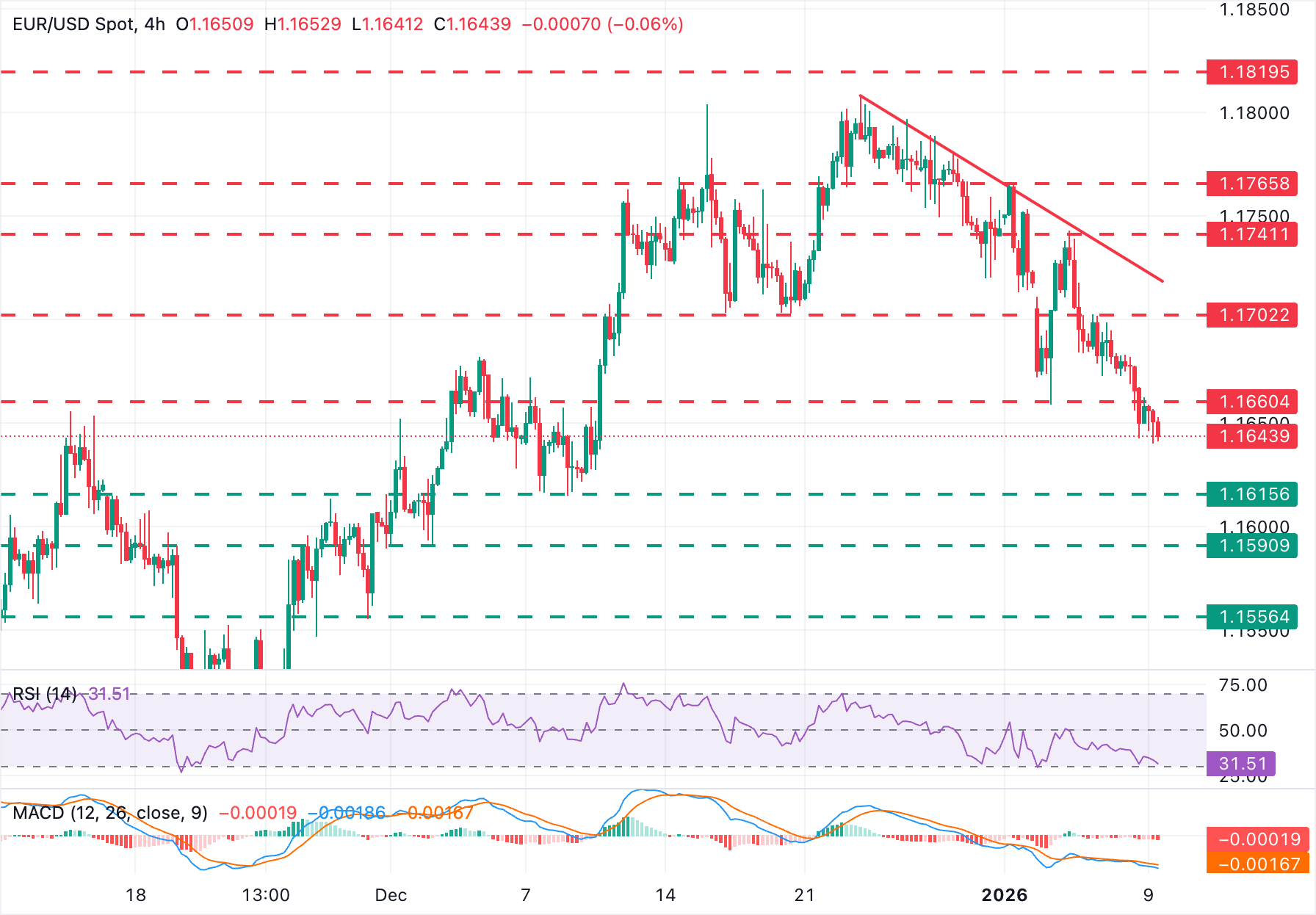
The EUR/USD broke and confirmed below the support level at the 1.1660 area, which shows that the bearish bias from 1.1808 highs remains in play. Technical indicators endorse that view. The 4-hour Moving Average Convergence Divergence (MACD) histogram bars remain below the zero level, and the Relative Strength Index (RSI) extended its decline to 31, approaching oversold levels.
Intraday lows at 1.1644 are under pressure at the time of writing, with bears looking at the December 8 and 9 lows, in the area of 1.1615. Further down, the target is the December 1 and 2 lows near 1.1590.
To the upside, the previous support at 1.1660 is acting as resistance now, closing the path towards Wednesday's high, near 1.1700, and the descending trendline from December highs, now at 1.1720.
Economic Indicator
Industrial Production s.a. (MoM)
The Industrial Production released by the Statistisches Bundesamt Deutschland measures outputs of the German factories and mines. Changes in industrial production are widely followed as a major indicator of strength in the manufacturing sector. A high reading is seen as positive (or bullish) for the EUR, whereas a low reading is seen as negative (or bearish).
Read more.Last release: Fri Jan 09, 2026 07:00
Frequency: Monthly
Actual: 0.8%
Consensus: -0.4%
Previous: 1.8%
Source: Federal Statistics Office of Germany
Economic Indicator
Trade Balance s.a.
The Trade Balance released by the Statistisches Bundesamt Deutschland is a balance between exports and imports of total goods and services. A positive value shows a trade surplus, while a negative value shows a trade deficit. It is an event that generates some volatility for the EUR. If a steady demand in exchange for German exports is seen, that would turn into a positive growth in the trade balance, and that should be positive for the EUR.
Review Alex Nekritin's Article - Trading the Euro with Germany Trade Balance
Last release: Fri Jan 09, 2026 07:00
Frequency: Monthly
Actual: €13.1B
Consensus: €16.5B
Previous: €16.9B
Source: Federal Statistics Office of Germany
data
Recommended Articles


