


USD/INR flattens while outlook remains upbeat due to consistent FIIs selling
- The Indian Rupee trades calmly against the US Dollar at open in a thin trading volume day.
- FIIs turned out to be net sellers in 17 out of 20 trading days so far this month.
- Investors await FOMC minutes for fresh cues on the US interest rate outlook.
The Indian Rupee (INR) trades almost flat against the US Dollar (USD) at the open on Tuesday. The USD/INR pair wobbles around 90.30 as trading volume gets squeezed in the final stretch of the year, with near-term bias remaining bullish due to consistent outflow of foreign funds from the Indian stock market.
On Monday, Foreign Institutional Investors (FIIs) offloaded their stake worth Rs. 2,759.89 crore in the Indian equity market. So far this month, FIIs have remained net sellers in 17 out of 20 trading days and have pared their stake worth Rs. 26,908.22 crore.
Overseas investors have been keeping a distance from the Indian secondary market amid the trade stalemate between the United States (US) and India. Negotiators from both nations have expressed several times that they are close to reaching a trade deal, but have not announced so far, due to which Washington is charging 50% tariffs on imports from New Delhi, the highest among all its trading partners.
In Tuesday’s session, investors will focus on the Trade Deficit – RBI (Q3), which will be published at 17:00 GMT. The data will demonstrate the change in the total amount of goods and services exported from and imported by India.
Daily Digest Market Movers: USD/INR trades stably ahead of FOMC minutes
- Another reason behind the sideways move in the USD/INR pair is the steady US Dollar ahead of the release of Federal Open Market Committee (FOMC) minutes of the December meeting in the late New York session.
- During the press time, the US Dollar Index (DXY), which tracks the Greenback’s value against six major currencies, trades flat around 98.00.
- Investors will pay close attention to FOMC minutes to get fresh cues on the monetary policy outlook for 2026.
- In the policy meeting, the Fed decided to cut interest rates by 25 basis points (bps) to 3.50%-3.75%. This was the third interest rate cut by the Fed in a row. Fed policymakers signaled that monetary policy conditions needed to loosen further to support deteriorating job market conditions.
- After the policy outcome, San Francisco Fed Bank President Mary Daly also stated that she favored interest rate cuts in the policy meeting, as the job market is getting softer, and added that policymakers cannot let the labor market falter.
- In the policy announcement, the Fed’s Economic Projections report showed that policymakers collectively see the Federal Funds Rate heading to 3.4% by the end of 2026, indicating that there will be only one interest rate cut in the entire next year.
- Contrary to the Fed’s projections, the CME FedWatch tool shows that the Fed will cut borrowing rates by at least 50 bps in 2026.
- Next year, the major highlight will be the announcement of Fed Chair Jerome Powell’s successor by the White House. United States (US) President Donald Trump said on Monday that he plans to announce his pick for “the next chair sometime in January”. Latest comments from Trump have signaled that former Fed Chair Kevin Warsh, White House Economic Adviser Kevin Hassett, current Fed Governors Christopher Waller and Michelle Bowman are leading contenders for the post of the Fed’s next Chairman.
Technical Analysis: USD/INR wobbles near 20-day EMA
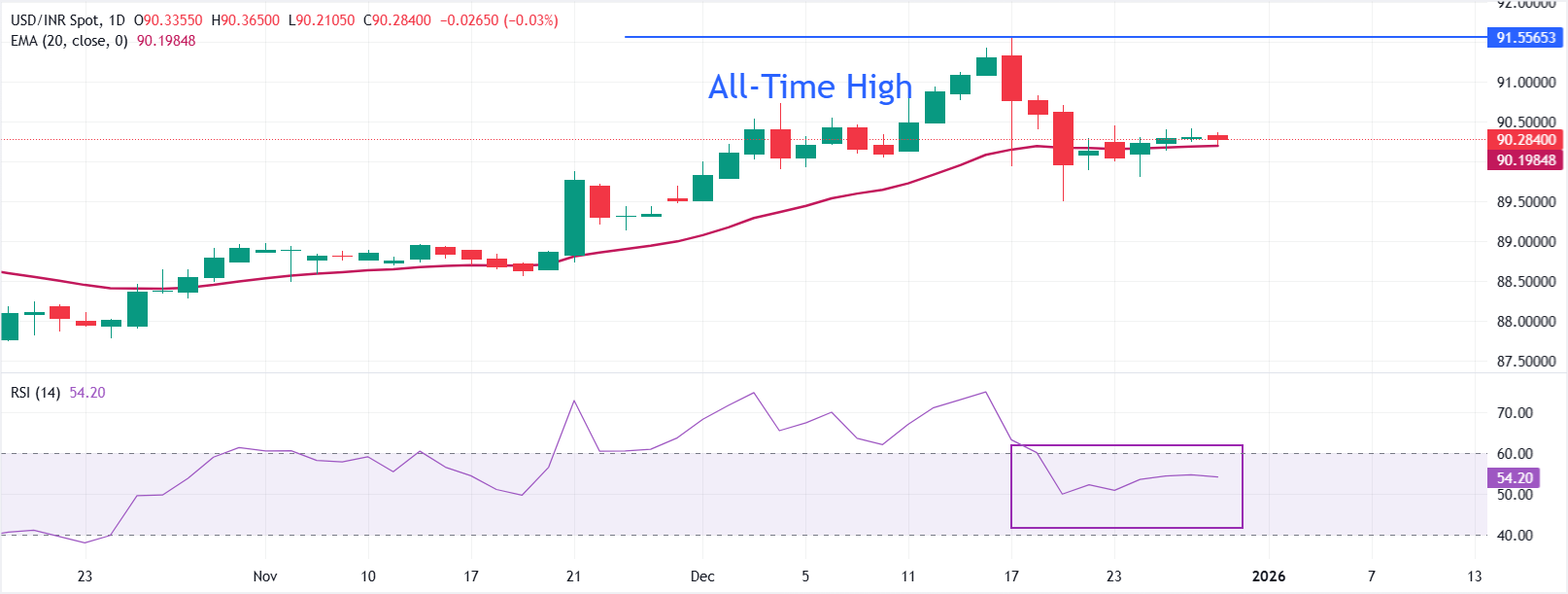
USD/INR trades flat near 90.30 in the opening trade on Tuesday. The 20-day Exponential Moving Average is rising at 90.20, with price holding above it and preserving a mild bullish bias. The 20-day EMA has been edging higher for several sessions, underscoring steady demand.
The 14-day Relative Strength Index (RSI) at 54 (neutral) reflects balanced momentum after easing from prior overbought readings.
Price action continues to respect the ascending 20-day EMA, which acts as immediate support at 90.20. A sustained close above this average keeps the trend profile positive and could encourage further upside toward the all-time high of 91.55, while a break below it would tilt the bias toward consolidation.
(The technical analysis of this story was written with the help of an AI tool.)
Indian Rupee FAQs
The Indian Rupee (INR) is one of the most sensitive currencies to external factors. The price of Crude Oil (the country is highly dependent on imported Oil), the value of the US Dollar – most trade is conducted in USD – and the level of foreign investment, are all influential. Direct intervention by the Reserve Bank of India (RBI) in FX markets to keep the exchange rate stable, as well as the level of interest rates set by the RBI, are further major influencing factors on the Rupee.
The Reserve Bank of India (RBI) actively intervenes in forex markets to maintain a stable exchange rate, to help facilitate trade. In addition, the RBI tries to maintain the inflation rate at its 4% target by adjusting interest rates. Higher interest rates usually strengthen the Rupee. This is due to the role of the ‘carry trade’ in which investors borrow in countries with lower interest rates so as to place their money in countries’ offering relatively higher interest rates and profit from the difference.
Macroeconomic factors that influence the value of the Rupee include inflation, interest rates, the economic growth rate (GDP), the balance of trade, and inflows from foreign investment. A higher growth rate can lead to more overseas investment, pushing up demand for the Rupee. A less negative balance of trade will eventually lead to a stronger Rupee. Higher interest rates, especially real rates (interest rates less inflation) are also positive for the Rupee. A risk-on environment can lead to greater inflows of Foreign Direct and Indirect Investment (FDI and FII), which also benefit the Rupee.
Higher inflation, particularly, if it is comparatively higher than India’s peers, is generally negative for the currency as it reflects devaluation through oversupply. Inflation also increases the cost of exports, leading to more Rupees being sold to purchase foreign imports, which is Rupee-negative. At the same time, higher inflation usually leads to the Reserve Bank of India (RBI) raising interest rates and this can be positive for the Rupee, due to increased demand from international investors. The opposite effect is true of lower inflation.
Recommended Articles


