

EUR/USD holds gains with Eurozone GDP and US PCE inflation in focus
- The Euro resumes its bullish trend, with 1.1680 holding bulls for now.
- The Eurozone GDP and the Employment Change will drive the Euro on Friday.
- In the US, all eyes will be on September's PCE Price Index release.
EUR/USD resumes gains on Friday, trading at 1.1660 at the time of writing, after bouncing from the 1.1640 area on Thursday. Downside attempts remain limited with markets bracing for a quarter-point interest rate cut by the Federal Reserve next week.
Economic data released on Thursday revealed that US initial Jobless Claims declined unexpectedly in the last week of November, although the figures might have been distorted by the Thanksgiving holidays.
Beyond that, US Challenger Job Cuts declined by 53% in November, to 71,321 from 153,074 in October, although the report also showed that hiring plans remained stalled amid the uncertain economic context.
In the Eurozone calendar, the third estimation of the Q3 Gross Domestic Product (GDP) and the Employment Change of the same period will attract attention during the European session, although the main focus will be on September's delayed US Personal Consumption Expenditures (PCE) Price Index, the last inflation gauge ahead of next week's Fed monetary policy meeting.
Euro Price Today
The table below shows the percentage change of Euro (EUR) against listed major currencies today. Euro was the strongest against the US Dollar.
| USD | EUR | GBP | JPY | CAD | AUD | NZD | CHF | |
|---|---|---|---|---|---|---|---|---|
| USD | -0.13% | -0.15% | -0.36% | -0.07% | -0.19% | -0.14% | -0.13% | |
| EUR | 0.13% | -0.02% | -0.23% | 0.06% | -0.06% | -0.01% | 0.00% | |
| GBP | 0.15% | 0.02% | -0.23% | 0.08% | -0.04% | 0.01% | 0.02% | |
| JPY | 0.36% | 0.23% | 0.23% | 0.29% | 0.16% | 0.20% | 0.22% | |
| CAD | 0.07% | -0.06% | -0.08% | -0.29% | -0.13% | -0.08% | -0.06% | |
| AUD | 0.19% | 0.06% | 0.04% | -0.16% | 0.13% | 0.05% | 0.06% | |
| NZD | 0.14% | 0.00% | -0.01% | -0.20% | 0.08% | -0.05% | 0.00% | |
| CHF | 0.13% | -0.00% | -0.02% | -0.22% | 0.06% | -0.06% | -0.01% |
The heat map shows percentage changes of major currencies against each other. The base currency is picked from the left column, while the quote currency is picked from the top row. For example, if you pick the Euro from the left column and move along the horizontal line to the US Dollar, the percentage change displayed in the box will represent EUR (base)/USD (quote).
Daily Digest Market Movers: US Dollar remains on the defensive amid Fed cutting hopes
- The US Dollar remains the worst performer of the G8 currencies this week. The downbeat ADP Employment Change report seen earlier this week has cemented hopes that the Fed will cut rates next week, while in Europe, manufacturing activity data beat expectations, providing additional support to the Euro.
- On Thursday, Eurozone Retail Sales disappointed with a 0% growth in October, undershooting market expectations of a 0.1% growth. September's data was revised up to a 0.1% rise from the previously estimated 0.1% decline. The Euro pulled back after the release to pick up shortly afterwards.
- US Initial Jobless Claims dropped to 191,000 in the last week of November, their lowest level in three years, from 218,00 in the previous week. The market took these figures with caution, as job seekers might have left their unemployment claims on hold during the Thanksgiving holidays.
- Futures markets are pricing in an 87% chance of a 25 basis points Fed interest rate cut at their December 10 meeting, and between two and three more cuts next year, according to the CME Group's Fedwatch Tool.
- News about the possibility of White House economic adviser Kevin Hassett replacing Jerome Powell as the next Fed chairman is also weighing on the US Dollar. The Financial Times has reported that Bond investors have complained to the US Treasury, concerned that Hassett might carry on an aggressive easing cycle.
- In the Eurozone, the focus on Friday is on the Q3 GDP latest estimate, which is expected to confirm that the economy grew 0.2% QoQ and 1.4% YoY from the same period last year, from 0.1% and 1.5% respectively in Q2.
- The Eurozone Employment Change, also out this Friday, is seen growing 0.1% in the quarter and 0.5% year-on-year, unchanged from the previous month.
- Later on the day, the US PCE Price Index is expected to confirm that inflation remains sticky, with the headline reading accelerating to a 2.8% year-on-year reading, from 2.7% in August, and the core reading growing at a steady 2.9% yearly pace.
Technical Analysis: EUR/USD bulls remain capped below 1.1680
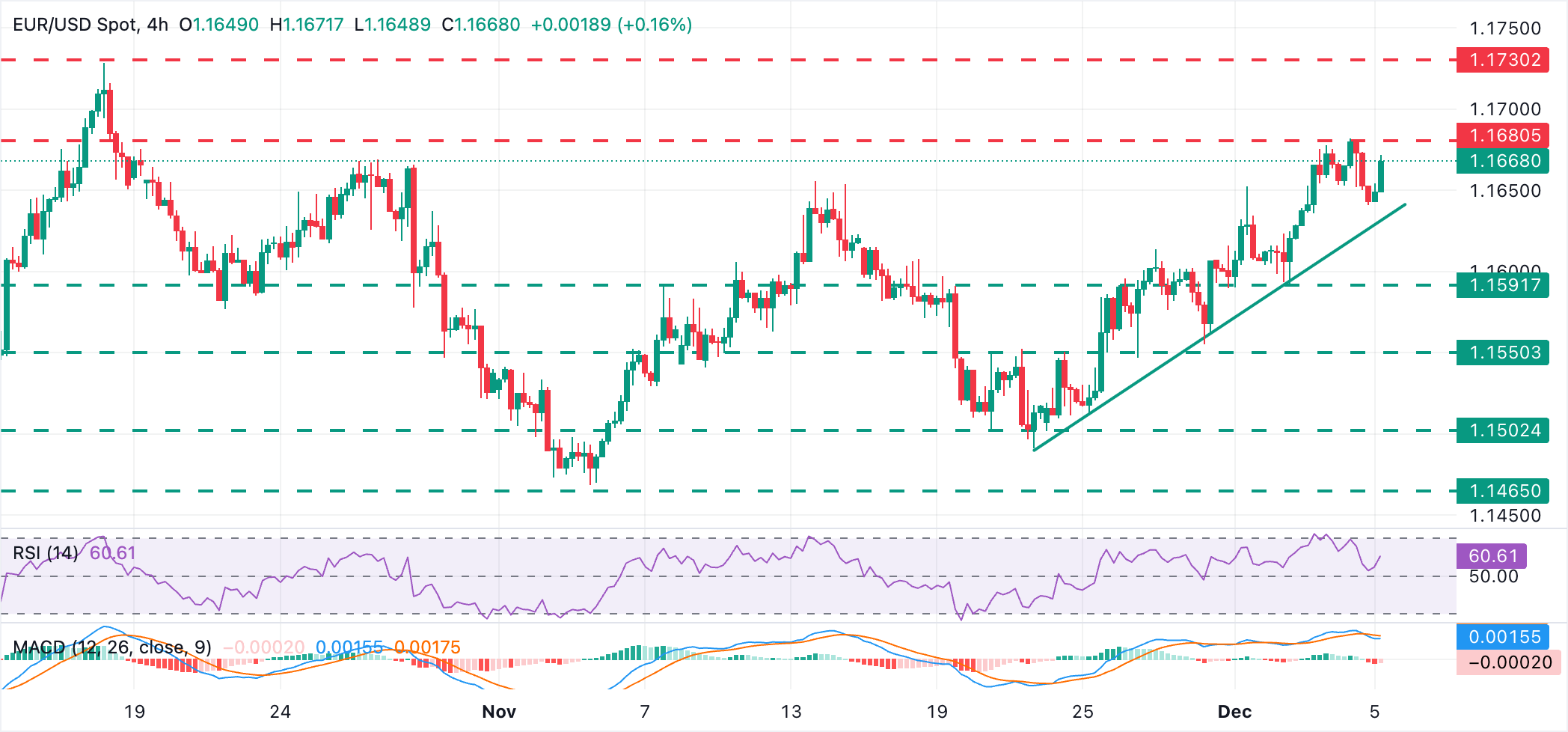
EUR/USD maintains its immediate bullish trend intact, with downside attempts contained above trendline support, now at 1.1630, while the 1.1670-1.1680 area keeps holding bulls. The 4-hour Relative Strength Index (RSI) remains steady above the 50 level, currently at 61, although the Moving Average Convergence Divergence (MACD) indicator has pulled back below the zero level, indicating that the bullish trend is losing steam.
Bulls need to breach Thursday's high at 1.1682 to extend their rally towards the October 17 high, near 1.1730, ahead of the October 1 high, at 1.1778.
A bearish reaction below the mentioned 1.1630 level, on the contrary, might lure bears to retest the weekly lows at 1.1595. Further down, the November 26 and 28 lows in the 1.1550-1.1555 area emerge as the next targets.
Euro FAQs
The Euro is the currency for the 20 European Union countries that belong to the Eurozone. It is the second most heavily traded currency in the world behind the US Dollar. In 2022, it accounted for 31% of all foreign exchange transactions, with an average daily turnover of over $2.2 trillion a day. EUR/USD is the most heavily traded currency pair in the world, accounting for an estimated 30% off all transactions, followed by EUR/JPY (4%), EUR/GBP (3%) and EUR/AUD (2%).
The European Central Bank (ECB) in Frankfurt, Germany, is the reserve bank for the Eurozone. The ECB sets interest rates and manages monetary policy. The ECB’s primary mandate is to maintain price stability, which means either controlling inflation or stimulating growth. Its primary tool is the raising or lowering of interest rates. Relatively high interest rates – or the expectation of higher rates – will usually benefit the Euro and vice versa. The ECB Governing Council makes monetary policy decisions at meetings held eight times a year. Decisions are made by heads of the Eurozone national banks and six permanent members, including the President of the ECB, Christine Lagarde.
Eurozone inflation data, measured by the Harmonized Index of Consumer Prices (HICP), is an important econometric for the Euro. If inflation rises more than expected, especially if above the ECB’s 2% target, it obliges the ECB to raise interest rates to bring it back under control. Relatively high interest rates compared to its counterparts will usually benefit the Euro, as it makes the region more attractive as a place for global investors to park their money.
Data releases gauge the health of the economy and can impact on the Euro. Indicators such as GDP, Manufacturing and Services PMIs, employment, and consumer sentiment surveys can all influence the direction of the single currency. A strong economy is good for the Euro. Not only does it attract more foreign investment but it may encourage the ECB to put up interest rates, which will directly strengthen the Euro. Otherwise, if economic data is weak, the Euro is likely to fall. Economic data for the four largest economies in the euro area (Germany, France, Italy and Spain) are especially significant, as they account for 75% of the Eurozone’s economy.
Another significant data release for the Euro is the Trade Balance. This indicator measures the difference between what a country earns from its exports and what it spends on imports over a given period. If a country produces highly sought after exports then its currency will gain in value purely from the extra demand created from foreign buyers seeking to purchase these goods. Therefore, a positive net Trade Balance strengthens a currency and vice versa for a negative balance.
Recommended Articles


