


EUR/USD cracks below 1.1600 as fear trade lifts Dollar ahead of NFP
- EUR/USD slips as AI-bubble fears hit equities and traders await Thursday’s Nonfarm Payrolls report.
- Recent US jobless claims and orders data fuel volatility ahead of FOMC minutes and December cut odds.
- Euro pressured by firmer Dollar, with Eurozone inflation expected to hold near ECB’s 2% target.
EUR/USD turns negative on the day and drops below 1.1600 for the second straight day on risk-off mood as investors wait for NVIDIA earnings, and digest US labor market data, orders ahead of Thursday’s Nonfarm Payrolls report. The pair trades at 1.1586, down 0.04%.
Euro dips for a second day as Wall Street jitters, stronger Dollar, and US data weigh on sentiment before NVIDIA earnings
Speculation of a possible AI bubble is taking its toll on Wall Street, with equities turning south. US data revealed the first print of jobless claims since the government shutdown, with investors also eyeing the Federal Open Market Committee (FOMC) latest meeting minutes.
During the last two weeks, Fed officials had struck hawkish comments, but recent data had risen the chances of a 25-basis points rate cut at the December meeting. However, a strong Nonfarm Payrolls report on Thursday, could trigger a repricing for further easing, next month.
The Euro is also pressured by the Dollar’s strength. The US Dollar Index (DXY) which tracks the performance of American currency against other six is up 0.04% at 99.57.
In Europe, Tuesday’s docket is absent. On Wednesday, inflation for the Eurozone is expected to remain unchanged by economists, with the Harmonized Index of Consumer Prices (HICP) and core HICP to remain near the European Central Bank (ECB) 2% target.
Daily market movers: EUR/USD drops amid mixed US data
- The US economic docket featured Initial Jobless Claims for the week ending October 18, came at 232,000, revealed the Department of Labor. The Commerce Department featured Factory Orders for August, which increased by 1.4% aligned with estimates up from July’s -1.3% decline.
- Richmond Fed President Thomas Barkin said the Fed’s dual mandate is “in balance,” citing upside risks to inflation and downside risks to the labor market. He stressed that the absence of official economic data complicates policymakers’ ability to assess where the Fed currently stands.
- Fed Governor Christopher Waller struck a more dovish tone, describing the labor market as “weak.” He added that inflation expectations remain well anchored and noted that core inflation is now close to the Fed’s 2% target.
- According to the CME FedWatch Tool, markets now assign a 50% probability to a rate cut at the December meeting — up from 46% earlier in the day, but still below the 67% likelihood seen last week.
- In Europe, the HICP for October is expected to rise to 2.1% YoY unchanged and monthly, 0.2%, up from 0.1%. Core HICP is expected to remain unchanged at 2.4% YoY.
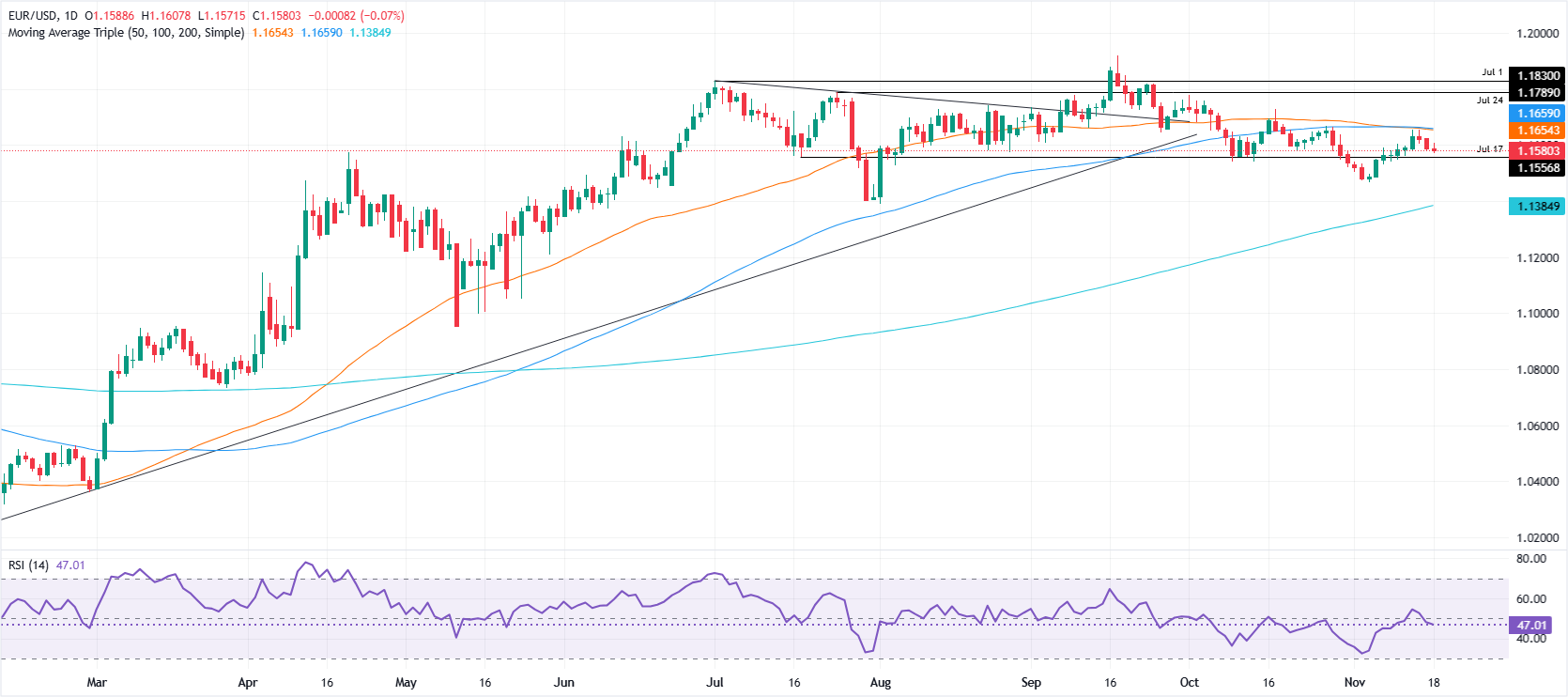
EUR/USD technical outlook: Tumbles below 1.1600, traders eye 1.1550
EUR/USD tumbled for the third straight day, clearing the 20-day Simple Moving Average (SMA) at 1.1580 opening the door for further downside. A breach beyond 1.1550 will expose 1.1500. Conversely, if EUR/USD rises past 1.1600 the shared currency might remain trapped within the 1.1600-1.1650 range. A breach of the latter will expose the 100-day SMA at 1.1659.
Euro FAQs
The Euro is the currency for the 20 European Union countries that belong to the Eurozone. It is the second most heavily traded currency in the world behind the US Dollar. In 2022, it accounted for 31% of all foreign exchange transactions, with an average daily turnover of over $2.2 trillion a day. EUR/USD is the most heavily traded currency pair in the world, accounting for an estimated 30% off all transactions, followed by EUR/JPY (4%), EUR/GBP (3%) and EUR/AUD (2%).
The European Central Bank (ECB) in Frankfurt, Germany, is the reserve bank for the Eurozone. The ECB sets interest rates and manages monetary policy. The ECB’s primary mandate is to maintain price stability, which means either controlling inflation or stimulating growth. Its primary tool is the raising or lowering of interest rates. Relatively high interest rates – or the expectation of higher rates – will usually benefit the Euro and vice versa. The ECB Governing Council makes monetary policy decisions at meetings held eight times a year. Decisions are made by heads of the Eurozone national banks and six permanent members, including the President of the ECB, Christine Lagarde.
Eurozone inflation data, measured by the Harmonized Index of Consumer Prices (HICP), is an important econometric for the Euro. If inflation rises more than expected, especially if above the ECB’s 2% target, it obliges the ECB to raise interest rates to bring it back under control. Relatively high interest rates compared to its counterparts will usually benefit the Euro, as it makes the region more attractive as a place for global investors to park their money.
Data releases gauge the health of the economy and can impact on the Euro. Indicators such as GDP, Manufacturing and Services PMIs, employment, and consumer sentiment surveys can all influence the direction of the single currency. A strong economy is good for the Euro. Not only does it attract more foreign investment but it may encourage the ECB to put up interest rates, which will directly strengthen the Euro. Otherwise, if economic data is weak, the Euro is likely to fall. Economic data for the four largest economies in the euro area (Germany, France, Italy and Spain) are especially significant, as they account for 75% of the Eurozone’s economy.
Another significant data release for the Euro is the Trade Balance. This indicator measures the difference between what a country earns from its exports and what it spends on imports over a given period. If a country produces highly sought after exports then its currency will gain in value purely from the extra demand created from foreign buyers seeking to purchase these goods. Therefore, a positive net Trade Balance strengthens a currency and vice versa for a negative balance.
Recommended Articles


