


EUR/USD rises to 1.1590 as weak US data pressures Dollar
- EUR/USD rises as Dollar weakens on disappointing US data, rebounding from earlier session lows.
- ADP report shows further labor market cooling, while NFIB optimism index hits yearly low.
- Senate passes stopgap funding bill; traders await House vote as Fed officials send mixed signals.
The Euro advances during the North American session posting gains of 0.30% as the Greenback tumbles on worse than expected US ADP jobs data and business turning pessimistic on the economic outlook. The EUR/USD trades at 1.1590 after bouncing of daily lows of 1.1547.
Euro gains as soft ADP report, business pessimism reinforce bets for a December Fed rate cut
The US economic docket remains scarce, yet Automatic Data Processing (ADP) released the weekly ADP Employment Change, which reinforced the thesis that the labor market is weakening. Also, the NFIB Small Business Optimism Index fell to its lowest level in the year.
Late on Monday, the US Senate passed the funding stopgap bill on a 60-40 vote last night. Now is the turn for the House of Representatives, with House Speaker Mike Johnson saying that he expects the funding will pass quickly.
In the meantime, the lack of economic data leaves traders leaning to Fed speakers, which were absent on Tuesday, but crossed the wires on Monday. Fed Governor Stephen Moran struck to its dovish stance eyeing a 50-basis point rate cut at the December meeting. Contrarily, St. Louis Fed Alberto Musalem revealed that inflation is closer to 3% than 2%, that the labor market has cooled orderly and that monetary policy is closer to neutral than modestly restrictive.
In Europe, the German ZEW survey in November showed that German investors are pessimistic about the economic outlook, even though current conditions improved beneath estimates. Across the whole bloc, the index improved beyond forecasts.
Daily market movers: EUR/USD to extend gains on monetary policy divergence
- The US Dollar Index (DXY), which tracks the performance of the American currency against other six, dipped on concerns about the weakness of the US labor market, is down 0.15% at 99.47.
- The NFIB Small Business Optimism Index slipped to 98.2 in October but remained above the 52-year average of 98. Meanwhile, the Uncertainty Index dropped 12 points from September to 88 — its lowest level so far this year — suggesting improved clarity among business owners despite lingering economic headwinds.
- The looming US government reopening keeps speculation on when the Bureau of Labor Statistics (BLS) will reveal the September Nonfarm Payrolls report. Goldman Sachs expect the NFP report to be unveiled at around November 18 or 19.
- Monetary policy divergence supports further Euro upside as the European Central Bank (ECB) is projected to keep rates unchanged through 2027. Conversely, the Fed is expected to continue its easing cycle, with traders pricing in 125 bps of cuts toward the end of 2026.
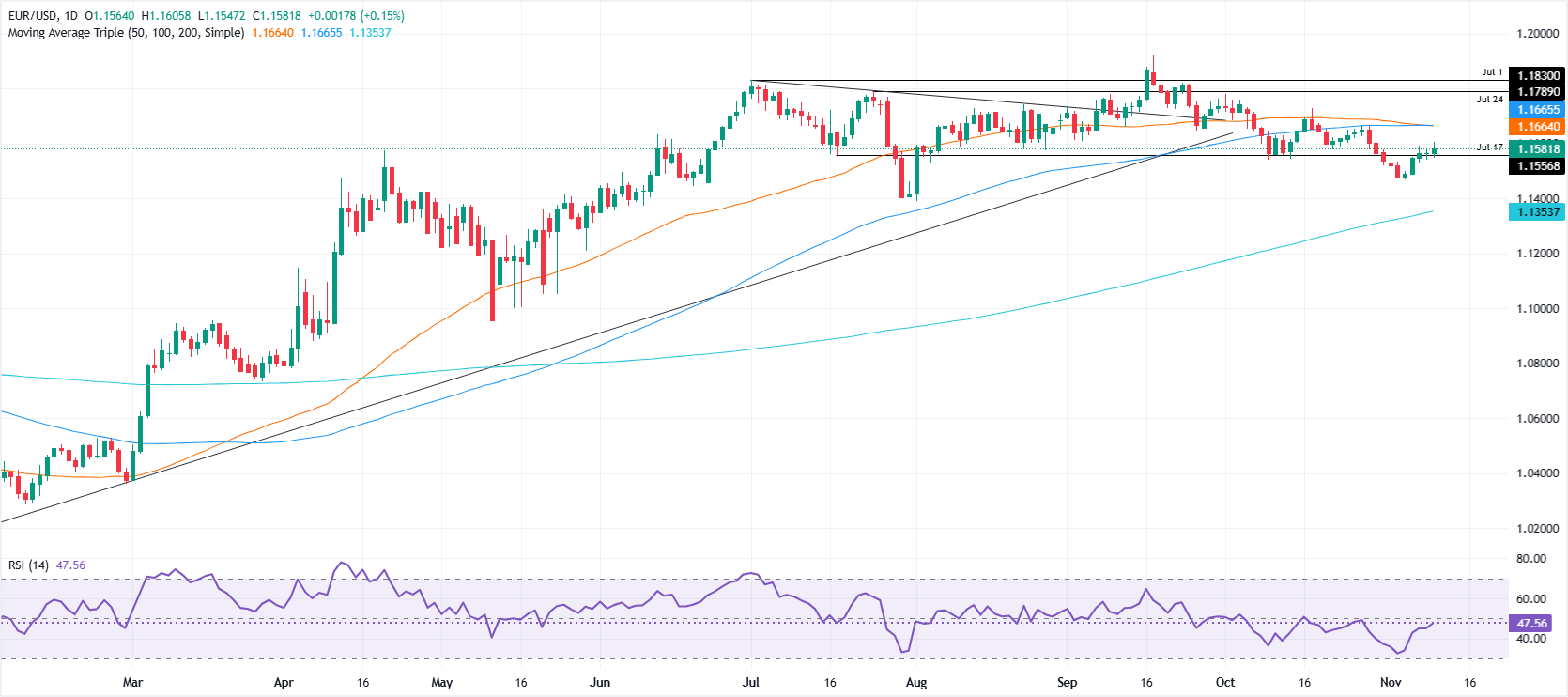
Technical outlook: EUR/USD consolidates beneath 1.16
The EUR/USD retains a bearish undertone despite sellers struggle to drive the pair toward the 200-day Simple Moving Average (SMA) at 1.1350. The Relative Strength Index (RSI) shows that buyers are gathering momentum, but the index is still below its 50 neutral level, an indication that bears remain in charge.
A drop below 1.1500 would expose the August 1 cycle low at 1.1391, reinforcing the broader downtrend. On the flipside, a sustained breach of 1.1600, paves the way for challenging 1.1700.
Euro FAQs
The Euro is the currency for the 20 European Union countries that belong to the Eurozone. It is the second most heavily traded currency in the world behind the US Dollar. In 2022, it accounted for 31% of all foreign exchange transactions, with an average daily turnover of over $2.2 trillion a day. EUR/USD is the most heavily traded currency pair in the world, accounting for an estimated 30% off all transactions, followed by EUR/JPY (4%), EUR/GBP (3%) and EUR/AUD (2%).
The European Central Bank (ECB) in Frankfurt, Germany, is the reserve bank for the Eurozone. The ECB sets interest rates and manages monetary policy. The ECB’s primary mandate is to maintain price stability, which means either controlling inflation or stimulating growth. Its primary tool is the raising or lowering of interest rates. Relatively high interest rates – or the expectation of higher rates – will usually benefit the Euro and vice versa. The ECB Governing Council makes monetary policy decisions at meetings held eight times a year. Decisions are made by heads of the Eurozone national banks and six permanent members, including the President of the ECB, Christine Lagarde.
Eurozone inflation data, measured by the Harmonized Index of Consumer Prices (HICP), is an important econometric for the Euro. If inflation rises more than expected, especially if above the ECB’s 2% target, it obliges the ECB to raise interest rates to bring it back under control. Relatively high interest rates compared to its counterparts will usually benefit the Euro, as it makes the region more attractive as a place for global investors to park their money.
Data releases gauge the health of the economy and can impact on the Euro. Indicators such as GDP, Manufacturing and Services PMIs, employment, and consumer sentiment surveys can all influence the direction of the single currency. A strong economy is good for the Euro. Not only does it attract more foreign investment but it may encourage the ECB to put up interest rates, which will directly strengthen the Euro. Otherwise, if economic data is weak, the Euro is likely to fall. Economic data for the four largest economies in the euro area (Germany, France, Italy and Spain) are especially significant, as they account for 75% of the Eurozone’s economy.
Another significant data release for the Euro is the Trade Balance. This indicator measures the difference between what a country earns from its exports and what it spends on imports over a given period. If a country produces highly sought after exports then its currency will gain in value purely from the extra demand created from foreign buyers seeking to purchase these goods. Therefore, a positive net Trade Balance strengthens a currency and vice versa for a negative balance.
Recommended Articles


