

NZD/USD Price Analysis: Finds temporary support slightly below 0.6000, downside remains favored

Source Fxstreet
  • NZD/USD is expected to see more downside due to multiple headwinds.
  • Investors remain uncertain ahead of the US core PCE inflation for February.
  • A breakdown of the Double Top formation weakens the Kiwi asset.

The NZD/USD pair finds interim support near 0.5990 in the European session on Wednesday. The Kiwi asset is vulnerable in the broader term as the New Zealand economy has shifted into a technical recession. The economy was contracted in the last two quarters of 2023.

The Reserve Bank of New Zealand (RBNZ) is facing a balancing act between high inflation and a poor economic outlook. To maintain downward pressure on stubborn inflation, the RBNZ maintains the Official Cash Rate (OCR) at 5.5%. However, economic activities bear the consequences. Low liquidity flow in an economy dampens firms’ investment plans and consumer spending.

Meanwhile, asset-specific action is being observed in global markets as risk-perceived currencies face the heat of uncertainty ahead of the United States core Personal Consumption Expenditure price index (PCE) data for February, which will be published on Good Friday. S&P 500 futures have posted significant gains in the London session.

The US Dollar Index (DXY) rises to 104.40, an inch away from monthly high of 104.50. 10-year US Treasury yields remain unchanged at 4.23%.

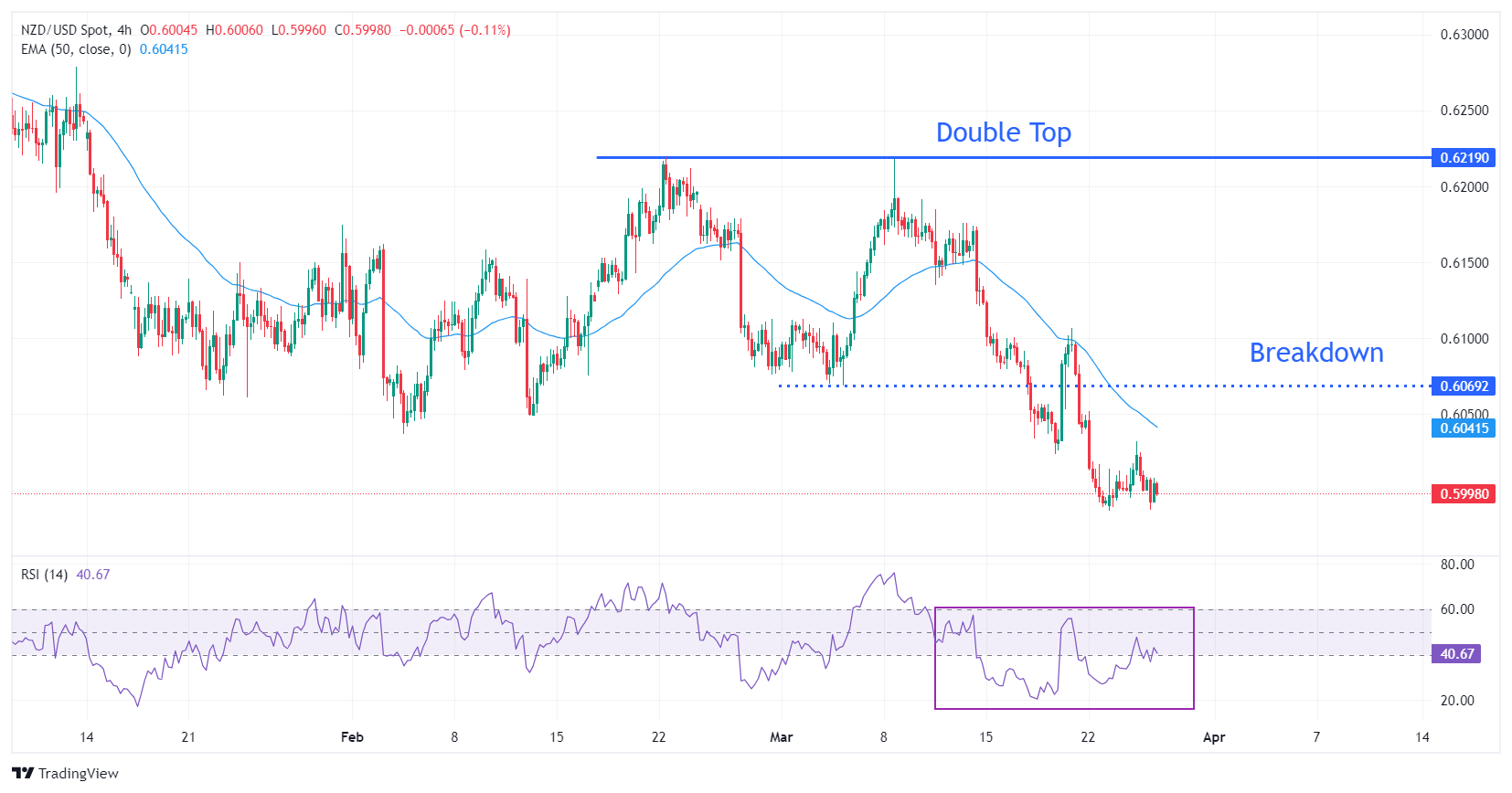
NZD/USD sees a sharp downside move after a breakdown of the Double Top chart formation near 0.6069 on a four-hour timeframe. The asset has tested territory below the psychological support of 0.6000 and is expected to discover more downside. The 50-period Exponential Moving Average (EMA) near 0.6040 is a major barricade for the New Zealand Dollar bulls.

The 14-period Relative Strength Index (RSI) oscillates in the bearish range of 20.00-60.000. Investors would look for building fresh shorts whenever the RSI witnessed a pullback to 60.00.

If the asset breaks below the intraday low of 0.5987, more downside will appear. This would drag the asset toward the November 17 low at 0.5940, followed by the round-level support of 0.5900.

In an alternate scenario, a recovery move above March 6 low at 0.6069 will drive the pair toward March 18 high at 0.6100. A breach of the latter will drive the asset further to March 12 low at 0.6135.

NZD/USD four-hour chart
NZD/USD

Overview
Today last price 0.6004
Today Daily Change 0.0000
Today Daily Change % 0.00
Today daily open 0.6004
 
Trends
Daily SMA20 0.6096
Daily SMA50 0.6111
Daily SMA100 0.6135
Daily SMA200 0.6075
 
Levels
Previous Daily High 0.6032
Previous Daily Low 0.5995
Previous Weekly High 0.6107
Previous Weekly Low 0.5989
Previous Monthly High 0.6219
Previous Monthly Low 0.6037
Daily Fibonacci 38.2% 0.6018
Daily Fibonacci 61.8% 0.6009
Daily Pivot Point S1 0.5989
Daily Pivot Point S2 0.5973
Daily Pivot Point S3 0.5952
Daily Pivot Point R1 0.6026
Daily Pivot Point R2 0.6047
Daily Pivot Point R3 0.6063


Disclaimer: For information purposes only. Past performance is not indicative of future results.
placeholder
WTI (USOIL) Is down 2.03% on Sep 25: Here Is WhyWTI (USOIL) is down 2.03% at Sep 24 22:20(UTC+0), now at $92.517, with a 7-day down of 3.63%.What is driving WTI (USOIL)’s stock price down today?The drop in WTI crude oil prices was primarily driven by
Author  TradingKey
15 hours ago
WTI (USOIL) is down 2.03% at Sep 24 22:20(UTC+0), now at $92.517, with a 7-day down of 3.63%.What is driving WTI (USOIL)’s stock price down today?The drop in WTI crude oil prices was primarily driven by
placeholder
Silver Price Forecast: XAG/USD remains steady near $64.00 as oil prices easeSilver price (XAG/USD) inches higher after two days of losses, trading around $63.90 per troy ounce during Asian hours on Friday. Non-yielding Silver is finding underlying support as inflation concerns ease following a pullback in crude oil prices.
Author  FXStreet
16 hours ago
Silver price (XAG/USD) inches higher after two days of losses, trading around $63.90 per troy ounce during Asian hours on Friday. Non-yielding Silver is finding underlying support as inflation concerns ease following a pullback in crude oil prices.
placeholder
Gold Price Forecast: Gold Drops Below $4,300, Will It Continue to Fall? As of the European session on September 24, gold prices (XAUUSD) extended their correction, dipping below $4,300 intraday to hit a low of $4,262.45. After previously rebounding close to $
Author  TradingKey
Yesterday 09: 57
As of the European session on September 24, gold prices (XAUUSD) extended their correction, dipping below $4,300 intraday to hit a low of $4,262.45. After previously rebounding close to $
placeholder
Yen touches 158.37 as Tokyo reopens, then slips back — ¥15.4 trillion of intervention and the 200-day line stand between here and 160USD/JPY reached 158.37 overnight, its highest since early September, then eased to 157.88 as Japanese markets reopened after a three-day holiday. The Ministry of Finance has spent ¥15.4 trillion defending the yen since late July and the BOJ ran a rate check on September 18. The 200-day average sits at 158.43.
Author  Irene Q.
Yesterday 06: 59
USD/JPY reached 158.37 overnight, its highest since early September, then eased to 157.88 as Japanese markets reopened after a three-day holiday. The Ministry of Finance has spent ¥15.4 trillion defending the yen since late July and the BOJ ran a rate check on September 18. The 200-day average sits at 158.43.
placeholder
US input costs rose at the fastest pace in four years — the September flash PMI beat is an inflation story, not a growth storyUS September flash PMIs came in far above expectations, with the composite at 58.4, a five-year high. But the detail that moved markets was input cost inflation at its fastest since October 2022, driven by fuel, transport and supply shortages. Brent is back above $100 and the 10-year Treasury yield has hit its highest since 2007.
Author  Suzie
Yesterday 06: 46
US September flash PMIs came in far above expectations, with the composite at 58.4, a five-year high. But the detail that moved markets was input cost inflation at its fastest since October 2022, driven by fuel, transport and supply shortages. Brent is back above $100 and the 10-year Treasury yield has hit its highest since 2007.
goTop
quote