


Australian Dollar seems vulnerable after weaker domestic GDP and China's Services PMI


The Australian Dollar attracts some sellers following the release of weaker domestic GDP print.
China’s economic woes and US-China trade war fears also undermine the China-proxy Aussie.
The USD bulls remain on the sidelines ahead of Powell’s speech, lending support to AUD/USD.
The Australian Dollar (AUD) moves lower in reaction to weaker domestic Gross Domestic Product (GDP) growth figures. Given that the headline inflation in Australia has fallen to the central bank's 2%-3% target range, slower growth could put pressure on the Reserve Bank of Australia (RBA) to respond with lower interest rates. Furthermore, new US export curbs on China, concerns about China's fragile economic recovery and US President-elect Donald Trump's impending tariffs turn out to be another factor weighing on the China-proxy Aussie.
The US Dollar (USD), on the other hand, continues to be underpinned by expectations for a less dovish Federal Reserve (Fed), though bulls opt to wait for more cues about the future rate-cut path. This, in turn, assists the AUD/USD pair to hold above the weekly low and a multi-month trough touched last Tuesday. Traders might also opt to move to wait for Fed Chair Jerome Powell's speech later today. Apart from this, the US Nonfarm Payrolls (NFP) report should influence the interest rate outlook in the US and provide a fresh directional impetus.
Australian Dollar drifts lower as weak GDP print lifts chances for an early RBA rate cut
The Australian Bureau of Statistics (ABS) reported this Wednesday that the economy expanded by 0.3% in the third quarter and by 0.8% on a yearly basis, missing estimates for a reading of 0.4% and 1.1%, respectively.
Commenting on the critical economic report, Australia's Treasurer Jim Chalmers said that the national accounts show positive but weak GDP growth and that it is encouraging to see growth in real disposable incomes.
According to the latest data published by Caixin on Wednesday, China's Services Purchasing Managers' Index (PMI) declined to 51.5 in November from 52.0 in October.
The US announced a new set of export controls to curb China's technological advancements and restricted the sale of crucial semiconductor-manufacturing equipment and high-bandwidth computer memory to the country.
This comes after US President-elect Donald Trump threatened a 100% tariff on BRICS nations – Brazil, Russia, India, China, and South Africa – if they undermine the US Dollar by creating or backing alternative currencies.
The US Job Openings and Labor Turnover Survey (JOLTS) data published on Tuesday showed that the number of job openings on the last business day of October stood at 7.74 million, up from 7.37 million in the prior month.
The data eases fears of a significant slowdown in the US labor market and might force the Federal Reserve to take a cautious stance on cutting rates amid expectations that Trump's expansionary policies will boost inflation.
The US Treasury bond yields shot up in reaction to the upbeat data, though failed to impress the US Dollar bulls as the markets are still pricing in a greater chance that the Fed will lower borrowing costs again in December.
San Francisco Fed President Mary Daly said that the US economy is in a really good place, while the labor market is in balance and is not a source of inflation. Daly added that the December rate cut is not off the table.
Board of Governors member Adrianna Kugler reiterated that the progress on inflation is still underway, while the policy is not on a preset course and that the central bank will make decisions meeting by meeting.
Adding to this, Chicago Fed President Austan Goolsbee said that rates remain in restrictive policy and need to come down a fair amount from where they are now over the next year if inflation gets close to the target.
The market attention now shifts to Fed Chair Jerome Powell's speech, which, along with the US Nonfarm Payrolls (NFP) report on Friday, should guide policymakers on their next monetary policy decision.
AUD/USD bears await a breakdown below short-term trading range support near 0.6440-0.6435
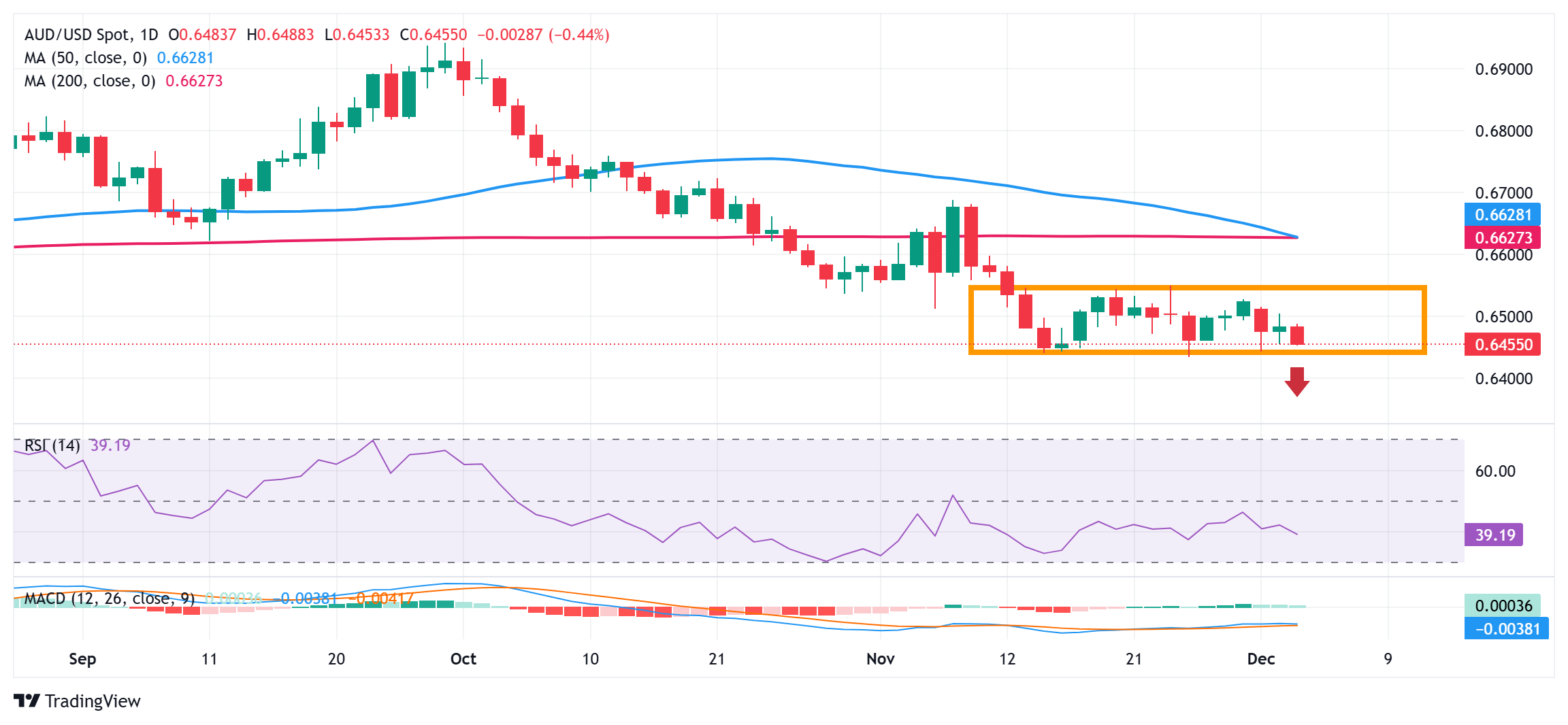
From a technical perspective, the range-bound price action over the past two weeks or so might still be categorized as a bearish consolidation phase against the backdrop of the fall from the September monthly swing high. Moreover, oscillators on the daily chart are holding in negative territory and are still away from being in the oversold zone. This, in turn, suggests that the path of least resistance for the AUD/USD pair is to the downside and supports prospects for a further depreciating move. That said, it will still be prudent to wait for some follow-through selling below the 0.6440-0.6435 region, or the multi-month low, before placing fresh bets. Spot prices might then turn vulnerable to weaken further below the 0.6400 mark and retest the year-to-date low, around the 0.6350-0.6345 region touched in August.
On the flip side, any meaningful recovery back above the 0.6500 psychological mark is likely to confront stiff resistance and remain capped near the 0.6535-0.6540 supply zone. A sustained strength beyond, however, could trigger a short-covering rally and allow the AUD/USD pair to reclaim the 0.6600 round figure en route to the 0.6625-0.6630 confluence hurdle. The latter comprises the 200- and the 50-day Simple Moving Averages (SMAs), which if cleared decisively might shift the near-term bias in favor of bullish traders and pave the way for additional gains.
Read more
* The content presented above, whether from a third party or not, is considered as general advice only. This article should not be construed as containing investment advice, investment recommendations, an offer of or solicitation for any transactions in financial instruments.


