

Japanese Yen drifts lower on reports of extra 15% US tariffs on all imports from Japan

 Trending Articles
- Silver Price Forecast: XAG/USD surges to record high above $56 amid bullish momentum
- Fed Chair Candidate: What Would a Hassett Nomination Mean for U.S. Stocks?
- After the Crypto Crash, Is an Altcoin Season Looming Post-Liquidation?
- The 2026 Fed Consensus Debate: Not Hassett, It’s About Whether Powell Stays or Goes
- U.S. PCE and 'Mini Jobs' Data in Focus as Salesforce (CRM) and Snowflake (SNOW) Report Earnings 【The week ahead】
- AUD/USD holds steady below 0.6550 as traders await Australian GDP release
The Japanese Yen attracts fresh sellers amid reports of additional US tariffs.
Mixed BoJ rate hike cues further undermine the JPY amid a positive risk tone.
Rising September Fed rate cut bets weigh on the USD and cap the USD/JPY pair.
The Japanese Yen (JPY) weakens slightly during the Asian session on Thursday in reaction to reports that US President Donald Trump could impose an additional 15% tariff on all Japanese imports. This, along with the uncertainty over the likely timing of the next interest rate hike by the Bank of Japan (BoJ) and a generally positive risk tone, undermines the safe-haven JPY. Apart from this, a modest US Dollar (USD) bounce from over a one-week low touched on Wednesday pushes the USD/JPY pair back above mid-147.00s in the last hour.
Meanwhile, the BoJ last week left the door open for a further interest rate hike by the end of this year. In contrast, the Federal Reserve (Fed) is widely expected to lower borrowing costs at the September policy meeting, which could cap the attempted USD recovery. Furthermore, the divergent BoJ-Fed policy outlook could act as a tailwind for the lower-yielding JPY and warrants caution for bearish traders. This makes it prudent to wait for some follow-through buying before positioning for any further appreciating move for the USD/JPY pair.
Japanese Yen is pressured by renewed trade concerns, though bears lack conviction
Asahi newspaper, citing a White House official, reported this Thursday that US President Donald Trump could impose an extra 15% tariff on all Japanese imports. The US will not apply exceptions to Japan for products that already have tariffs exceeding 15%, the report added further.
This adds a layer of uncertainty on the back of the recent political developments in Japan. In fact, the ruling Liberal Democratic Party’s loss in the upper house election on July 20 raised concerns about Japan's fiscal health amid calls from the opposition to boost spending and cut taxes.
Moreover, data released on Wednesday showed that real wages in Japan fell for the sixth straight month in June and fueled worries about a consumption-led recovery. This suggests that prospects for Bank of Japan rate hikes could be delayed and undermines the Japanese Yen.
The BoJ, however, has repeatedly said that it will hike interest rates further if growth and inflation continue to advance in line with its estimates. This is holding back the JPY bears from placing aggressive bets and acting as a tailwind for the USD/JPY pair despite a bearish US Dollar.
The USD Index (DXY), which tracks the greenback against a basket of currencies, fell to a one-week low on Wednesday amid expectations for more interest rate cuts than previously expected by the Federal Reserve this year. The bets were lifted by the incoming weaker US macro data.
The US Nonfarm Payrolls report for July pointed to a sharp deterioration in labor market conditions. Furthermore, the US ISM Services PMI released on Tuesday underscored the ongoing drag on the economy amid the uncertainty surrounding Trump's erratic trade policies.
This, in turn, affirmed market bets that the Fed will resume its rate-cutting cycle in September and lower borrowing costs by 25 basis points at least two times by the year-end. This keeps the US Treasury bond yields and the USD depressed, which could cap gains for the USD/JPY pair.
Traders now look forward to the release of the US Weekly Initial Jobless Claims data, due later during the North American session. Apart from this, speeches from FOMC members could drive the USD demand. This, along with trade headlines, might influence the currency pair.
USD/JPY needs to find acceptance above 38.2% Fibo. hurdle for bulls to seize control
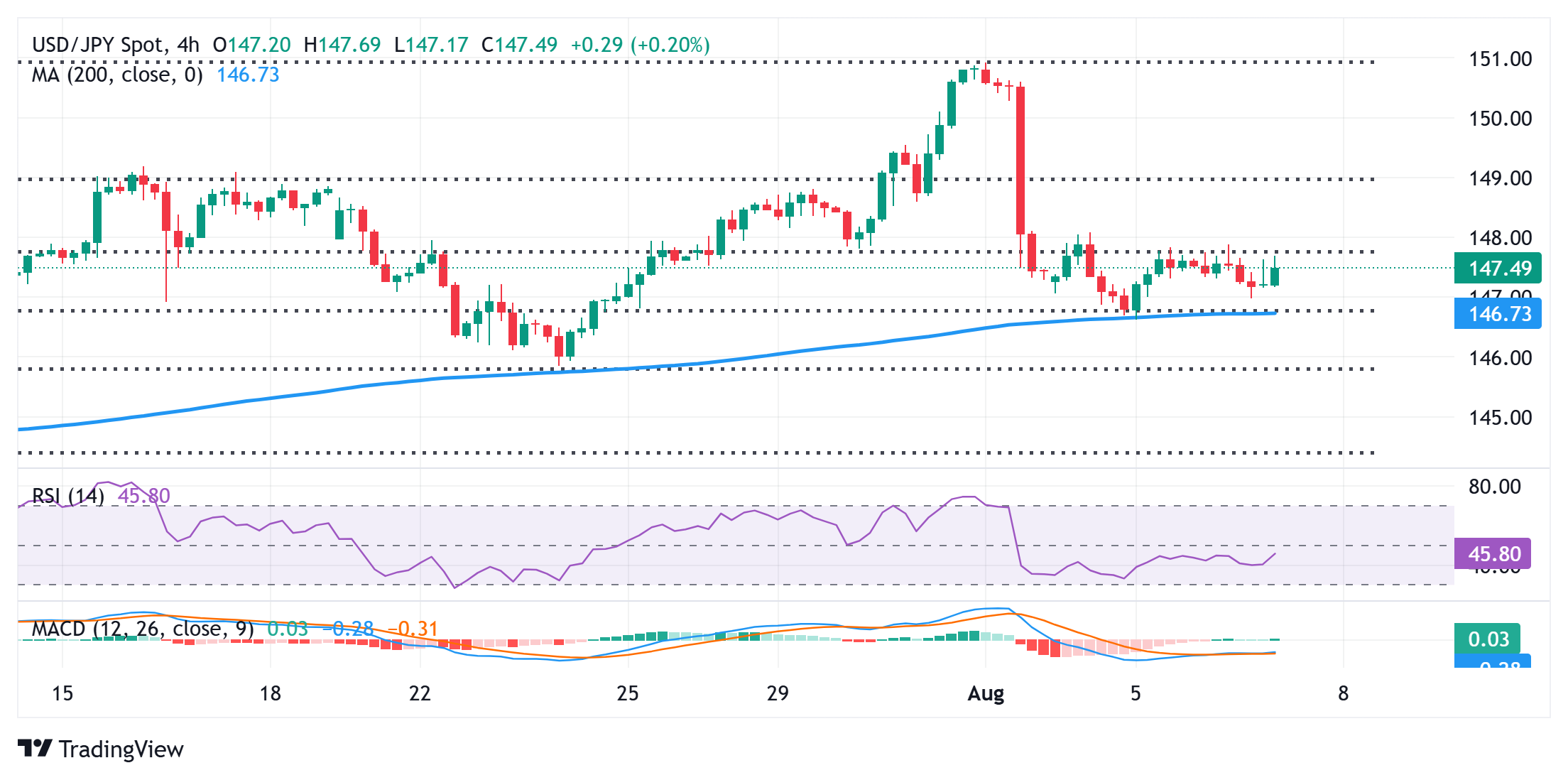
From a technical perspective, this week's rebound from the 200-period Simple Moving Average (SMA), around the 146.60 area, or the weekly low, and the subsequent move up favors the USD/JPY bulls. However, oscillators on the said chart are yet to confirm the positive outlook. Moreover, spot prices, so far, have been struggling to clear the 38.2% Fibonacci retracement level of the upswing from the July monthly low. This, in turn, makes it prudent to wait for a sustained move beyond the 147.80-147.85 region before positioning for any further gains. The currency pair might then surpass the 148.00 round figure and climb to the 148.45-148.50 region. The momentum could extend further towards the 149.00 neighborhood, or the 23.6% Fibo. retracement level.
On the flip side, the Asian session low, around the 147.15 region, closely followed by the 147.00 mark, could offer immediate support to the USD/JPY pair ahead of the 146.75 confluence. The latter represents the 200-period SMA on the 4-hour and the 50% Fibo. retracement level, which, if broken decisively, should pave the way for deeper losses. Spot prices might then accelerate the fall towards testing sub-146.00 levels, or the 61.8% Fibo. retracement level. Some follow-through selling below the latter could expose the 145.00 psychological mark.
Read more
* The content presented above, whether from a third party or not, is considered as general advice only. This article should not be construed as containing investment advice, investment recommendations, an offer of or solicitation for any transactions in financial instruments.


