


Japanese Yen refreshes multi-month low against USD; seems vulnerable ahead of US NFP

 Trending Articles
- Gold drops below $4,700 on stronger US Dollar, Middle East tensions
- Bitcoin Returns to $79,000 Level. Prediction Markets Bullish on Breaking $80,000 in April
- Gold holds steady near $4,600 as Fed rate decision looms
- Fed FOMC Meeting Is Approaching: Where Is the Focus? Will There Be More Rate Cuts This Year?
- Goldman Sachs: Structurally Bullish on Gold to $5,400, But Warns of Short-Term Pullback
- Today’s Market Recap: Fed Dissent and AI Capex Surges Define Volatile Earnings Week
The Japanese Yen continues to be undermined by the BoJ’s slight dovish tilt on Thursday.
Reduced September Fed rate cut bets act as a tailwind for the USD and the USD/JPY pair.
Traders now look forward to the release of the crucial US NFP report for a fresh impetus.
The Japanese Yen (JPY) touches a fresh four-month low against its American counterpart during the Asian session on Friday and seems vulnerable to weaken further. The Bank of Japan (BoJ) revised up its inflation forecasts on Thursday and offered a less gloomy outlook on the economy, keeping hopes alive for the resumption of rate hikes later this year. However, BoJ Governor Kazuo Ueda struck a dovish tone and signaled patience in policy normalization, to observe the tariff impact after the US-Japan trade deal. Furthermore, domestic political uncertainty, which has been fueling concerns about Japan's fiscal health, continues to undermine the JPY.
Meanwhile, the global risk sentiment takes a hit after US President Donald Trump signs an executive order imposing higher tariffs of up to 41% on key trading partners across the globe. This offers some support to traditional safe-haven assets and helps limit JPY losses. The US Dollar (USD), on the other hand, is seen consolidating its strong weekly gains to its highest level since late May, bolstered by the slightly more hawkish-than-expected Federal Reserve (Fed), and contributes to capping the USD/JPY pair. Traders also seem reluctant and opt to wait for the release of the US Nonfarm Payrolls (NFP) report before placing fresh directional bets.
Japanese Yen bears retain control amid diminishing odds for an immediate BoJ rate hike
Bank of Japan, as was expected, decided to maintain the status quo on rates at the end of the July meeting on Thursday. In the post-meeting press conference, BoJ Governor Kazuo Ueda downplayed inflation risks and didn't show any real intention to hike interest rates anytime soon.
Ueda noted that Japan's economy is recovering moderately and that the US-Japan trade deal reduces uncertainty over the economic outlook. The BoJ will look at the data to come out without any preconception and will make an appropriate decision at each meeting, Ueda added further.
Moreover, the BoJ revised its Core CPI forecast to +2.7% for the fiscal year 2025 vs the previous +2.2%. The central bank reiterated that it will continue to raise the policy rate if the economy and prices move in line with the forecast, keeping the door open for a rate hike by the end of this year.
Investors, however, seem convinced that prospects for BoJ rate hikes could be delayed for a bit longer following the ruling Liberal Democratic Party’s loss in the July 20 polls. This, in turn, drags the Japanese Yen to over a four-month low against a bullish US Dollar during the Asian session.
The S&P Global's Japan Manufacturing Purchasing Managers' Index (PMI) was finalized at 48.9 for July, slightly higher than the flash reading of 48.8. This, however, suggested that Japan's manufacturing activity moved back into contraction territory after briefly stabilising in June.
The survey data, however, was collected before the announcement of the Japan-US trade agreement last week, which lowered tariffs to 15% from a previously threatened 25%. Moreover, business confidence improved to a six-month high in July, though it does little to impress the JPY bulls.
The US Dollar, on the other hand, climbs to its highest level since late May amid reduced bets for a September interest rate cut by the Federal Reserve. In fact, Fed Chair Jerome Powell said on Wednesday that it was too soon to say whether the central bank would cut rates at its next meeting.
Powell added that the current modestly restrictive monetary policy has not been holding back the economy. The outlook was reaffirmed by the Advanced US GDP print, which showed that the economy expanded by a 3% annualized pace during the second quarter of the current year.
Furthermore, the US Bureau of Economic Analysis reported on Thursday that the Personal Consumption Expenditures (PCE) Price Index rose to 2.6% in June from May's upwardly revised 2.4%. The core gauge – excluding volatile food and energy prices – climbed 2.8% as against 2.7% estimated.
Other details of the report showed that Personal Income grew by 0.3% on a monthly basis in June, while Personal Spending rose by 0.3%. This reaffirms the view that price pressures would pick up in the second half of the year and delay the Fed's rate-cutting cycle until at least October.
Meanwhile, US President Donald Trump signed executive orders on Thursday, placing tariffs on many US trade partners that are set to go into effect in 7 days instead of the Friday deadline initially set. This comes after the latest round of US-China trade talks ended with no deal in place.
Japan's Economy Minister Ryosei Akazawa stressed the importance of implementing the US-Japan trade deal and expects tariffs to impact the domestic economy. Akazawa raised concerns about currency trends, including speculative moves, though declined to comment on current forex levels.
The market focus now shifts to the release of the closely watched US monthly employment details. The popularly known Nonfarm Payrolls report is expected to show that the economy added 110K jobs in July and the Unemployment Rate edged higher to 4.2% from the 4.1% previous.
Apart from this, Friday's US economic docket also features the release of the ISM Manufacturing PMI. This, in turn, will play a key role in influencing the USD price dynamics and produce short-term trading opportunities around the USD/JPY pair heading into the weekend.
USD/JPY could pause near March swing high, around 151.20, before the next leg up
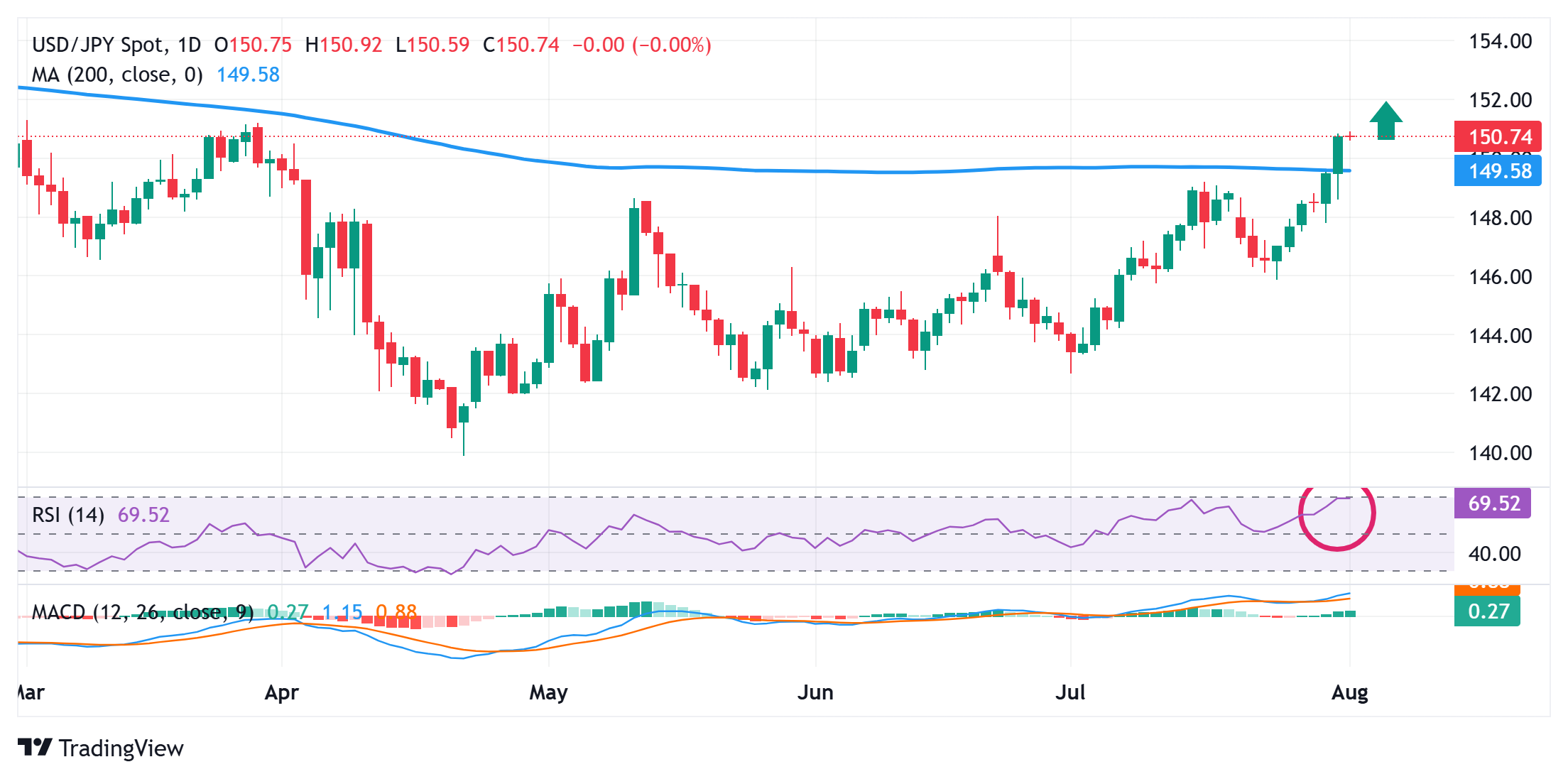
The overnight sustained breakout through the very important 200-day Simple Moving Average (SMA) and the subsequent strength beyond the 150.00 psychological mark was seen as a fresh trigger for the USD/JPY bulls. However, the daily Relative Strength Index (RSI) is on the verge of breaking into overbought territory, suggesting that spot price could pause the positive move at the March swing high, around the 151.20 region. Nevertheless, the broader setup backs the case for an extension of the recent well-established uptrend.
Hence, any corrective pullback towards the 150.00 round figure might be seen as a buying opportunity. This, in turn, should help limit the downside for the USD/JPY pair near the 149.55 region (200-day SMA). The latter should act as a strong near-term base for spot prices, which, if broken decisively, could prompt some technical selling and expose the next relevant support near the 149.00 mark.
Read more
* The content presented above, whether from a third party or not, is considered as general advice only. This article should not be construed as containing investment advice, investment recommendations, an offer of or solicitation for any transactions in financial instruments.


