




One US Inflation Number Is About to Change Everything for Australian Traders

One number lands every month and reshapes the outlook for AUD/USD, gold, and the ASX 200 before most Australian traders have finished their morning coffee. It is not CPI. It is not the unemployment rate. It is a three-letter acronym the Federal Reserve considers its single most important inflation gauge, and most retail traders in Australia have never heard of it. It’s PCE.
PCE, the Personal Consumption Expenditures Price Index, is the inflation measure the Fed officially targets. When it runs hot, rate cuts get pushed back, the US dollar strengthens, AUD/USD falls, gold comes under pressure, and Australian equities open weaker the next morning.
When it cools, the opposite happens simultaneously across all three instruments. The July 31 PCE release proved this in real time. Core PCE cooled alongside a softer-than-expected Q2 GDP report, the Fed held rates at 3.50% to 3.75% the day before, and markets immediately repriced a September rate cut to an 85% probability. AUD/USD, gold, and the ASX 200 all moved in response.
This guide covers what PCE is, why it matters more than CPI for Australian traders, what the July 31 PCE release showed, a fresh structural change happening to PCE itself that almost no retail commentary has covered, and exactly how PCE moves the three instruments Australian traders follow most closely.
What Is PCE and Why Does the Fed Use It Over CPI
The Personal Consumption Expenditures Price Index is published monthly by the Bureau of Economic Analysis and measures changes in prices paid by US consumers across a broad range of goods and services. The Fed has officially targeted PCE as its preferred inflation gauge since 2012 and aims to keep it at 2% per year on a sustained basis.
Two things make PCE fundamentally different from CPI. CPI measures a fixed basket of goods weighted according to a predetermined formula. PCE adjusts dynamically for how consumers actually behave. If beef prices surge and consumers switch to chicken, PCE captures that substitution and reflects actual spending patterns rather than a theoretical basket that ignores human behaviour. PCE also covers a broader range of expenditures including healthcare costs paid by employers and the government on behalf of consumers. As a result, PCE typically runs 0.3 to 0.5 percentage points lower than CPI for the same period.
That gap matters enormously because the Fed sets monetary policy based on PCE, not CPI. A CPI print that looks alarming may not trigger a Fed reaction if PCE tells a calmer story. Australian traders who track only CPI headlines are reading a different report from the one the Fed is acting on. Core PCE, which strips out volatile food and energy prices, is the specific figure traders watch most closely because it best represents the Fed's actual policy reaction function.
What the July 31 PCE Release Actually Showed
The July 31 PCE release landed one day after the Fed held rates at 3.50% to 3.75% at the July 28 to 29 FOMC meeting. The combination of a Fed hold followed by cooling PCE data on consecutive days was the most consequential macro sequence for Australian traders in the past fortnight.
According to US Bank Asset Management research published July 17, core PCE had accelerated from 3.0% in December 2025 to 3.3% in June 2026, extending a period of above-target inflation that began more than five years ago. But the July 31 PCE release confirmed the trajectory had cooled relative to mid-year fears, arriving alongside a softer-than-expected Q2 GDP report. IC Markets' July 31 market analysis noted that markets were dominated by cooling PCE inflation and a resilient labour market, with macro data suggesting economic growth is moderating while inflation continues to ease.
Fed Governor Christopher Waller then publicly backed a 25 basis point rate cut at the September meeting, citing growing labour market concerns. According to the CME FedWatch Tool, that statement pushed the September cut probability to 85%, which sent both AUD/USD and gold higher in the sessions that followed.
Why the Way PCE Is Calculated Is About to Change
There is a structural change happening to PCE itself that is almost entirely absent from retail trading commentary.
The Bureau of Economic Analysis is in the process of reformulating its PCE calculation methodology. According to reporting by the Wall Street Journal cited on Investing.com, this statistical revision is expected to lower the measured PCE inflation reading going forward. If PCE is structurally recalculated lower, the Fed's preferred inflation gauge will appear closer to the 2% target even before any actual cooling in consumer prices occurs.
This gives the Fed additional statistical cover to cut rates faster than the current data trajectory would otherwise justify. If the reformulation is implemented and PCE readings mechanically step down by 0.2 to 0.3 percentage points, market expectations for the pace of rate cuts in 2026 and 2027 could shift significantly toward a faster easing cycle. This is a structural positive for AUD/USD and gold that most Australian traders have not yet priced into their thinking.
What PCE Means for AUD/USD
AUD/USD is the instrument most directly and immediately affected by every PCE release. The mechanism is straightforward. When PCE runs hot, the Fed signals higher for longer, US dollar demand increases as global investors allocate toward higher-yielding US assets, and AUD/USD falls. When PCE cools and rate cut expectations build, the dollar weakens and AUD/USD rallies.
The AUD/USD chart confirms this pattern across 2026. The pair started January at around 0.6550, rallied toward 0.7300 by May as rate cut expectations built, sold off sharply through June and July as the Middle East conflict pushed oil above $100 and reignited inflation fears that delayed the cut timeline, and has since recovered to 0.70486 today as the July 31 PCE cooling and Waller's September cut comments gave the Aussie fresh support. The next PCE release is the July data on August 29. A further cooling print gives AUD/USD a clear path toward retesting the 0.7200 to 0.7250 resistance zone that capped the May rally.
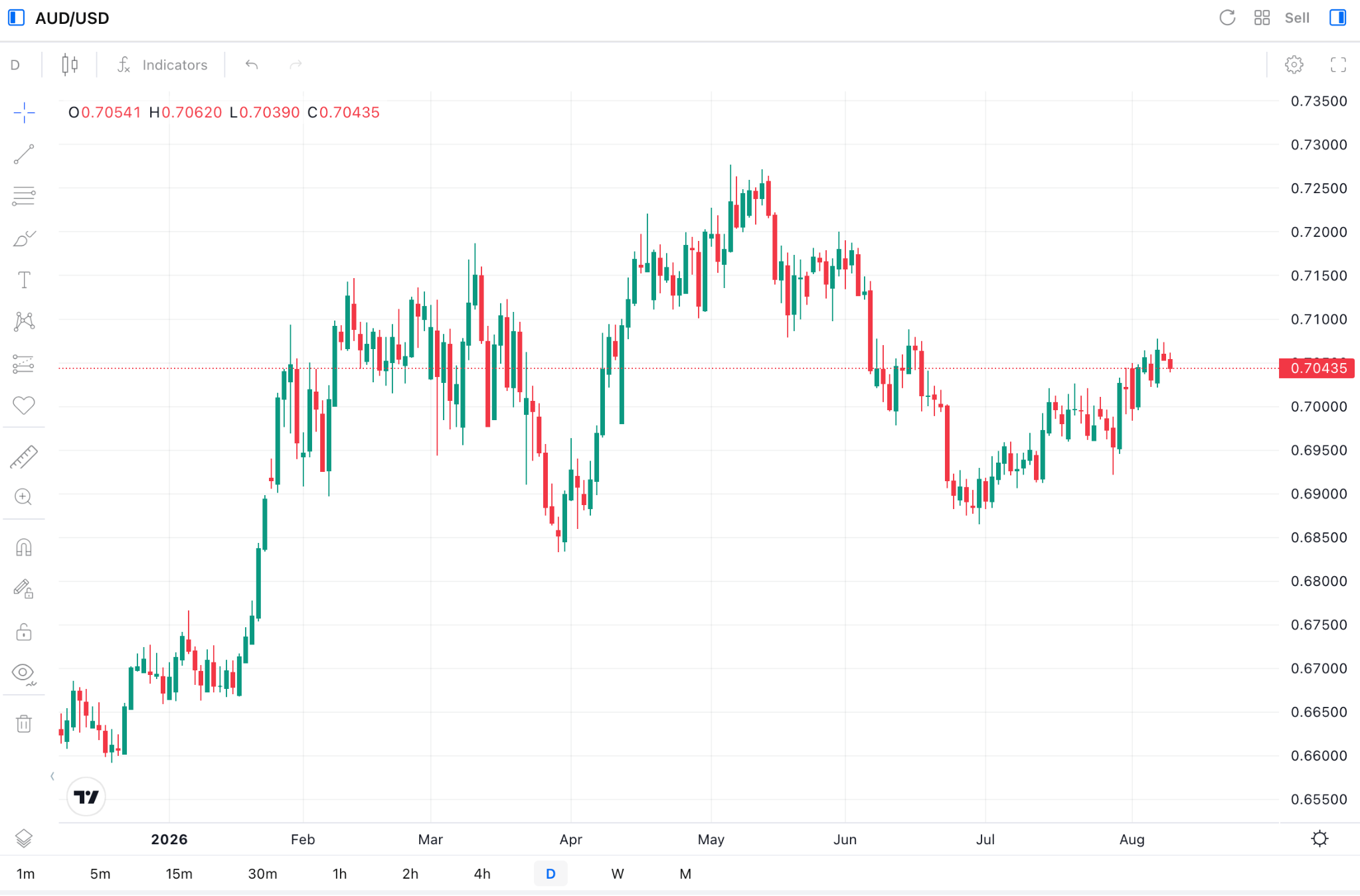
Source: Mitrade (AUD/USD Daily Chart)
“Get Started with an ASIC-regulated broker. Fast AUD funding via PayID. ”
What PCE Means for Gold
Gold and PCE share one of the most reliable inverse relationships in financial markets, and the 2026 chart makes the mechanism visible in real time.
Gold started 2026 around $4,100 to $4,200, surged to above $5,600 in February as the Iran conflict drove safe haven demand and real yields collapsed, then crashed as the ceasefire was agreed in late July and the inflation premium compressed out of the safe haven price. Gold now trades at $4,405.12, recovering from July lows around $4,000 as the PCE cooling data and September cut expectations have rebuilt the rate-cut tailwind that supports non-yielding assets. The PCE-gold relationship works through real yields. When PCE cools and rate cuts are priced in, real yields compress and the opportunity cost of holding gold drops. With real yields barely positive, central banks buying gold at record pace, and the Fed's own projections showing inflation above target through year-end, the mechanism that makes gold a long-term purchasing power protector remains intact regardless of any single monthly PCE reading. The BEA reformulation adds a second structural tailwind specifically for gold. If PCE mechanically moves lower through a statistical revision, real yields will compress even before any actual policy rate cut occurs.
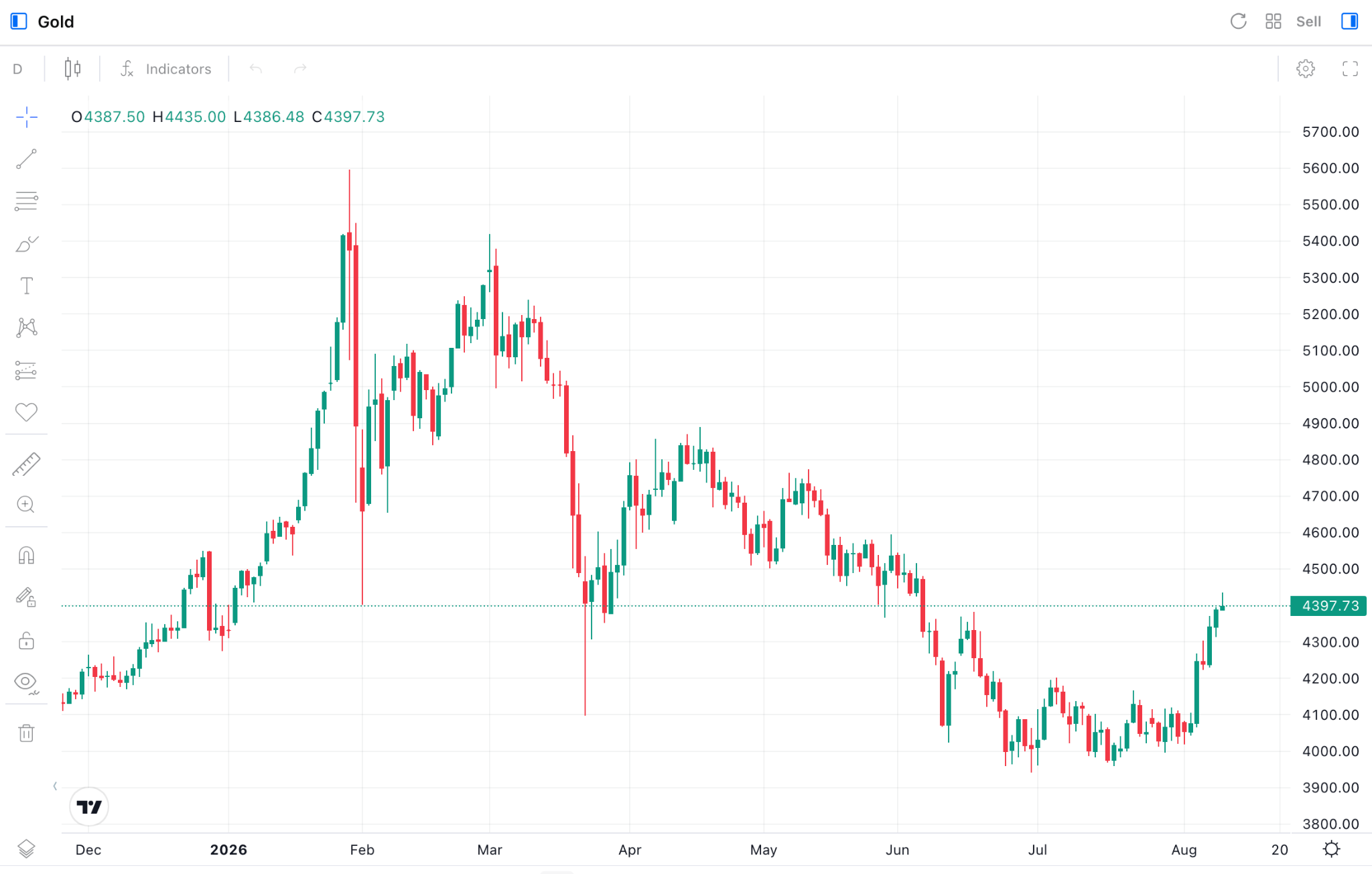
Source: Mitrade (Gold XAU/USD Daily Chart)
“Get Started with an ASIC-regulated broker. Fast AUD funding via PayID. ”
What PCE Means for the ASX 200
The ASX 200 is an overnight derivative of PCE through two distinct channels that Australian traders should understand separately.
The first is the direct correlation with Wall Street. When PCE cooling sends US equities higher, the ASX 200 typically opens with a positive bias the following morning. The July 31 PCE release combined with Microsoft's strong quarterly result that same night sent US technology stocks sharply higher and the ASX 200 opened accordingly stronger on August 1.
The second channel is AUD/USD. A stronger Australian dollar following a PCE cooling event tends to attract global capital into Australian assets, providing a secondary tailwind to the ASX 200 beyond the Wall Street lead. Both channels are now pointing in the same direction, giving Australian equities a supportive backdrop heading into the August results season from CSL, Cochlear, and Sonic Healthcare.
“Get Started with an ASIC-regulated broker. Fast AUD funding via PayID. ”
How Australian Traders Position Around PCE on Mitrade
The next PCE release will be the July 2026 data, scheduled for August 29, 2026. That is just a few days away and the result will determine whether the September rate cut narrative holds or faces a fresh challenge if inflation reaccelerates.
Mitrade, regulated by ASIC under licence AFSL 398528, offers AUD/USD and gold (XAU/USD) as CFD instruments from a single zero-commission account. Traders who expect cooling PCE to continue through the August data can go long AUD/USD and gold ahead of the August 29 release. Traders who believe the pace of cooling will disappoint can go short or use CFDs to hedge existing long positions in Australian equities.
The CME FedWatch Tool is the real-time indicator to watch alongside each PCE print. When PCE cools, FedWatch cut probabilities rise and move AUD/USD and gold simultaneously. When PCE surprises hot, probabilities shift back toward holds and both instruments face immediate pressure. Stop-loss and take-profit controls appear directly on the Mitrade order screen before any trade is confirmed. A free demo account with $50,000 in virtual funds lets traders practise positioning around PCE releases before committing real capital.
You might be interested in…
1. What is PCE inflation and why does the Fed use it instead of CPI?
PCE, or the Personal Consumption Expenditures Price Index, is published monthly by the Bureau of Economic Analysis and measures changes in prices paid by US consumers. The Fed has officially targeted PCE since 2012 because it adjusts dynamically for actual consumer behaviour rather than measuring a fixed basket of goods like CPI. PCE also covers a broader range of expenditures including healthcare costs paid by employers and the government. As a result, PCE typically runs 0.3 to 0.5 percentage points lower than CPI and the Fed sets policy based on PCE, not CPI.
2. When is the next PCE release and what are markets expecting?
The next PCE release will be the July 2026 data, scheduled for August 29, 2026. Markets are currently pricing an 85% probability of a 25 basis point rate cut at the September FOMC meeting based on the July 31 PCE cooling data and Fed Governor Waller's public statement supporting a September cut. A further cooling print on August 29 would likely cement that expectation and provide additional tailwinds for AUD/USD and gold.
3. How does PCE affect AUD/USD?
When PCE cools and Fed rate cut expectations build, the US dollar weakens and AUD/USD typically rallies as the interest rate differential between Australia and the US narrows. When PCE surprises hot and rate cuts are priced out, the dollar strengthens and AUD/USD falls. The pair currently trades at 0.70486, recovering from July lows after the July 31 PCE cooling confirmed the September cut narrative and gave the Australian dollar fresh support.
4. How does PCE affect gold prices?
PCE affects gold through real yields. When PCE cools and rate cuts are priced in, real yields fall and reduce the opportunity cost of holding gold, typically pushing the price higher. Gold currently trades at $4,405.12, recovering from July lows around $4,000 as the July 31 PCE release and subsequent September cut expectations rebuilt the rate-cut tailwind for the metal.
5. What is the BEA PCE methodology reformulation and why does it matter for traders?
The Bureau of Economic Analysis is in the process of revising its PCE calculation methodology in a change expected to mechanically lower the measured inflation reading going forward. If implemented, the Fed's preferred inflation gauge will appear closer to its 2% target even before actual consumer price pressures ease further. This gives the Fed additional statistical cover to cut rates faster than the current data trajectory would otherwise support, a structural positive for AUD/USD, gold, and the ASX 200.
6. Can Australian traders access AUD/USD and gold on Mitrade?
Yes. Mitrade offers AUD/USD and gold (XAU/USD) as CFD instruments under ASIC regulation with licence AFSL 398528. Both instruments move directly and immediately on PCE release outcomes and Fed rate cut expectation shifts. Traders can go long or short on both with zero commission and stop-loss controls directly on the order screen. A free demo account with $50,000 in virtual funds is available before going live.
Disclaimer: The content presented above, whether from a third party or not, is considered as general advice only. CFD trading involves significant risk of loss. Past performance does not guarantee future results. This article serves informational purposes only and does not constitute financial advice. Consider your risk tolerance before trading.


