




Nvidia Is Headed for Its Worst Month Since April 2022. History Says What the Stock Usually Did Next.
Key Points
Nvidia shares fell around 26% in November through the Nov. 27 close.
The median gain over the year after its nine worse months was around 50%.
Most of these months weren't the bottom.
- Motley Fool Issues Rare "Total Conviction" Buy Alert ›
Nvidia (NASDAQ:NVDA) stock closed Friday, Nov. 27, at $150.49, off around 26% from where it ended October, at $204.64 on Oct. 30. The drop came during a month when Jensen Huang resigned as CEO and, 11 days later, was reinstated by the board.
November's last trading day is Monday, Nov. 30. If shares close that day between about $139.10 and $164.60, this will be the artificial intelligence (AI) chipmaker's worst month since April 2022, when the stock fell 32%. No month since then has been worse than September 2022, when it dropped roughly 20%.
Missed Nvidia in 2009? This Rare Signal Is Flashing Again. In 2009, a "Double Down" signal flashed for a little-known chipmaker called Nvidia. For the first time in years, that same "Total Conviction" signal is flashing for a company 1/100th the size of Nvidia. Continue »
Since Nvidia went public in January 1999, just nine months have been worse than November through Friday's close. A year after these nine, the stock was up seven times. But it usually dropped further first.
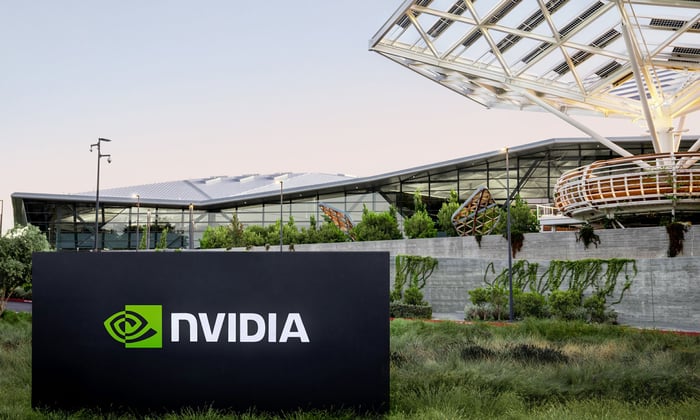
Image source: Nvidia.
What happened next?
For every month, I measured the change from the previous month's last close to that month's last close, with Yahoo Finance's split-adjusted daily prices. Then I checked how the stock did in the six and 12 months after each bad month ended.
| Month | Drop that month | Six months later | 12 months later |
|---|---|---|---|
| September 1999 | Down 32% | Up 339% | Up 751% |
| November 2000 | Down 35% | Up 111% | Up 170% |
| September 2001 | Down 35% | Up 61% | Down 69% |
| June 2002 | Down 49% | Down 33% | Up 33% |
| July 2002 | Down 36% | Down 7% | Up 72% |
| December 2002 | Down 33% | Up 99% | Up 102% |
| January 2008 | Down 28% | Down 53% | Down 68% |
| July 2008 | Down 39% | Down 31% | Up 13% |
| April 2022 | Down 32% | Down 27% | Up 50% |
Data source: Yahoo Finance. Calculations by author.
Across all nine, the median one-year gain was around 50%. Several rebounds were massive. Shares jumped almost 751% over the year after September 1999 and more than doubled after December 2002.
The two exceptions were severe. The stock dropped around 69% over the year after September 2001 and 68% in the year after January 2008.
Nvidia's results didn't just follow the broader market. In the year after November 2000, the Nasdaq Composite (NASDAQINDEX:^IXIC) slid about 26% but Nvidia's stock climbed 170%. And over the year after July 2008, the index dropped roughly 15% but Nvidia gained 13%.
Five of the nine months, though, came between November 2000 and December 2002, in the dot-com crash. So the record includes fewer separate episodes than nine months could suggest.
Lower prices usually came first
The bad month usually wasn't the low. In seven of the nine cases, shares closed at least 30% under the bad month's last close sometime in the next year. And six months after the bad month ended, the stock was lower in five of the nine cases.
April 2022 is the latest example. Nvidia shares kept dropping into October 2022, when they closed around 39% under April's last close. Six months after April, they were still down about 27%. By the end of April 2023, though, they were up about 50%.
For an investor buying after a month like November, that might mean riding out more losses before any gains, even if the next year turns out fine.
What's different this time?
The biggest difference I see is the valuation going in. At the end of April 2022, Nvidia's stock cost around 48 times its earnings per share for its latest fiscal year, which closed in January 2022. At Friday's close, it cost about 16 times its earnings for the last four quarters.
Put another way, every dollar of Nvidia's recent profit now costs about a third of what it did in April 2022. Based on the average analyst estimate for fiscal 2028 earnings (the year ending in January 2028), the stock trades at roughly 9 times those expected earnings.
The company is growing fast, too. In the third quarter of its fiscal 2027 (the period ended Oct. 25, 2026), Nvidia's revenue hit $115.8 billion, up 103% from a year earlier. Quarterly revenue has risen from $68.1 billion in the fiscal fourth quarter that ended in January, and management expects about $130 billion in this quarter, which lasts a week longer than usual. That forecast implies around 12% sequential growth, a slowdown from the 20% Nvidia just reported.
Of course, a low price-to-earnings ratio only helps if these earnings hold up. Data center sales were about 93% of Nvidia's revenue for fiscal Q3, so the company depends heavily on how much its customers keep spending on AI. If that spending cools, this month could end up looking more like January 2008 than April 2022.
Does that make Nvidia stock a buy after a month like this?
I think it's worth considering. A month like November has more often been a better time to buy the stock than to sell it, even if it usually wasn't the bottom. And at today's price, shares look cheap to me for a company growing this fast. I'd just leave room to add shares if they keep sliding.
Should you buy stock in Nvidia right now?
Before you buy stock in Nvidia, consider this:
The Motley Fool Stock Advisor analyst team just identified what they believe are the 10 best stocks for investors to buy now… and Nvidia wasn’t one of them. The 10 stocks that made the cut could produce monster returns in the coming years.
Consider when Netflix made this list on December 17, 2004... if you invested $1,000 at the time of our recommendation, you’d have $328,591!* Or when Nvidia made this list on April 15, 2005... if you invested $1,000 at the time of our recommendation, you’d have $924,693!*
Now, it’s worth noting Stock Advisor’s total average return is 791% — a market-crushing outperformance compared to 201% for the S&P 500. Don't miss the latest top 10 list, available with Stock Advisor, and join an investing community built by individual investors for individual investors.
See the 10 stocks »
*Stock Advisor returns as of November 28, 2026.
Daniel Sparks and his clients do not have positions in any of the stocks mentioned. The Motley Fool has positions in and recommends Nvidia. The Motley Fool has a disclosure policy.
Recommended Articles


